Subtotal $0.00


Magazines cover a wide array subjects, including but not limited to fashion, lifestyle, health, politics, business, Entertainment, sports, science,


Magazines cover a wide array subjects, including but not limited to fashion, lifestyle, health, politics, business, Entertainment, sports, science,
 Fact Checked by Coinsbeat Editorial Team | Expert Reviewed by Themiya
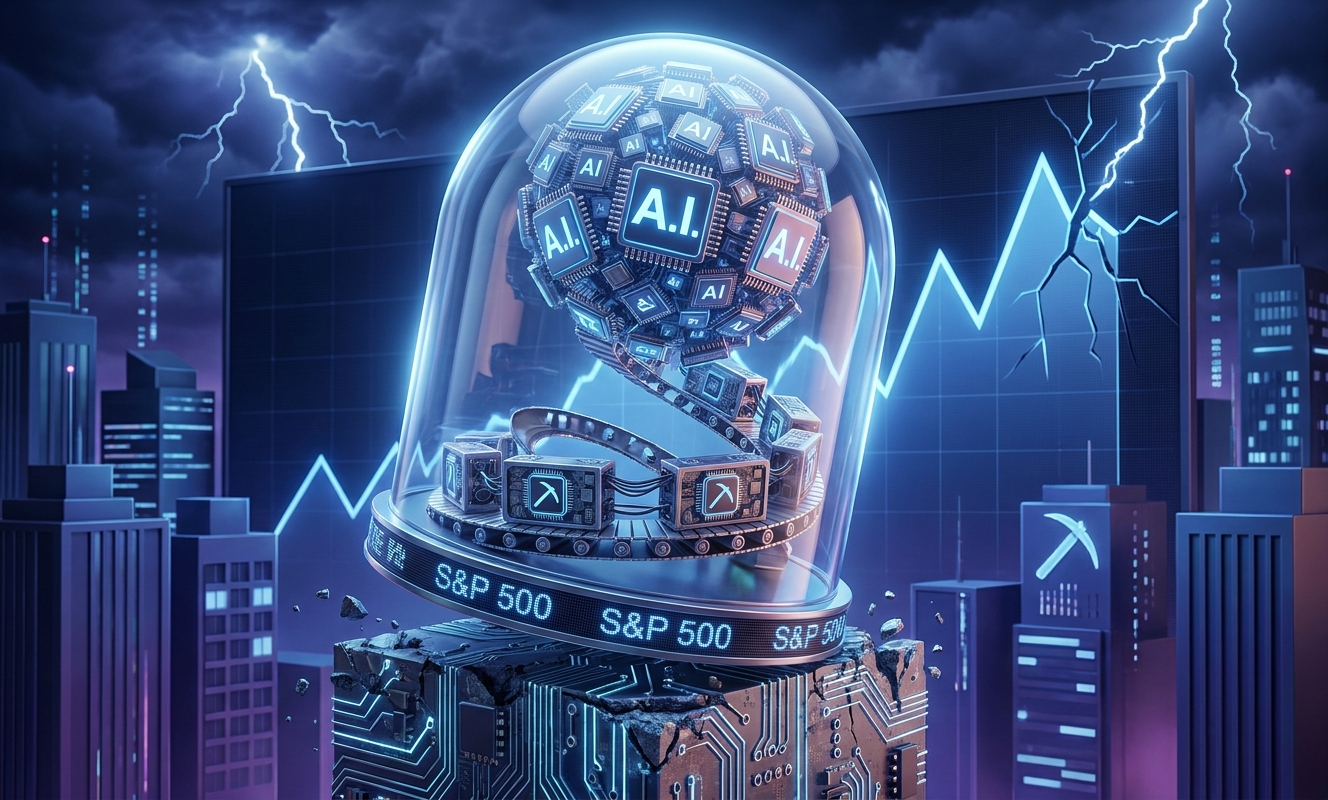
The top 10 AI stocks just hit 41% of the S&P 500. Bank of America dropped that number quietly, and anyone paying attention should feel a chill. That’s dot-com peak concentration. That’s Nifty Fifty territory. And it lands right on top of a sector that crypto investors have been told to love for the past 18 months: public Bitcoin miners who pivoted hard into AI infrastructure.
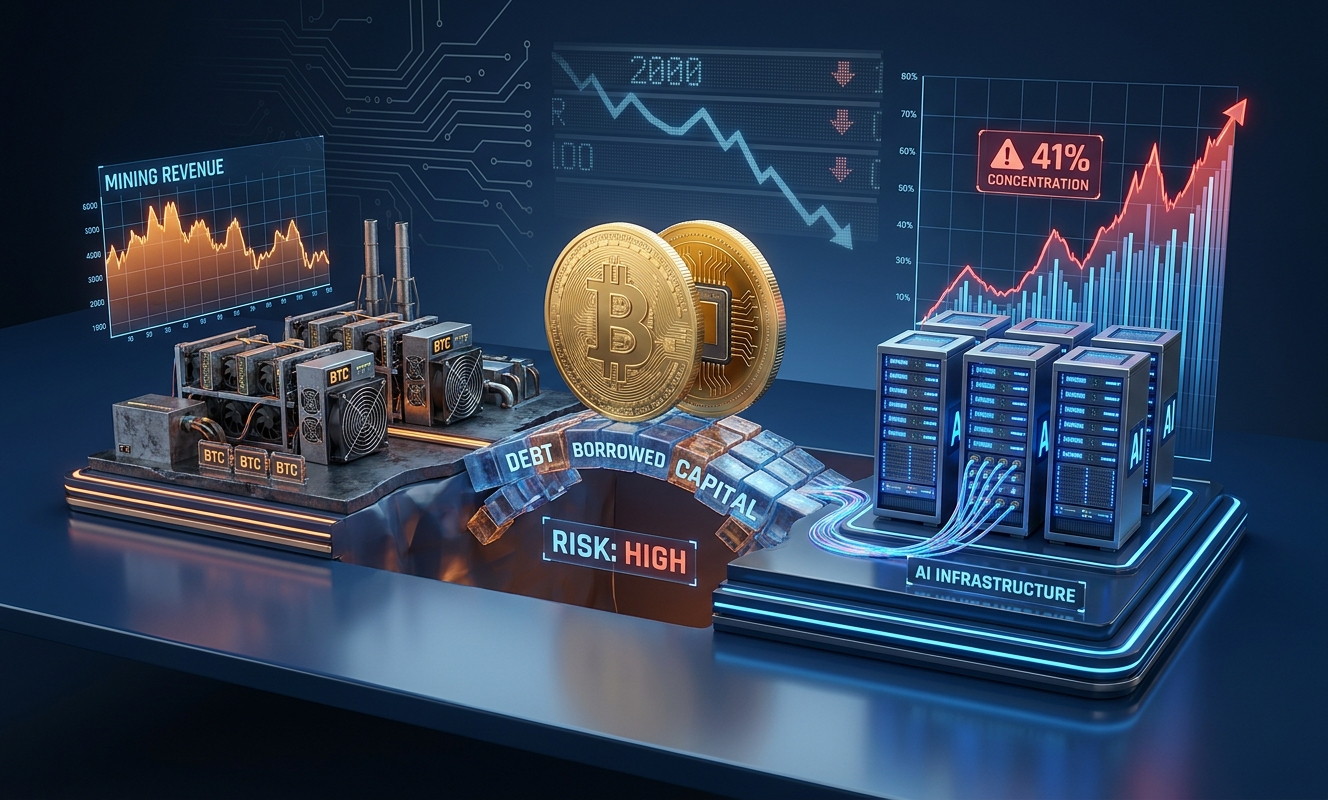
Here’s the thing. This isn’t just a stock market problem. It’s a Bitcoin problem. A credit problem. And for a handful of miners sitting on billions in AI-linked debt, it could become an existential problem faster than most people expect.
Let’s be real about what happened. Public miners didn’t add AI as a side hustle. They repriced their entire equity story around it. Visible Alpha’s projections for 2026 revenue tell you exactly how deep this goes:
These aren’t companies dabbling in AI. Some of them are data-center operators who still happen to mine Bitcoin on the side. CoinShares said it plainly: WULF, Core Scientific, Cipher, and Hut 8 are effectively becoming data-center operators. That’s a different animal entirely. Different risk profile, different valuation metrics, different failure modes.
And the debt is staggering. IREN sits on $3.7 billion in convertible notes. WULF carries $5.7 billion in total debt. These aren’t small bets hedged by Bitcoin holdings. This is a leveraged infrastructure play on continued AI hyperscaler demand. Remove that demand, and the capital stack doesn’t look the same.
Core Scientific is the clearest case study. In Q4 2025, colocation revenue jumped to $31.3 million from $8.5 million a year prior. Meanwhile, self-mining revenue fell from $79.9 million to $42.2 million. The company physically converted Bitcoin mining halls into high-density AI colocation space. That conversion already happened. It can’t be reversed quickly.
Here’s where it gets uncomfortable. Of the $279.2 million Core Scientific spent on capex in Q4, $226.2 million was funded by CoreWeave under existing customer agreements. That looks smart on the surface because it limits Core Scientific’s cash burn. But it also means Core Scientific’s buildout is literally dependent on CoreWeave’s growth ambitions staying intact. If CoreWeave pulls back or restructures, that customer-funded pipeline dries up.
The company also had to restate prior financial statements after identifying improper capitalization of assets tied to demolished mining infrastructure. Honestly, that kind of accounting complexity doesn’t come from running a clean mining operation. It comes from trying to account for a business that’s mid-transformation, converting floors, swapping cooling systems, and changing the fundamental nature of every asset on the balance sheet simultaneously.
And remember, CoreWeave went public in 2025. Its own 10-K discloses significant risks tied to AI demand and contracted power commitments. Core Scientific’s risk profile is now partially a function of CoreWeave’s risk profile. That’s a counterparty chain most retail investors aren’t pricing in.
BofA’s chart is doing a specific job here. It’s telling you that AI-related equities have reached the same index concentration levels that preceded the dot-com crash, the Nifty Fifty collapse, and the unwinding of Japan’s asset bubble. Three different historical episodes. Same warning sign.
Now look at where miners placed their chips. They raised billions in debt. They converted irreplaceable power infrastructure. They signed long-duration leases with AI cloud tenants. They cut Bitcoin mining capacity, with Riot halting a 600 MW Phase II expansion at Corsicana to evaluate AI/HPC alternatives, dropping projected self-mining capacity from 46.7 EH/s to 38.4 EH/s in the process.
That hashrate doesn’t come back quickly. Grid interconnections take years. Substation upgrades take years. If AI demand cools and miners want to return capacity to Bitcoin, they can’t just flip a switch. The infrastructure was optimized for high-density compute, not ASICs. Power sites were selected for stable, expensive grid access rather than cheap stranded energy. The physical transformation has a one-way ratchet built into it.
Here’s where the analysis gets counterintuitive. If AI infrastructure demand cools, miners with AI exposure get hurt first and hardest. Their equity multiples compress. Their debt becomes harder to service. Their construction pipelines lose justification. That’s the obvious pain.
But for the miners that stayed focused on Bitcoin, a deflating AI cycle could actually ease some competitive pressure. Right now, Bitcoin mining competes with hyperscalers for the same constrained set of inputs:
The IEA projected global data-center electricity consumption rising from 415 TWh in 2024 to roughly 945 TWh by 2030. AI-optimized servers are the biggest driver. That demand pressure is what made power-ready Bitcoin mining sites suddenly valuable enough to attract data-center tenants. If AI capex cycles down, those sites get contested less. Difficulty could adjust downward as capacity leaves the network, improving hashprice for remaining miners.
That’s the silver lining. It’s real. But it’s also sitting downstream of a lot of industrial-scale pain at publicly listed miners carrying heavy AI debt loads.
Most people focus on long-term colocation leases because they look stable. IREN is running a different exposure. The company targeted more than $500 million in annualized AI cloud revenue from 23,000 GPUs, with 11,000 already contracted at around $225 million ARR on average two-year terms.
Two-year GPU contracts reprice significantly faster than a 15-year colocation lease. GPU spot rates have already seen volatility as H100 supply increased through 2024 and 2025. If utilization drops or customers don’t renew, those ARR figures reset fast. IREN is exposed to both the capital cost of its GPU fleet and the market rate reset cycle, which is tighter than the infrastructure-lease model everyone else is running.
Between you and me, GPU cloud contracts feel like the riskiest sub-segment here because they’re priced at the intersection of hardware supply, AI software demand, and enterprise budgets, all three of which are moving targets right now.
Look, the market hasn’t actually pressure-tested the miner AI thesis yet. BTC is sitting near $76,000 to $77,000 with fees near zero and estimated production costs near $80,000 per coin. Mining economics are already strained. The AI narrative was partly a survival story, a way to raise capital and justify valuations when BTC wasn’t doing the heavy lifting.
The real stress test is sequential: AI multiples compress, debt servicing becomes painful, equity raises get harder, then the miners who sold BTC to fund AI buildouts have neither a functioning Bitcoin business nor a fully operational AI business. That’s the scenario nobody is modeling in public.
The next signals won’t come from press releases. Watch financing terms on new debt raises. Watch tenant delivery schedules. Watch whether new power contracts are being signed or pushed. Watch hashprice data against cost-per-BTC disclosures. Those four data points will tell you who actually has a business and who has a story.
Public Bitcoin miners added a full credit cycle on top of an already brutal Bitcoin cycle. They now carry:
That’s five distinct risk layers stacked into companies that retail investors often buy as simple “Bitcoin miners.” The AI pivot changed what these companies are. The equity volatility from an AI sector correction won’t just clip their stock price. For the most leveraged names, it could impair their ability to service debt without selling BTC at exactly the wrong time.
Pro-tip: If you hold any publicly listed miner position right now, separate the companies by AI revenue concentration using the Visible Alpha projections cited above. Miners with over 50% projected HPC revenue share in 2026 are not Bitcoin proxies anymore. They’re leveraged infrastructure plays on the AI trade. Size them accordingly, and check their debt maturity schedules before the next macro risk-off episode hits.
References & Sources:
Investors looking for an affordable entry point into the artificial intelligence boom often search for low-priced equities. While the broader S&P 500 is heavily concentrated with trillion-dollar tech giants, some AI-adjacent stocks trade in the $3 to $5 range. Historical examples flagged by portfolio screeners include SoundHound AI Inc. (SOUN), C3.ai Inc. (AI) during market dips, SoFi Technologies Inc. (SOFI), and Opera Ltd. ADR (OPRA). However, it is crucial to note that these low-priced stocks carry massive volatility—often swinging 50% to 90%—and a high beta. In a market environment where AI concentration mimics the precarious peak of the dot-com bubble, investing in micro-cap AI stocks comes with substantial speculative risk.
If the AI bubble bursts, the stock market could face a severe, market-wide correction reminiscent of the early 2000s dot-com crash. Because AI-related stocks currently make up a historically high concentration of the S&P 500’s total value, a sudden shift in investor expectations would rapidly deflate the sky-high valuations of tech hyperscalers. This localized tech sell-off would trigger an AI-induced contagion, dragging down broad equity indices. The global financial fallout would be significant, freezing tech sector investments, shrinking corporate capital expenditures, and spilling over into adjacent, high-beta sectors like cryptocurrency and Bitcoin mining.
The current AI stock surge is heavily driven by a handful of mega-cap technology companies commonly referred to as “hyperscalers.” This exclusive group includes Microsoft, Alphabet (Google), Amazon, and Meta Platforms, alongside hardware dominators like Nvidia. These corporations are funneling hundreds of billions of dollars into AI infrastructure, data centers, and advanced microchips. In fact, hyperscaler capital expenditures are expected to hit a staggering $645 billion by 2026. This unprecedented concentration of capital and market weight in just a few top-heavy tech titans is exactly why analysts are comparing the current S&P 500 landscape to the peak of the dot-com bubble.
Bitcoin miners have become highly exposed to the AI stock bubble due to the overlapping demands for advanced computing hardware and energy-intensive data centers. In recent years, many crypto mining operations pivoted to offer High-Performance Computing (HPC) and AI cloud services to diversify their revenue streams. While this pivot boosted their valuations during the AI boom, it inherently tied their stock performance to AI market sentiment. If the AI bubble bursts and tech giants drastically reduce their capital expenditures, the lucrative AI hosting contracts and inflated valuations these hybrid Bitcoin miners currently enjoy could evaporate, leaving them with depreciating hardware and staggering energy costs.