Subtotal $0.00


Magazines cover a wide array subjects, including but not limited to fashion, lifestyle, health, politics, business, Entertainment, sports, science,


Magazines cover a wide array subjects, including but not limited to fashion, lifestyle, health, politics, business, Entertainment, sports, science,

 Fact Checked by Coinsbeat Editorial Team | Expert Reviewed by Themiya
Everyone’s staring at Wall Street. Meanwhile, the actual infrastructure shift in crypto is being quietly assembled in Tel Aviv and Karachi. And most analysts haven’t even noticed.
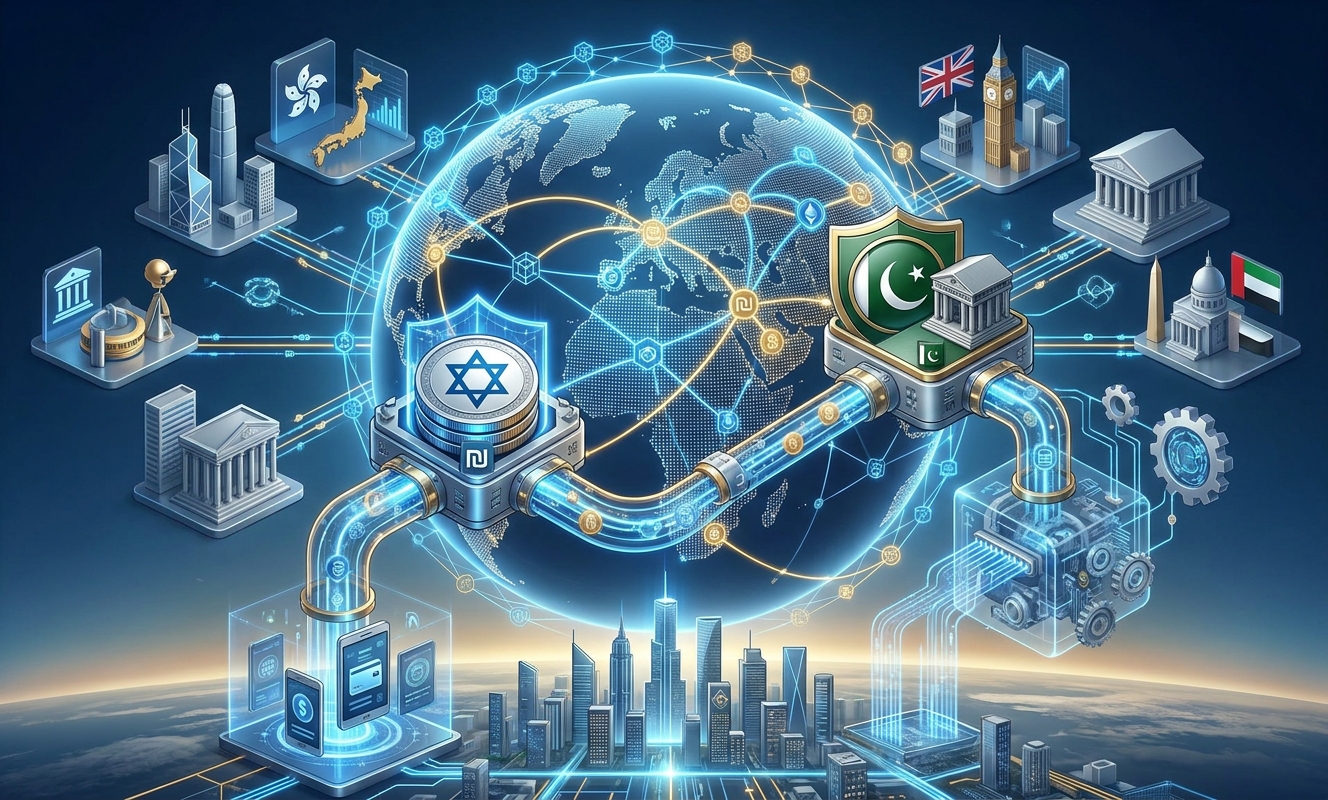
Two moves happened this month that deserve more attention than they’re getting. Israel’s Capital Market Authority approved BILS, a shekel-pegged stablecoin from Bits of Gold, after a two-year pilot. Days later, Pakistan’s State Bank issued BPRD Circular Letter No. 10 of 2026, officially burying its 2018 crypto ban and allowing regulated banks to open accounts for licensed virtual asset service providers. Let’s be real: these aren’t headline-grabbing events. No celebrity endorsements. No billion-dollar fund flows. But structurally? This is the stuff that actually matters long-term.
Here’s the thing about the US Bitcoin ETF cycle. It’s legitimizing crypto as a financial product. Full stop. It lets pension funds and hedge funds get exposure without touching a private key. That’s useful, sure. But it doesn’t solve the operational problem.
The operational problem is this: crypto, for the vast majority of the planet, still can’t reliably connect to a bank account, a merchant checkout, or a local currency without jumping through informal, unregulated hoops.
That’s precisely what Pakistan just started fixing. The SBP circular isn’t symbolic. It’s concrete financial plumbing. Bank accounts are the unglamorous backbone of any legitimate financial operation. Without them, a licensed crypto firm in Pakistan can’t hold client funds cleanly, can’t reconcile transaction flows, can’t satisfy KYC/AML demands at scale. The whole operation stays in the grey zone. With them, regulated VASPs can pull crypto activity out of the informal economy and into supervised channels.
Chainalysis ranked Pakistan among the top global crypto adoption countries. Think about that for a second. Massive organic adoption, zero banking access for the firms trying to serve it. That’s a pressure valve that just got cracked open.
The BILS approval from Israel is a different animal, but equally important. Bits of Gold built this on Solana, with Fireblocks, QEDIT, and EY involved in the pilot. The technical stack is solid. But the policy signal underneath it is what’s really interesting.
Dollar stablecoins, primarily USDT and USDC, have essentially colonized crypto’s settlement layer. Tether alone is doing $111 billion in 24-hour volume. USDC isn’t far behind. The dollar won the stablecoin race without even trying, because the demand was already there and nobody offered a credible alternative.
A shekel-pegged stablecoin asks a pointed question: does Israel want to cede its domestic payments layer to USD-denominated tokens permanently? The answer, apparently, is no. BILS is Israel’s attempt to keep the shekel relevant inside the on-chain financial infrastructure that’s being built right now, whether sovereign governments like it or not.
This matters beyond Israel. It’s a template. If a local-currency stablecoin can get regulatory approval, achieve actual issuance, and attract merchant and exchange adoption, it proves the model for dozens of other jurisdictions watching from the sidelines.

Zoom out and you see the same pattern repeating across multiple jurisdictions simultaneously. Hong Kong’s HKMA granted stablecoin issuer licenses to Anchorpoint Financial and HSBC in April. Japan’s FSA is dragging crypto assets toward Financial Instruments and Exchange Act oversight, meaning disclosure rules, insider-trading prohibitions, and market-abuse surveillance. The UK’s FCA opened its new crypto authorization window for September 2026. The EU’s MiCA framework is already live and forcing compliance across the continent.
South Korea adds a merchant dimension. The Crypto.com and KG Inicis integration puts crypto payment rails in front of foreign travelers and K-commerce shoppers. The K Bank partnership with Ripple explores cross-border remittances. The UAE is pushing a dirham-backed stablecoin, DDSC, on ADI Chain for institutional settlement.
Honestly, the pattern is hard to dismiss at this point. Here’s what the operational map actually looks like right now:
None of these are finished products. All of them are live tests. And that’s exactly the point.
Look, the US market still dominates the numbers. Total crypto market cap was near $2.59 trillion at end of April. Bitcoin alone sits at $1.56 trillion. Dollar stablecoin volume dwarfs everything else. The financialization narrative, ETFs, institutional custody, spot markets, that’s real and it’s enormous.
But here’s the investor’s lens nobody wants to apply. The ETF cycle creates exposure without utility. It brings capital in. It doesn’t build the usage layer that justifies multi-decade valuations.
The IMF put this plainly in its March 2026 paper on stablecoin inflows. Stablecoin flows are already moving FX markets, affecting local currency depreciation, dollar premia, and parity deviations. The moment stablecoins start behaving like a segment of the FX market, every central bank and financial regulator on earth has skin in the game. That changes the political economy of crypto adoption entirely.
For altcoins specifically, this regulatory buildout has non-obvious implications. Solana gets a credibility boost from its role in the BILS infrastructure. XRP and Ripple keep showing up wherever cross-border payment rails are being tested, South Korea, remittance corridors, bank partnerships. These aren’t random selections. Regulated entities choosing infrastructure are optimizing for compliance, speed, and cost. Not ideology.
Bitcoin, meanwhile, remains relatively insulated from this operational layer debate. It’s increasingly treated as reserve collateral, not payments infrastructure. That actually works in its favor as these regulated payment rails get built out around it.
Here’s where I pump the brakes on the optimism. Every single one of these developments is still in the announcement-to-reality gap, and that gap has eaten a lot of promising crypto projects alive.
BILS has regulatory approval. It does not yet have proof of issuance, merchant adoption, or exchange liquidity. A shekel stablecoin that nobody actually uses is just a press release with a blockchain wallet attached.
Pakistan’s circular gives banks permission to serve licensed VASPs. But PVARA, Pakistan’s virtual asset regulatory authority, still needs to actually license those VASPs. And those VASPs still need banks willing to onboard them under the new compliance conditions. That’s multiple institutional decisions that could each stall independently.
Hong Kong’s new licensees still need to launch actual products. Japan’s new rules still need to survive market stress. The UK regime doesn’t even take effect until late 2027. The UAE’s retail stablecoin story is murky at best.
The IMF’s stablecoin risk data adds a layer of systemic concern. As these local-currency stablecoins and payment tokens scale, they become FX instruments. Central banks don’t take kindly to competition with domestic monetary policy. The same regulatory approvals being celebrated today could become the target of emergency restrictions tomorrow if capital flow pressures get uncomfortable.
Don’t front-run adoption. The operational rails being built in Israel, Pakistan, and Hong Kong are genuinely significant. But the difference between a regulatory green light and actual transaction volume is where speculative capital goes to die. Coins shilled on “Pakistan banking access” or “shekel stablecoin” narratives before usage data materializes are classic exit liquidity setups. Wait for proof of issuance, merchant volume, and licensed VASP bank account confirmations before adjusting portfolio exposure based on this theme.
Watch the infrastructure layer, not the narrative layer. Solana’s role in BILS is worth tracking because regulated institutional pilots have a way of turning into sticky adoption. Same with Ripple’s repeated appearances in bank-adjacent payment integrations across South Korea and beyond. These aren’t moonshot bets. They’re quiet accumulation arguments for assets that keep showing up where the serious regulatory work is happening. Position accordingly, with patience measured in quarters, not weeks.
References & Sources:
While America’s institutional crypto boom heavily influences market trends, the next cryptocurrency to explode could be driven by utility in emerging sectors like AI and global decentralized networks. For example, AI-driven tokens like Bittensor (TAO) are gaining immense traction for blending open-source, decentralized AI with blockchain technology. Furthermore, as tech-forward nations like Israel and high-adoption countries like Pakistan embrace digital assets for cybersecurity infrastructure and peer-to-peer remittances respectively, the next massive crypto surge will likely belong to tokens that solve real-world financial gaps and offer high utility in these evolving markets.
Israel has taken a highly structured and proactive stance on cryptocurrency, balancing innovation with strict security. Since 2016, the nation has formalized crypto regulations, requiring virtual currency brokers and custodians to secure licenses under the Capital Market, Insurance, and Savings Authority (CMA). By prioritizing clear regulatory frameworks under the Supervision of Financial Services Law, Israel has positioned itself as a global hub for blockchain development and cybersecurity. While the US experiences a massive speculative boom, Israel’s regulated approach provides a critical blueprint for how institutional security and state-backed crypto infrastructure will evolve globally.
Despite operating in a regulatory gray area, Pakistan boasts one of the highest grassroots cryptocurrency adoption rates in the world. Driven by a rapidly depreciating fiat currency, inflation, and a massive unbanked population, Pakistani citizens are increasingly utilizing cryptocurrencies like Bitcoin and stablecoins for wealth preservation and cross-border remittances. This organic, peer-to-peer adoption demonstrates the immense practical utility of blockchain technology in emerging economies. While the world watches the institutional ETF crypto boom in America, Pakistan highlights the unstoppable force of retail-driven, necessity-based adoption that represents the true, borderless future of digital finance.
The United States is currently leading an institutional and market-driven crypto boom, but Israel and Pakistan represent the two foundational pillars of cryptocurrency’s actual future: structural innovation and grassroots necessity. Israel showcases a highly regulated, tech-forward environment where blockchain deeply integrates with national cybersecurity and institutional finance. Conversely, Pakistan illustrates explosive retail adoption driven by economic survival, bypassing traditional, restrictive banking systems. Together, they demonstrate that the next phase of global crypto evolution will expand far beyond American Wall Street speculation, embedding deeply into both secure state frameworks and everyday global commerce.