Subtotal $0.00


Magazines cover a wide array subjects, including but not limited to fashion, lifestyle, health, politics, business, Entertainment, sports, science,


Magazines cover a wide array subjects, including but not limited to fashion, lifestyle, health, politics, business, Entertainment, sports, science,
 Fact Checked by Coinsbeat Editorial Team | Expert Reviewed by Themiya
Meta already tried this once. It failed spectacularly. So why is everyone acting like this time is different?
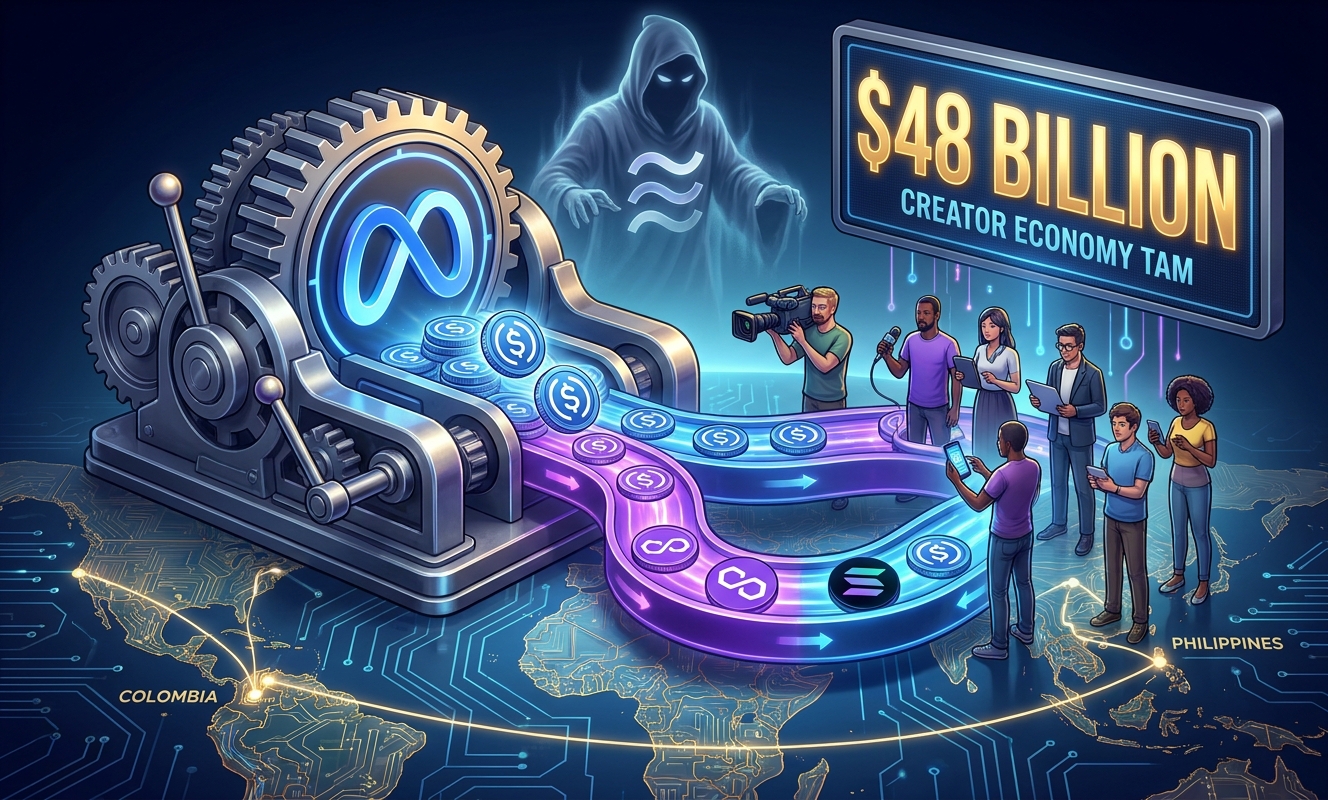
On April 29, Meta quietly announced USDC payouts for eligible creators through Solana and Polygon wallets, starting with selected creators in Colombia and the Philippines. No fanfare. No Zuckerberg keynote. Just a discreet rollout that, if you squint hard enough, looks like a company that’s been burned before and isn’t ready to take the heat again publicly.
Let’s be real about the history here. Libra launched in 2019, got regulators breathing down its neck, got rebranded to Diem, and then the whole thing got sold off to Silvergate Bank in early 2022 for parts. Three years of work, billions in lobbying goodwill burned, and absolutely nothing to show for it. That’s not a minor stumble. That’s a full face-plant on a global stage.
So what changed? Honestly, quite a bit. But not everything.
Here’s the thing that most coverage is missing. Meta isn’t building new infrastructure this time. It’s plugging into existing rails that Stripe, Circle, and others have spent years constructing, absorbing regulatory punishment, and quietly scaling. That’s a fundamentally smarter move than Libra’s original sin, which was trying to launch a proprietary global currency controlled by a consortium of corporations. Regulators hated that. Governments hated that. It was always going to die.
This time? Meta is just a payer using USDC. Circle takes the regulatory heat. Stripe handles the compliance plumbing. Meta gets the distribution benefit without owning the liability. Smart, actually. Cold and calculated, but smart.
The infrastructure argument holds up under scrutiny too. Stripe now explicitly markets stablecoin payouts across 101 countries that were previously locked out of Stripe Treasury. Cross-border settlements in minutes rather than days. KYC and AML built into the onboarding flow. Solana and Polygon as the chosen networks, both of which offer low fees and reasonable throughput for high-volume micro-payments.
Colombia and the Philippines weren’t chosen randomly either. Both markets have large creator economies, well-documented friction with traditional cross-border payouts, and populations that have historically shown appetite for dollar-denominated savings. These are high-friction corridors where USDC can actually compete on speed and cost against legacy wire transfers. It’s a clever starting point for a pilot that needs early wins to justify expansion.
Goldman Sachs pegged the creator economy at roughly $250 billion in 2023. Their projection for 2027 sits at $480 billion. That’s 50 million creators globally, pulling income from brand deals, ad revenue shares, subscriptions, tips, and direct payments. And Goldman’s research found that brand deals alone represent about 70% of creator revenue, meaning the vast majority of creator income runs through business-to-creator payment pipelines.
Now do the math on modest stablecoin penetration of that market.
That’s not a rounding error. That’s a material shift in what stablecoins actually get used for. Right now, the overwhelming majority of stablecoin volume is traders shuffling money between exchanges and protocols. Real-world payment use is a fraction of the headline number. Creator payouts at this scale would genuinely move that needle.
And here’s the macro implication that’s even more interesting. Because roughly 98% of stablecoins are dollar-denominated, any serious expansion of creator payouts over these rails is effectively digital dollarization of the internet labor market. A creator in Manila or Bogotá getting paid in USDC is getting paid in dollars, with fewer intermediaries, at near-instant settlement speeds. That’s not just a payments story. That’s a geopolitical story about dollar dominance in the internet economy.
Look, anytime a platform the size of Meta selects specific networks for a payments rollout, those networks get a legitimacy stamp that no marketing budget can buy. Meta chose Solana and Polygon. Not Ethereum mainnet (too expensive, too slow for micro-payments). Not some proprietary chain. Solana and Polygon.
For Solana especially, this is significant. The network has been building its payments narrative hard for the past 18 months, and a Meta endorsement, even an indirect one through network selection, is institutional validation of the highest order. Solana already processes transactions at sub-cent fees with sub-second finality. It’s genuinely well-suited for high-frequency, low-value creator payouts at scale.
Polygon’s inclusion makes sense too from a developer ecosystem standpoint, given its deep integrations with enterprise payment partners and its existing relationships with brands and platforms running EVM-compatible infrastructure.
Don’t expect a massive immediate price pump on either asset from this announcement alone. Institutional adoption narratives take time to price in. But if this pilot scales and Meta starts routing billions in creator payments through these networks over the next two years, the transaction volume and fee revenue implications are genuinely bullish for both ecosystems long-term.
Honestly, the entire outcome of this initiative hinges on one thing. Wallet abstraction. That’s it. Full stop.
In the bull case, wallet complexity disappears from the user experience entirely. Creators receive USDC the way they receive a Venmo payment. They don’t know they’re on Solana. They don’t know what a seed phrase is. They just see dollars arrive faster than their old bank transfer. Off-ramps in Colombia and the Philippines become cheap and instant. Other platforms, gig marketplaces, affiliate networks, subscription tools, all start offering the same option because Meta normalized it. Creator payments become one of the first large non-trading stablecoin categories.
In the bear case, Meta’s own help page tells the story. The current documentation walks creators through compatible wallet selection, blockchain network choices, and security steps. That is not mainstream-ready UX. That’s a tutorial written for someone who already knows what a blockchain is. Most creators do not know what a blockchain is, and honestly, they shouldn’t have to.
Stripe itself flags the wrong-network risk, where assets sent across incompatible chains can vanish without recourse. Tell that to a content creator in Manila who just lost a month’s earnings because they accidentally sent USDC to an Ethereum address on a Polygon transaction. That story, when it inevitably happens, becomes the headline that kills adoption cycles for months.
The BIS data supports the bear case as a baseline. Out of $35 trillion in 2025 stablecoin volume, only $390 billion was real-economy payments. The infrastructure exists. Mainstream adoption hasn’t followed. There’s a gap between “the rails are built” and “normal people are using them,” and that gap is almost entirely a UX problem.
Here’s what nobody wants to say out loud. Meta still carries the regulatory stigma from Libra. The company proved it was willing to try building a private global currency, regulators crushed it, and the institutional memory of that fight hasn’t fully faded. The GENIUS Act and CLARITY Act battles currently playing out in Washington are directly shaped by the fear that a large tech platform could quietly accumulate monetary influence through stablecoin infrastructure.
Meta is aware of this. That’s precisely why this rollout is so quiet and why the company is using Circle’s USDC rather than anything proprietary. It’s regulatory camouflage. By letting Circle and Stripe absorb the compliance scrutiny, Meta positions itself as just another enterprise client of existing regulated infrastructure, not as a financial institution trying to rewrite the rules of global money movement.
Whether regulators accept that framing is a separate question entirely. If this pilot scales aggressively, expect Congressional interest to follow. Between you and me, the moment Meta starts routing even $1 billion monthly in USDC payouts, some senator is going to call a hearing about it.

Bottom line. Meta’s USDC move is smarter than Libra was, better timed than Libra was, and built on infrastructure that actually exists. But “better than Libra” is an extremely low bar. The $48 billion TAM is real, the network selection is thoughtful, and the corridor logic is sound. Whether this becomes a payments revolution or an expensive footnote comes down entirely to whether any company in this space can make the wallet experience disappear for normal people. That problem hasn’t been solved yet. When it is, this story gets very interesting very fast.
References & Sources:
In the United States government, META stands for the Maritime Environmental and Technical Assistance Program, an initiative overseen by the Maritime Administration (MARAD). However, when discussing the future of digital commerce and the creator economy, Meta refers to the technology conglomerate formerly known as Facebook. Unlike the government program, Meta the tech giant is currently pioneering decentralized finance initiatives, such as a USDC stablecoin pilot, to revolutionize cross-border payouts and capture billions in the growing digital creator market.
Meta’s USDC pilot drastically improves creator payouts by allowing influencers and digital creators to receive their earnings in USD Coin (USDC), a cryptocurrency pegged directly to the US dollar. This blockchain-based system bypasses traditional banking intermediaries, meaning creators experience near-instantaneous processing times, significantly lower transaction fees, and the elimination of complex cross-border payment barriers. Ultimately, it ensures creators keep more of their hard-earned money and get paid faster.
Stablecoins like USDC offer the perfect middle ground for global creators by combining the speed of cryptocurrency with the stability of fiat money. Unlike volatile cryptocurrencies such as Bitcoin or Ethereum, USDC maintains a steady 1:1 value with the US dollar. This stability protects international creators from sudden market crashes while giving them equitable, borderless access to financial infrastructure without the exorbitant currency conversion fees charged by traditional payment gateways.
Yes, stablecoins have the potential to largely replace traditional payment methods in the creator economy. Traditional financial systems are often bogged down by multi-day settlement periods, high processing fees, and strict geographical limitations. Because stablecoins utilize decentralized blockchain networks, they facilitate transparent, low-cost microtransactions at lightning speed. As major platforms like Meta continue to successfully pilot and scale these tools, widespread adoption of stablecoins for automated, billions-of-dollars-scale creator payouts becomes increasingly inevitable.