Subtotal $0.00


Magazines cover a wide array subjects, including but not limited to fashion, lifestyle, health, politics, business, Entertainment, sports, science,


Magazines cover a wide array subjects, including but not limited to fashion, lifestyle, health, politics, business, Entertainment, sports, science,
 Fact Checked by Coinsbeat Editorial Team | Expert Reviewed by Themiya
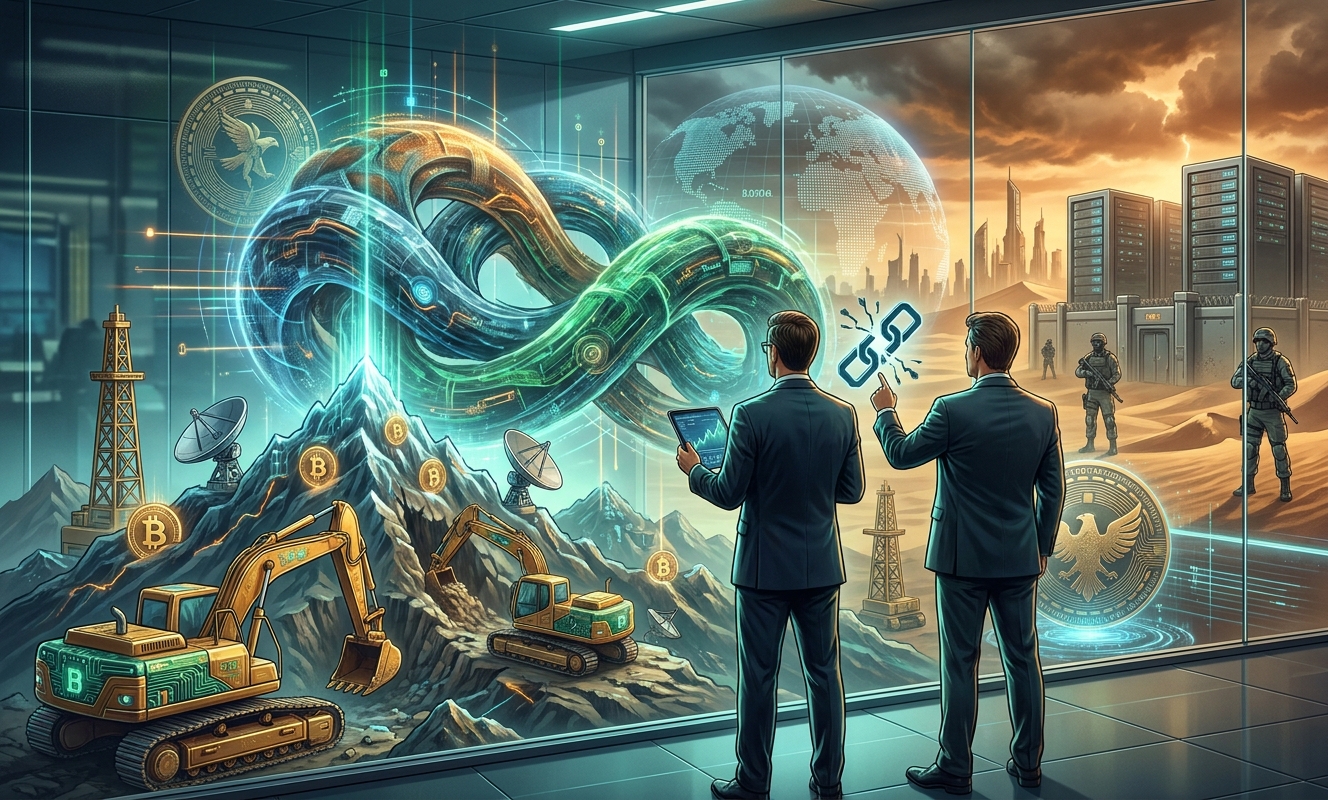
Let’s be real. When private capital tied to the president’s sons lands inside a Nasdaq shell that then merges with a critical minerals company carrying conditional letters from two federal agencies totaling up to $1.6 billion, that’s not a coincidence you file away and forget. That’s a governance map you need to read carefully, especially if you’re deployed in crypto markets where Trump-linked deal structures have already reshaped how capital flows.
Here’s the thing about how this deal was built. It wasn’t one transaction. It was three, stacked over roughly eight months, each one adding a layer of distance between the Trump family name and the underlying asset.
Layer one. In August 2025, Skyline Builders, a Nasdaq-listed company, ran a private placement that raised $17.8 million. Dominari Securities was a placement agent. The Financial Times reports that Donald Trump Jr. and Eric Trump bought into Skyline through that placement via American Ventures, a special purpose vehicle managed by a Dominari subsidiary. They added to the position on October 28, 2025. The SEC filings don’t name the Trump sons directly in those placements. What the filings do confirm is the American Ventures series exposure and the placement chronology.
Dominari’s own quarterly report confirms it held 90% membership interests in American Ventures Management LLC and American Ventures IM LLC. Its annual report then identifies Donald Trump Jr. and Eric Trump as advisory board members and 5%-or-more stockholders of Dominari itself. So the chain isn’t hidden. It’s just distributed across enough filings that casual observers miss it.
Layer two. On October 31, 2025, Skyline disclosed it had agreed to pay $20 million for roughly a 20% stake in an unnamed Delaware LLC operating in critical minerals. The FT identified that LLC as Kaz Resources, connected to Cove Capital and Cove Kaz Capital Group.
Layer three. On April 30, 2026, Skyline and Cove Kaz announced a full transaction agreement to combine into Kaz Resources Inc., ticker KAZR on Nasdaq, with closing targeted for Q4 2026 or early 2027, pending shareholder votes, regulatory approvals, and an effective SEC registration statement.
That’s the architecture. Shell, stake, merger. Clean. Quiet. Layered.
This is where the story gets uncomfortable for anyone who cares about how industrial policy actually operates.
The Cove Kaz assets sit in Kazakhstan. Specifically, the Northern Katpar and Upper Kairakty tungsten deposits, which Cove Capital and Tau-Ken Samruk (Kazakhstan’s national mining company) announced in November 2025 as a joint venture. Cove Kaz holds 70%, the Kazakh state holds 30%. Total development cost estimate: approximately $1.1 billion.
Now, the financing signals. The Export-Import Bank of the United States issued a letter of interest for up to $900 million. The U.S. International Development Finance Corporation issued separate letters of interest exploring up to $700 million in debt financing and project development funding. Combined headline figure: $1.6 billion in potential federal backing, exceeding the project’s own stated cost estimate.
Honestly, those numbers grab attention. But here’s the critical distinction that the market tends to blur. A letter of interest is not a commitment. EXIM’s own guidance describes it as a tool to outline possible financing terms and conditions before any final commitment is made. The DFC language is similarly conditional. These are expressions of willingness to explore, not binding contracts. No money has moved. No deal has closed.
But the optics are still significant. Federal agencies are signaling support for an asset that privately connected capital tied to the president’s sons is simultaneously gaining exposure to through a public-market vehicle. Whether or not that sequence involved any coordination is precisely what remains unresolved.
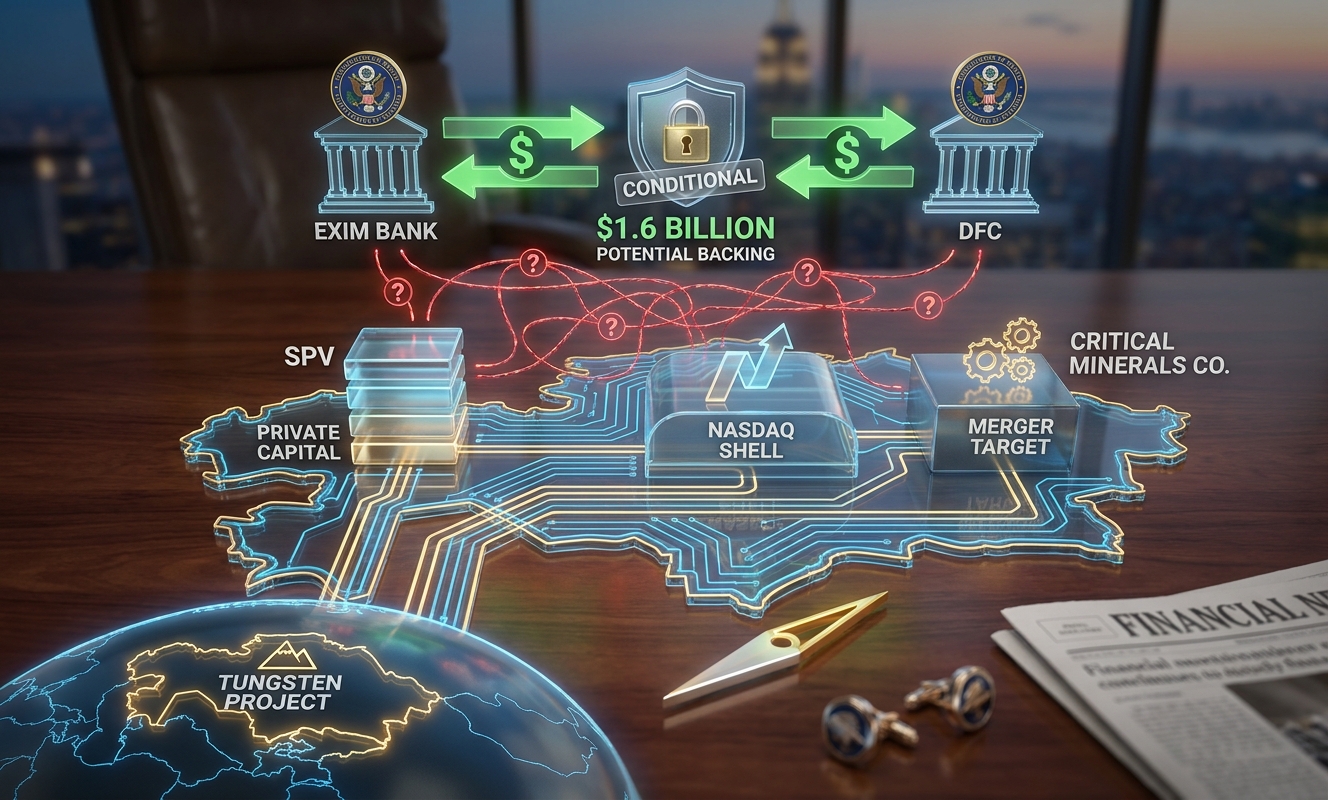
Look, tungsten isn’t Bitcoin. But the capital-routing logic here is identical to structures crypto markets have already absorbed.
Consider the pattern. American Bitcoin used a public-market merger path through Gryphon Digital Mining to go public. World Liberty Financial borrowed $75 million against illiquid WLFI tokens while a $1.6 billion token dump loomed. Justin Sun structured a reverse merger involving Tron and a listed vehicle with Eric Trump connected. Every one of these deals used the same toolkit: SPVs, shells, and conditional financing, with Trump-family adjacency as the policy proximity signal.
Skyline-Cove Kaz is another node in that same network. The commodity changed. The method didn’t.
There’s also a sector overlap that’s easy to underestimate. Bitcoin miners, AI data center operators, defense contractors, and critical minerals developers all compete for the same things right now: power access, federal permits, offtake agreements, government demand signals, and favorable supply-chain policy. Washington choosing preferred supply chains doesn’t stay in one sector. It bleeds across all of them. Politically connected capital can treat these as adjacent risk lanes because, structurally, they are.
With Bitcoin’s market cap sitting around $1.55 trillion, digital assets are large enough that federal policy signals and politically affiliated financing structures move the price of adjacent companies, whether those companies hold BTC, mine it, issue governance tokens, or supply tungsten to defense manufacturers.
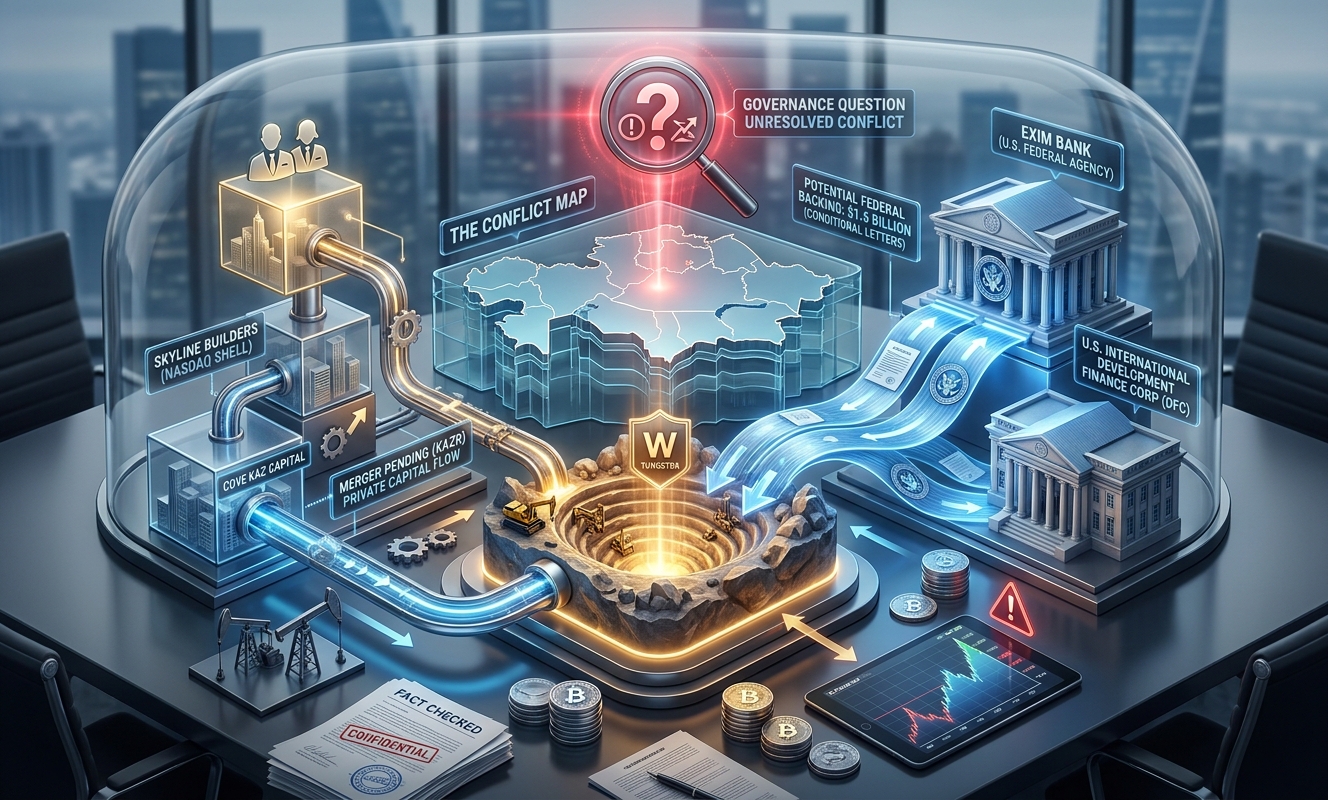
The FT story includes a central caveat worth repeating verbatim in spirit: there is no suggestion that the Trump sons knew Cove was close to securing US administration backing when they made their initial Skyline investments, or that they influenced the agency decisions.
Donald Trump Jr.’s spokesperson described him as a passive investor in American Ventures with no operational role and no federal government interface for companies he invests in or advises. Eric Trump did not respond to FT requests.
Fine. Those are the public positions. But the governance question doesn’t require proving intent or coordination. The structure itself is the issue. Private investment exposure, Nasdaq-listed public vehicle, federal financing interest, and policy-aligned sector positioning all pointing at the same asset creates a conflict-risk profile regardless of what anyone knew or when they knew it.
The U.S. Office of Government Ethics has long noted that certain federal conflict statutes don’t apply to the president and vice president the way they apply to other executive branch officials. That guidance doesn’t resolve the broader ethics questions here, and it certainly doesn’t cover private-citizen family members operating in markets adjacent to federal industrial policy execution.
Four things remain genuinely open. What did the Trump sons know about imminent federal support when they invested? Did they have any role in the process leading to the agency letters? Will EXIM and DFC letters become binding commitments? And what is the actual economic exposure through American Ventures and any related Skyline series vehicles?
Until those questions have documented answers, this is a live governance story, not a closed one.
Between you and me, the real story here isn’t whether the Trump sons did something illegal. It’s that the structure was designed well enough that we’re still having that conversation after eight months of public filings. That’s not accidental. And in markets, structure is always the tell.
References & Sources:
Trump’s primary cryptocurrency venture is World Liberty Financial (WLFI). Founded in 2024, it is a decentralized finance (DeFi) protocol developed by its namesake company. The business venture was established in collaboration with Zachary Folkman, Chase Herro, Alex Witkoff, Zach Witkoff, and key members of the Trump family. It represents a major pivot for the Trump organization into the digital asset and blockchain space.
Donald Trump Jr. and Eric Trump have become heavily involved in cryptocurrency through ventures like World Liberty Financial and various overseas crypto-linked bets. They have acted as key advocates and promoters, steering the Trump family’s business portfolio into decentralized finance (DeFi) and international crypto mining operations, positioning themselves as major voices in the emerging digital asset market.
The Trump family’s international cryptocurrency ventures have run into complex geopolitical, financing, and security conflicts overseas. According to reports from the Financial Times, their crypto mining bets have faced intense regulatory hurdles, concerns over the physical and cybersecurity of international mining operations, and complicated financing structures that raise questions about foreign business conflicts of interest.
Cryptocurrency mining requires massive computing power, specialized hardware, and significant energy consumption. Overseas, these operations frequently become security concerns due to the potential strain on local power grids, vulnerability to cyberattacks, and regulatory gaps. Additionally, the heavy infrastructure requires substantial capital, which can lead to opaque financing structures and potential entanglements with foreign state or non-state actors.