Subtotal $0.00


Magazines cover a wide array subjects, including but not limited to fashion, lifestyle, health, politics, business, Entertainment, sports, science,


Magazines cover a wide array subjects, including but not limited to fashion, lifestyle, health, politics, business, Entertainment, sports, science,
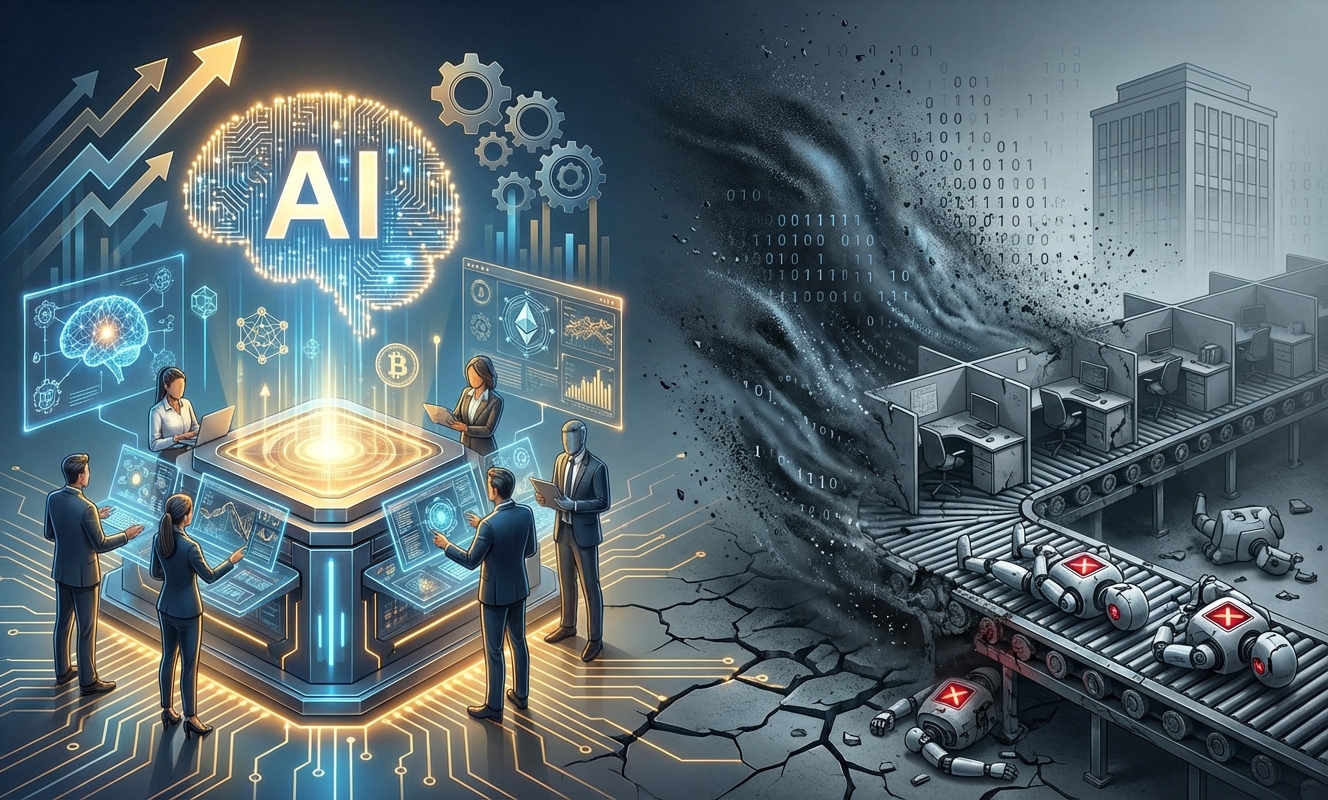
Everyone’s screaming about AI replacing developers. The data tells a different, messier story. And if you’re building a career in crypto, the nuance here could be the most important thing you read this quarter.
Let’s be real. The doomers have been loud. Every second LinkedIn post promises that LLMs will hollow out engineering teams by 2026. Except Citadel Securities ran the numbers using Indeed data, and software-engineer job postings are actually rising relative to the broader market, even as overall postings stay weak. That’s not a rounding error. That’s a direct contradiction of the dominant narrative.
Federal projections back this up. The Bureau of Labor Statistics forecasts 15% growth in software developer and QA roles from 2024 to 2034, with roughly 129,200 openings per year. Project management specialists are projected to grow 6%, adding around 78,200 openings annually. These aren’t speculative numbers. They’re the same boring government forecasts that institutional hiring managers actually use.
So why does the “AI will erase builders” story keep getting traction? Honestly, because it sells. Panic drives clicks. And because there is something real happening, just not where most people are looking.
Here’s the thing. AI isn’t showing up at crypto firms as a mass layoff machine. It’s showing up as a force multiplier for the experienced people who already know what a broken workflow looks like.
Anthropic’s own usage data is revealing. The single most common task on Claude.ai? Fixing broken code. That accounted for 6% of all usage in November 2025. Computer and mathematical tasks made up roughly a third of all conversations and nearly half of first-party API traffic. In other words, one of the most visible real-world uses of frontier AI is speeding up software maintenance, not replacing the engineers doing it.
For crypto specifically, think about what your exchange, wallet team, or protocol developer actually needs humans for:
A model can assist with all of that. It doesn’t own any of it. And in crypto, where the reputational and financial stakes can collapse a project overnight, that distinction matters enormously.

Look, the picture isn’t uniformly rosy. Office and administrative support rose to 13% of Claude API traffic in the January 2026 index, covering email management, document processing, CRM work, and scheduling. That’s a real substitution signal. If your role is built around repeatable process work, formatting, throughput, and scheduling, the pressure is measurable and it’s already here. The ILO identified clerical occupations as the highest global exposure category. That’s not a surprise, but it is a problem for the people in those seats.
This is where I’d urge anyone building a career in this industry to pay attention. The senior jobs look durable. The junior jobs are in trouble. Not because they’re being eliminated today, but because they’re being quietly absorbed into AI-assisted workflows before the next generation of talent gets to do them.
A Dallas Fed paper from January 2026 found employment in highly AI-exposed occupations among younger workers slipped from 16.4% in November 2022 to 15.5% in September 2025. Small numbers. But directionally consistent with something worth watching. Entry-level roles are where people learn pacing, debugging, client judgment, and the thousand small decisions that eventually make someone a senior engineer or a competent creative lead.
If firms use AI to compress those production tasks before junior staff get to do them, the short-term economics look great. Smaller teams. More output. Better margins. The medium-term math is uglier. You end up with a thin talent pipeline right as you need experienced operators the most. Crypto firms already compete hard for people who understand market structure, security, and operational risk under pressure. Cutting training pathways makes that problem worse, not better.
Block’s announced 50% workforce reduction is the most prominent real-world example of a crypto-adjacent firm betting that AI can handle what headcount used to. That takes Block from 10,000-plus employees to under 6,000, with $450 million to $500 million in restructuring charges. That’s an aggressive bet. And if it pays off on paper while quietly gutting their own builder pipeline, we might not see the damage for another two or three years. By then, the institutional knowledge walks out the door with the people who got cut.
Broad AI adoption data from late 2025 shows generative-AI use among working adults climbed from 44.6% in August 2024 to 54.6% in August 2025. Work-specific use rose from 33.3% to 37.4% over the same window. The productivity signal is starting to show up too, with estimated labor productivity rising up to 1.3% since ChatGPT launched, and industries with higher AI time savings seeing 2.7 percentage points higher productivity growth relative to pre-pandemic trends.
For crypto markets, the read-through is this:
The World Economic Forum’s 2025 forecast projects structural labor-market change equal to 22% of today’s jobs by 2030. That sounds terrifying in isolation. The actual breakdown is 170 million jobs created versus 92 million displaced, for a net positive of 78 million. AI and ML specialists, fintech engineers, and software developers are listed among the fastest-growing roles in percentage terms. The IMF adds a reasonable warning that advanced economies feel both the benefits and the disruptions faster, and that gains tend to concentrate among higher-income workers and capital owners.
Neither pure optimism nor pure panic fits the data. The honest read is a mixed outcome with uneven distribution. Experienced technical and creative operators in crypto likely sit on the winning side of that distribution, at least for now. Junior and administrative workers face a harder adjustment.

If you’re in crypto right now, the strategic move is straightforward even if it’s not easy. The workers who hold value in an AI-assisted workflow are the ones who can set direction, verify outputs, catch model failures before they hit production, and take accountability when something breaks. That’s the function AI cannot absorb without a human in the loop. The workers who lose ground are those whose output looks like a sequence of rules that can be handed to a cheaper human-plus-model combination.
Concretely, this means:
Here’s the catch nobody’s talking about loudly enough. Crypto is already an industry with a severe shortage of operators who combine market structure knowledge, security intuition, and product judgment. That shortage drives up compensation for experienced people and makes it genuinely hard for protocols and exchanges to hire. If the industry collectively uses AI to eliminate the junior roles that used to produce senior operators in three to five years, that shortage gets significantly worse.
The near-term economics of cutting junior coding, support, research, and design roles look attractive. The medium-term consequence is competing even harder for scarce senior talent in a market that’s already expensive. Firms that keep some version of a training pipeline, even a leaner one, will be structurally better positioned than firms that optimized for headcount reduction in 2026 and then scramble for experienced operators in 2028.
The question worth watching isn’t whether AI is killing crypto jobs today. It’s whether the industry is quietly dismantling the system that produces the people it will desperately need in three years.
Tech company Block, the parent organization of popular payment services Square and Cash App, recently laid off approximately 40% of its workforce, amounting to around 4,000 employees. The company explicitly cited rapid efficiency gains in artificial intelligence as the primary driver for the restructuring. This massive layoff underscores a broader tech industry trend: organizations are quietly eliminating routine, entry-level roles that can now be automated by AI, redirecting their budgets toward specialized, high-skill technical talent that can further develop and manage these advanced systems.
Yes, AI is expected to cause severe disruptions to entry-level employment, particularly within white-collar and tech sectors. Industry leaders are already sounding the alarm; for example, in May 2025, Dario Amodei, CEO of the AI company Anthropic, warned that AI could drive unemployment up 10 to 20 percent over the next few years. He noted it could potentially “wipe out half of all entry-level white-collar jobs.” Tasks like writing boilerplate code, basic data entry, and tier-one customer support are being rapidly automated, effectively destroying the traditional stepping stones new graduates use to enter the workforce.
While AI is aggressively thinning out junior roles, it is simultaneously creating an unprecedented boom in demand for high-skill tech professionals. Companies are aggressively hiring Machine Learning Engineers, Large Language Model (LLM) Architects, AI Ethicists, Data Scientists, and Cloud Security Experts. Because AI tools require massive amounts of clean data, complex infrastructure, and strict security protocols to function correctly, businesses desperately need senior-level experts who possess the advanced critical thinking and specialized system-design skills that AI cannot replicate.
To survive in a labor market where AI handles basic programming and administrative tasks, junior tech workers must pivot toward skills that complement, rather than compete with, artificial intelligence. Entry-level professionals should focus on mastering AI tool integration, effectively becoming “AI operators” who can multiply their own productivity. Additionally, they should prioritize developing complex problem-solving abilities, strategic system architecture, and soft skills like cross-departmental communication. Pursuing advanced certifications in data engineering or machine learning can also help candidates bypass the dying entry-level tier and jump straight into mid-level demand.
