Subtotal $0.00


Magazines cover a wide array subjects, including but not limited to fashion, lifestyle, health, politics, business, Entertainment, sports, science,


Magazines cover a wide array subjects, including but not limited to fashion, lifestyle, health, politics, business, Entertainment, sports, science,

 Fact Checked by Coinsbeat Editorial Team | Expert Reviewed by Themiya
The stock market threw a party on March 31. The Dow ripped 1,100 points, the S&P had its best single day in nearly a year, and financial media was practically handing out streamers. The narrative was clean and sellable: peace is coming to the Strait of Hormuz, oil is pulling back, risk is back on.
Don’t believe it for a second.
Beneath that headline euphoria, the derivatives markets, which is where the sophisticated money actually positions itself, told a completely different story. And Bitcoin, which now trades as a 24/7 barometer of global risk appetite, was reading that story loud and clear.
Here’s the thing about open interest. It’s not just a number to scroll past on CoinGlass. It’s a direct window into conviction. When open interest rises, traders are putting fresh capital to work. They believe something. When it falls, they’re cutting exposure, pocketing losses, and stepping back from the table.
Bitcoin’s total open interest currently sits at roughly 703,940 BTC, translating to about $46.85 billion in notional value. That’s a market still loaded with leverage after weeks of serious stress. And on April 1, the same day Wall Street was popping champagne, Bitcoin open interest dropped 4.41% in a single session.
Let that sink in. Stocks rally on peace hopes. Bitcoin derivatives traders close positions. Those two things don’t tell the same story.
If genuine optimism were returning, you’d see the opposite behavior. You’d see aggressive re-entry into leveraged long positions, funding rates climbing, new contracts being opened. Instead, traders are quietly hitting the exit. That’s not a “risk-on” signal. That’s someone quietly backing toward the door while everyone else is dancing.
The funding rate on Bitcoin perpetual futures has been barely positive for two straight weeks, punctuated by repeated negative dips. For context, when a bull market has real legs, funding rates surge because bullish traders are willing to pay a premium to stay long. That’s the market screaming conviction.
What we have now? Silence. A flat, muted signal that screams one thing: nobody’s committing.
This isn’t retail noise, either. Of that $46 billion pile, more than $7 billion sits on CME, the regulated institutional exchange. Pension funds. Asset managers. Sophisticated hedging desks. These are not your average degens on a phone app. When they retreat, it reflects boardroom decisions, not FOMO-driven panic sells. That makes the open interest decline significantly harder to dismiss.

Earlier this year, options (which function essentially as insurance policies against sudden price moves) made up close to 90% of Bitcoin’s derivatives market. That ratio has now collapsed to around 65%.
Here’s why that matters. When futures dominate over options, the market becomes more directional and fragile. Options provide cushion. Futures provide exposure. A futures-heavy market is fine when trends are orderly, but when something breaks fast, there’s no shock absorber. You get a cascading liquidation cascade instead of an orderly retracement.
And the data shows a particularly nasty concentration of open positions clustered in the $66,000 to $67,000 price range. If Bitcoin wanders back into that zone, a rapid destabilization becomes a real possibility, not a tail risk to wave away.
Let’s talk about the Hormuz situation directly, because this is where the “Hormuz Hope” narrative completely falls apart under scrutiny.
Brent crude briefly dipped below $100 on April 1. Headlines declared victory. But ownership of Brent call options betting on crude hitting $150 a barrel by end of April has risen tenfold in the past month. Open interest in those contracts now sits at nearly 29,000 lots, each representing 1,000 barrels.
That is not a market pricing peace. That is a market furiously hedging against the ceasefire falling apart.
The largest concentration of oil options open interest remains in $100 call options. Professional energy traders are not celebrating. They’re buying insurance for a world where oil rips again. And here’s the kicker on the diplomatic picture: Trump said Iran asked for a ceasefire. Iran’s foreign ministry called that claim “false and baseless.” Two governments. One negotiation. Completely irreconcilable accounts.
Markets chose to price the optimistic version. The hedges chose to price both.
Wall Street’s own fear gauge dropped but held at 24.54. Anything above 20 is historically associated with elevated market stress. The VIX settling at 24.54 after a supposedly massive relief rally is not the all-clear signal it’s being sold as. It means the options market is still paying up for downside protection even while equities rip higher.
Honestly, the gap right now is almost comical in how wide it is. Stocks are pricing a ceasefire. Bitcoin derivatives are pricing caution. Oil options are pricing another energy spike. Something has to give, and historically, the derivatives market gets the last laugh.
Look, the “Hormuz Hope” rally didn’t happen in a vacuum. Quarter-end is a known period of institutional window dressing, where fund managers buy winners and dump losers to make their end-of-quarter portfolio snapshots look presentable for clients. March 31 was the last trading day of Q1. The timing is not coincidental.
Add in the fact that algorithmic trading systems are heavily tuned to geopolitical headline sentiment, and you get a reflexive, momentum-driven spike that doesn’t necessarily reflect genuine fundamental re-pricing. Retail traders see the green candles and pile in, providing exit liquidity for institutions that already repositioned.
This is how it works. Always has been.
The sequence here is not subtle if you know what to look at.
If this diplomatic situation deteriorates (and the contradictory government statements suggest that’s entirely plausible), the transmission mechanism is fast and brutal.
Oil spikes back above $110 or $115. That reignites inflation fears. The dollar strengthens on a flight-to-safety bid. Risk assets get hammered across the board. And Bitcoin, which has been increasingly correlated to macro risk sentiment rather than acting as any kind of independent safe haven, follows equities down.
The futures-heavy derivatives structure means there’s less cushion. The $66,000 to $67,000 concentration zone becomes a liquidation magnet. You get a waterfall, not a dip.
Between you and me, the setup right now rewards caution far more than it rewards conviction.
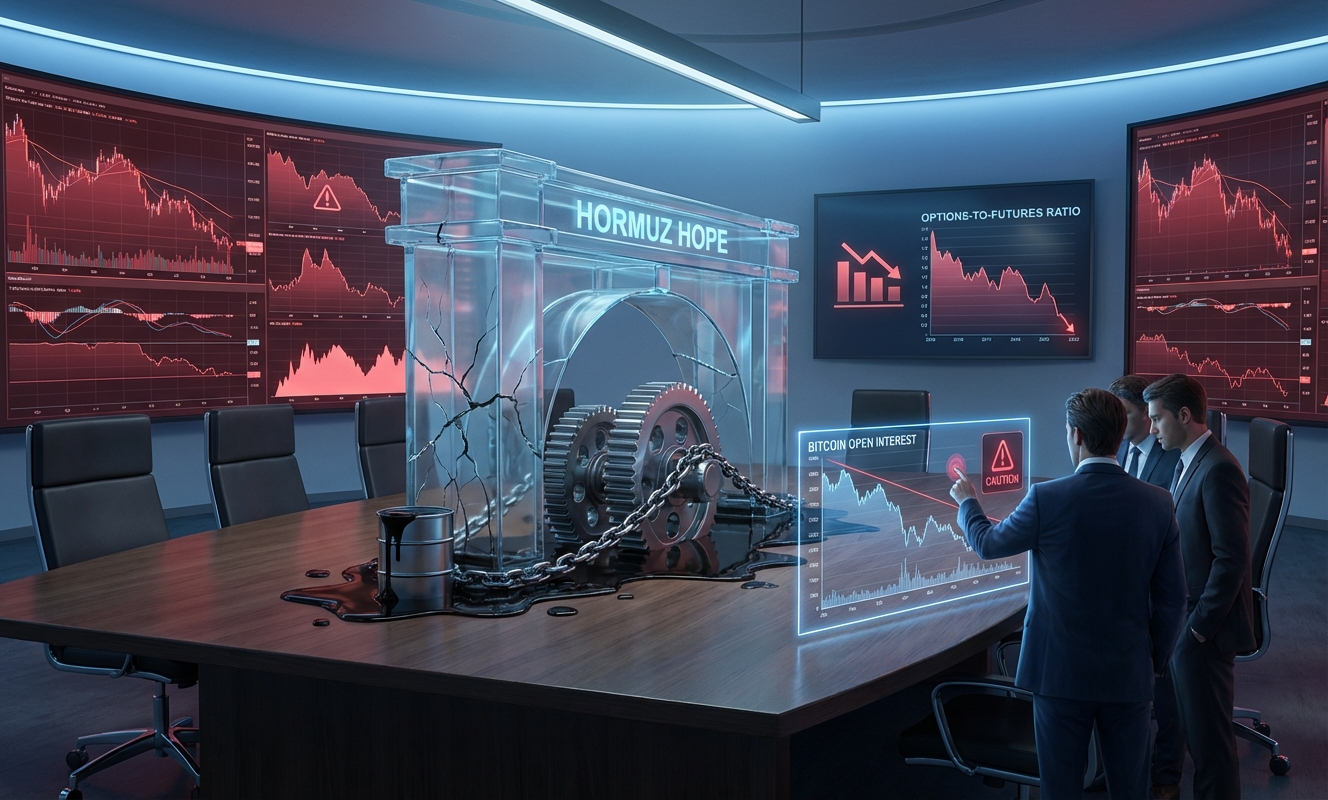
If you’re active in crypto markets right now, the playbook isn’t to chase this rally. The derivatives data suggests the smart positioning is to respect the caution signal. Consider reducing leverage exposure significantly. If you want Bitcoin exposure, lean toward spot over futures in this environment, because a futures-heavy market with concentrated open interest is a margin call waiting for a trigger.
Watch oil. Specifically, watch whether Brent reclaims $110. If it does, the “Hormuz Hope” narrative collapses in real time, and Bitcoin will be one of the first and fastest places that shows up. Set your alerts, keep your position sizes honest, and don’t be the exit liquidity the institutions are counting on.
The rally got the headlines. The derivatives got the truth.
References & Sources:
Bitcoin derivatives are currently flashing warning signs as open interest and funding rates adjust following a massive $46 billion market pullback. Traders are exercising caution, with options and futures markets indicating potential volatility and a shift away from the bullish sentiment initially sparked by the Iran ceasefire news. Spikes in implied volatility suggest that the market is bracing for further downward pressure or sideways consolidation.
The initial news of an Iran ceasefire triggered a brief relief rally across the cryptocurrency sector, injecting optimism into risk-on assets like Bitcoin. However, this momentum quickly faded, leading to a substantial $46 billion correction. Macroeconomic uncertainties and derivative market warnings ultimately outweighed the temporary geopolitical relief, causing traders to lock in profits and reduce exposure.
The $46 billion market drop is concerning because it wiped out significant leverage in the Bitcoin derivatives market. When sudden pullbacks of this magnitude occur, they often trigger cascading liquidations for over-leveraged long positions. This rapid reversal indicates weak underlying spot demand and suggests that the recent rally was driven heavily by speculative leverage rather than sustainable, long-term investment.
Bitcoin derivatives are financial contracts, such as futures and options, whose value is derived from the underlying price of Bitcoin. They are crucial to watch because they dictate market sentiment and liquidity. High open interest in derivatives can lead to sharp price swings, flash crashes, or short squeezes. Monitoring these metrics gives investors early warning signs about potential market instability, especially during sensitive macroeconomic or geopolitical events.