Subtotal $0.00


Magazines cover a wide array subjects, including but not limited to fashion, lifestyle, health, politics, business, Entertainment, sports, science,


Magazines cover a wide array subjects, including but not limited to fashion, lifestyle, health, politics, business, Entertainment, sports, science,

Miners don’t panic. They just sell. And right now, the protocol just handed them a very good reason to do exactly that.
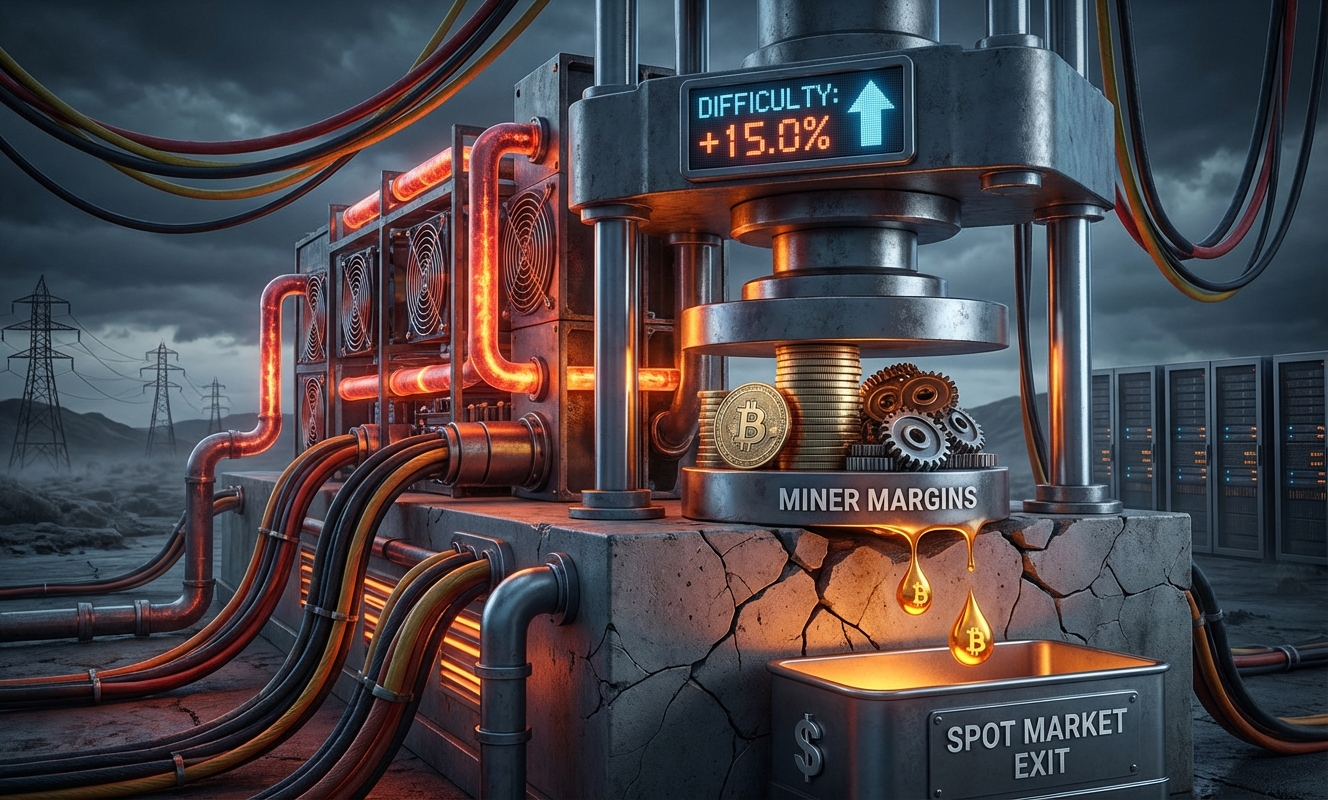
Bitcoin’s mining difficulty reset to 144.40 trillion, the largest single adjustment since 2021. This isn’t background noise. It’s a cost multiplier slamming into a market that’s been grinding sideways in the mid-$60,000s without the conviction to break either direction. The timing is brutal, and frankly, it wasn’t an accident of circumstance. It’s just how the math works when hashrate floods in and price doesn’t follow.
Let’s be real about what a difficulty adjustment is, because most retail traders treat it like a footnote. It isn’t.
When blocks arrive faster than the ten-minute target, the network auto-corrects by raising the computational work required per block. Security improves. Block cadence normalizes. Great for the protocol. Terrible for miner margins, especially when price isn’t cooperating.
Here’s the thing: difficulty is a cost multiplier. A 15% jump means miners are now burning 15% more electricity, generating 15% more wear on their rigs, for the exact same expected block reward. The math doesn’t care about your feelings. It doesn’t care about miner sentiment. It just compresses margins mechanically.
The clean metric to watch is hashprice: revenue per petahash per second per day. Around this adjustment window, hashprice dropped from roughly $33.50 to about $29.70 per PH/s/day. That’s a drop that doesn’t sound catastrophic on paper, but puts a meaningful chunk of the fleet into a zone where outcomes are decided by power costs, machine generation, and debt service schedules. And not everyone has good answers to all three.
Miners aren’t villains here. Honest. But their incentive structure right now points directly at spot markets.
Think about how a public mining company operates. They carry payroll. Site leases. Hosting contracts. Interest expense on debt they took on when margins looked better. Most of them also hold BTC on their balance sheets as a form of working capital. When current revenue from mining drops below what it costs to keep the lights on, those treasury coins become the fastest, most liquid solution to a very immediate problem.
They sell on obligation, not preference. That distinction matters enormously for price action. A seller who has to sell doesn’t wait for a better entry. They don’t pull bids to manufacture a dip. They just hit whatever spot market liquidity exists and convert BTC to fiat to cover this week’s power bill. Mechanical, scheduled, consistent.
And when multiple operators share similar fleet efficiencies and similar cost structures, which they often do because they’re all running similar-generation ASICs at comparable power rates, they can hit the same stress zone simultaneously. That’s when individual treasury sales cluster into something that actually moves price.
Price strength is the fastest fix for a miner squeeze. Full stop. Even a moderate push higher improves fiat revenue per block immediately, while most operating costs stay fixed. That single lever closes the cash-flow gap faster than any hardware upgrade or power renegotiation ever could.
But Bitcoin isn’t pushing higher right now. It’s chopping. And that’s the problem.
Range-bound price action is the environment where scheduled miner selling does the most damage. Here’s why:
Honestly, if you’re watching the $65,000 level and wondering why it keeps getting tested without clean resolution, part of the answer is sitting in miner treasuries right now.
This adjustment doesn’t exist in a vacuum. We’re in a post-halving environment where the block subsidy already got cut in half. Fees have to do significantly more work during quiet periods to compensate. When on-chain activity is low and fees are thin, that subsidy cut bites harder than it did in previous cycles.
The miners who built their models around a higher subsidy and assumed price appreciation would carry the rest are the ones most exposed right now. Their margin for error didn’t just shrink. It nearly disappeared. And a 15% difficulty spike is not a gentle reminder. It’s a direct hit.
Look, there are two coherent scenarios coming out of this adjustment window.
The squeeze path: Price continues to hover without follow-through. Hashprice stays compressed near the $30 per PH/s/day zone. Miners with scheduled obligations keep converting treasury coins into spot supply. That supply keeps price action heavy, which keeps miner revenue under pressure, which maintains the selling impulse. This loop doesn’t need to be dramatic to be effective. It just needs to persist.
The relief path: Some combination of modest price improvement, a fee spike from on-chain congestion, or a downward difficulty correction at the next adjustment reduces the cash-flow pressure. Selling cools. The forced-seller supply dries up. Market finds cleaner footing.
The constructive case is real. A difficulty reading of 144.40T signals that the network is absorbing industrial-scale compute and normalizing block cadence. That’s genuinely good for long-term security. Squeezes also function as clearing events, where hashrate migrates to operators with durable power strategies and modern, efficient fleets, while the weak hands renegotiate, consolidate, or power down entirely. The network comes out stronger on the other side.
But short-term? The flow risk is elevated. And the market doesn’t care about long-term fundamentals when it’s processing obligation-driven selling this week.
Skip the sentiment pieces. Here’s where the real signal lives right now:

Between you and me, the dangerous assumption right now is that miner selling is already priced in. It isn’t, necessarily. Here’s the catch.
Miner treasury sales don’t front-run the difficulty adjustment. They follow it, on a schedule set by when bills are due. That means the selling pressure from this adjustment is likely to continue arriving in small, consistent doses over the coming weeks rather than one clean flush that clears the air.
That’s the worst kind of overhead supply for a market trying to break out. It’s not dramatic enough to trigger a capitulation flush that resets sentiment. It’s just persistent enough to cap rallies and frustrate buyers. If you’re positioned long expecting a clean breakout from the current range, this is the specific mechanism that could keep it from happening for longer than you’d like.
Pro-Tip: Don’t trade against the obligation clock. If hashprice stays compressed and Bitcoin fails to hold above $67,000 on any attempted move higher, consider that the squeeze is still active and miner selling is still part of the supply picture. Wait for either a clear daily close above resistance that signals the constraint has eased, or watch for confirmation of the next difficulty adjustment trending lower before assuming the selling impulse has passed. Chasing breakouts into a structural overhead supply problem is how you become someone else’s exit liquidity.
The largest percentage increases in Bitcoin mining difficulty occurred during the network’s early days when the total hash rate was much smaller and highly volatile. The highest recorded percentage jump was 31.5% on July 9, 2011, followed closely by a 29.9% increase on June 12, 2011, and a 23.2% rise on August 17, 2011. However, in terms of sheer computing power, modern difficulty adjustments dwarf these historic numbers in absolute terms. For example, a recent 15% difficulty spike pushed the network to over 144.4 trillion—posting a record absolute increase following a massive hash rate rebound.
Bitcoin mining is constantly becoming harder because the protocol automatically adjusts its difficulty curve to match the amount of computing power (hash rate) currently active on the network. Recently, the network experienced a massive 15% difficulty jump, pushing the total difficulty up to 144.4 trillion. This was the largest percentage increase since the network recovered from the 2021 China mining ban. As more miners plug in high-powered mining rigs to compete for rewards, the network scales the difficulty up to ensure a new block is only mined roughly every 10 minutes. Interestingly, despite the intense competition, key on-chain metrics show that sudden difficulty spikes like this can actually flip miner behavior, causing them to confidently hoard their newly mined Bitcoin rather than sell it.
Yes, Bitcoin mining difficulty can and does go down. The Bitcoin network’s difficulty is programmatically designed to evaluate and adjust roughly every two weeks (every 2,016 blocks). This adjustment depends entirely on the average computing power present on the network during that two-week period. If miners unplug their rigs because of unprofitability, localized power outages, or regulatory bans, the network hash rate drops. This triggers a negative adjustment, which lowers the difficulty and makes Bitcoin easier to mine. Conversely, when new miners come online, it triggers a positive adjustment, such as the dramatic 15% upward spike recently witnessed.
Mining Bitcoin today is incredibly difficult and highly competitive. Due to Bitcoin’s steep difficulty curve, standard personal computers or basic GPUs are no longer capable of mining successfully. Today, you need to invest in a very powerful and expensive Application-Specific Integrated Circuit (ASIC) rig, alongside access to vast amounts of cheap electricity. Even with top-tier hardware, solo mining is statistically improbable for most operators. As a result, the vast majority of miners join Bitcoin mining pools to combine their hash power and increase their chances of earning consistent, fractional rewards. Despite these massive barriers to entry, bullish on-chain signals during severe difficulty spikes often convince major mining operators to aggressively hoard their accumulated BTC to maximize future profits.