Subtotal $0.00


Magazines cover a wide array subjects, including but not limited to fashion, lifestyle, health, politics, business, Entertainment, sports, science,


Magazines cover a wide array subjects, including but not limited to fashion, lifestyle, health, politics, business, Entertainment, sports, science,

 Fact Checked by Coinsbeat Editorial Team | Expert Reviewed by Themiya
Bitcoin didn’t just drop 4.4% on March 27 because of some vague “risk-off” mood. It dropped because a U.S. Secretary of State privately told G7 ministers the Iran conflict runs another two to four weeks, and someone in that room has a Bloomberg terminal. That’s the actual story here. The countdown is on the record now, and markets are pricing every single day of it.
Here’s the thing about private diplomatic briefings. They don’t stay private. The gap between Rubio’s public “weeks, not months” framing and his private two-to-four-week estimate to G7 ministers is razor thin, but the specificity of that private number is what changed the math for traders.
Vague timelines get discounted. Specific timelines get priced.
So now the market has a rough duration window. And duration, in this particular macro environment, translates almost directly to pain for Bitcoin. Not because Bitcoin is broken. Because the transmission chain from a prolonged Iran war to crypto liquidity is brutally mechanical right now.
That’s not a theory. That’s the sequence playing out in real time. The IMF documented that Bitcoin’s correlation with equities is now higher than its correlation with gold, bonds, or major currencies. And a 2024 study in Finance Research Letters confirmed Bitcoin returns respond to political uncertainty shocks specifically during periods of financial stress. We are inside that exact regime right now.
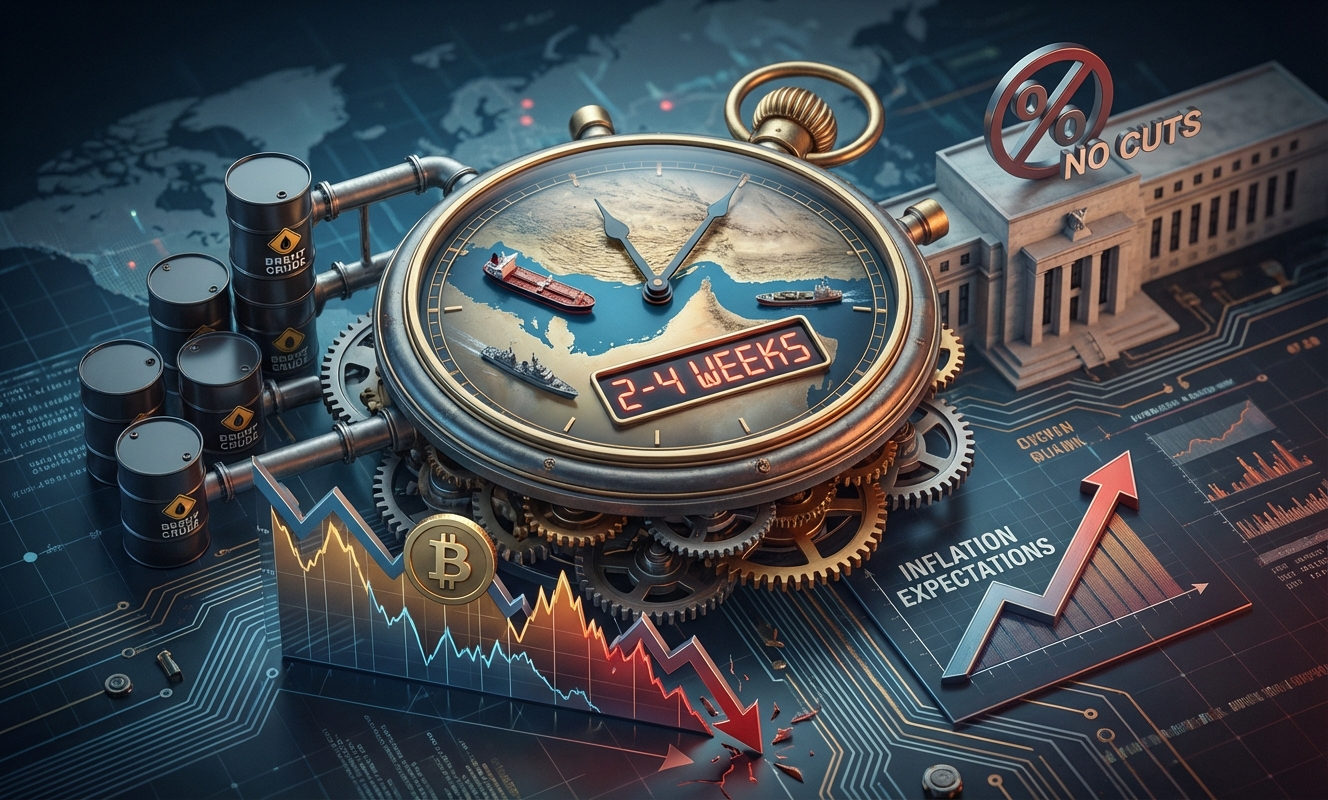
Let’s be real. The safe haven narrative never fully died, it just went underground and resurfaces every time crypto Twitter needs a bullish spin on a down day. The academic literature is not kind to it in this environment.
A 2025 quantile analysis found that gold, the U.S. dollar, and oil hedge geopolitical risk more consistently than crypto across varying risk levels. Another 2025 study found Bitcoin’s defensive properties only activate under geopolitically driven crash conditions. A specific threshold. Not just “there’s a war somewhere.”
The current oil-and-yield squeeze hasn’t hit that threshold. What we have instead is the least favorable macro regime for Bitcoin’s haven properties to activate. High yields, sticky inflation, zero rate cuts priced in, and foreign capital fleeing emerging markets and tech-adjacent assets at scale. Roughly $25.28 billion out of Taiwan, $13.5 billion out of South Korea, $10.17 billion out of India this month alone.
Bitcoin sits inside that same global growth and technology complex. It’s catching the same outflow logic. Honestly, expecting it to behave like digital gold in this environment is wishful thinking dressed up as analysis.
Shipping normalization begins. Brent retreats toward the $95-$110 range. Inflation expectations soften enough that the “no cuts in 2026” narrative starts cracking at the edges. Goldman Sachs has already argued that a clear end to military action would quickly erode the oil risk premium. On this path, Bitcoin’s compression reverses fast. We’re talking a $69,000-$75,000 range driven by the same liquidity sensitivity that caused the selloff, just in reverse. When de-escalation hopes climbed in late March, global equity funds took in $37.77 billion in a single week. That’s how fast the relief trade moves.
Hormuz friction persists. War-risk insurance alone keeps freight costs elevated even if military operations pause. Brent holds $110-$135, consistent with the Reuters analyst poll average of $134.62 under sustained disruption. Bitcoin grinds in a $58,000-$66,000 range with a liquidity ceiling that doesn’t lift until the oil shock visibly fades. Every military headline becomes a data point that extends or shortens the window. This is the scenario markets appear to be pricing right now.
Look, Rubio’s two-to-four-week estimate was private and informal. It’s not a contract. If the conflict drags past that window, if ceasefire talks collapse again like they did when Iran denied negotiations and equities sold off immediately, you’re looking at at least one more ugly inflation print, one more Fed meeting with zero cuts, and one more month of elevated energy costs before the macro backdrop even begins to clear. Bitcoin tests toward $52,000-$58,000 in that scenario. The haven narrative gets buried entirely. The liquidity-asset framing takes over completely.
About 20 million barrels per day flow through the Strait of Hormuz. That’s roughly 20% of global petroleum liquids consumption, with about 84% of that crude headed to Asia. The EIA notes only about 2.6 million barrels per day of Saudi and UAE pipeline bypass capacity is readily available.
That gap between what flows through Hormuz and what can be rerouted is the physical constraint underneath all the diplomatic noise. Here’s the thing most people miss. A ceasefire that leaves Hormuz shipping impaired delivers very limited macro relief. War-risk insurance doesn’t disappear the day guns go quiet. Elevated freight costs can extend the inflation pass-through by weeks or months after military operations pause.
So even the bull case requires shipping normalization, not just a ceasefire announcement. That’s a higher bar than the headlines suggest.

The market is toggling between de-escalation and escalation almost daily. When Trump delayed strikes on Iranian energy infrastructure, equity funds poured in $37.77 billion in a week. When Iran denied ceasefire talks, equities sold off immediately. Bitcoin is moving on the same dial.
Forget trying to call the resolution date. Instead, watch two specific data points as your real-time indicators.
Don’t get sucked into buying dips based on Rubio’s diplomatic statements alone. Statements are cheap. Tanker routes and Fed minutes are what actually move the needle. Size down, stay liquid, and wait for the oil print to confirm the direction before adding meaningful exposure.
Bitcoin’s most dangerous feature in this environment isn’t its volatility. It’s that retail holders keep applying the wrong mental model to it. They bought the “digital gold” story. They’re holding through a period when the academic evidence clearly shows Bitcoin’s defensive properties are regime-dependent and the current regime is the worst possible one for those properties to activate.
Two to four more weeks of elevated oil, frozen rate cuts, and sticky inflation expectations is a prolonged stay inside the unfavorable regime. Anyone who tells you Bitcoin will suddenly decouple and “discover its safe-haven nature” during this exact window is either shilling a bag or hasn’t read the 2025 literature. The liquidity ceiling is real. The duration of the war is the only variable that matters right now. And we just got a private, specific estimate of that duration from the U.S. Secretary of State.
That’s not bearish speculation. That’s just reading the room.
References & Sources:
Bitcoin and other cryptocurrencies are generally considered “risk-on” assets by institutional investors. When geopolitical tensions severely escalate—such as the threat of a prolonged war involving Iran—investors often de-risk their portfolios, moving capital away from volatile assets and into traditional safe-havens like gold, Treasury bonds, or the US Dollar. Additionally, the conflict has locked in high oil prices, which fuels broader inflation fears and reduces the likelihood of central bank interest rate cuts, creating a highly challenging macroeconomic environment for Bitcoin.
Senator Marco Rubio has reportedly signaled in private discussions that any military conflict involving Iran is unlikely to be a swift operation and may instead drag on for several weeks. This extended timeline has deeply unsettled global financial markets, as a prolonged conflict drastically increases the risk of severe energy supply chain disruptions, retaliatory escalations, and sustained economic instability.
Iran is a major player in the global energy sector and geographically borders the Strait of Hormuz, a critical maritime chokepoint through which approximately 20% of the world’s daily oil consumption passes. A military conflict in this region directly threatens to disrupt these vital supply lines. Anticipating massive supply shortages, oil markets immediately price in a heavy “geopolitical risk premium,” driving up the cost of crude oil and locking it in at elevated levels until the threat is neutralized.
Rising oil prices act as a primary driver for global inflation, as energy costs dictate the price of manufacturing, transportation, and everyday goods. To combat this inflation, central banks like the Federal Reserve are forced to maintain high interest rates. Higher interest rates reduce overall market liquidity and increase the cost of borrowing, which historically diminishes investor appetite for speculative, non-yielding assets like Bitcoin and alternative cryptocurrencies.