Subtotal $0.00


Magazines cover a wide array subjects, including but not limited to fashion, lifestyle, health, politics, business, Entertainment, sports, science,


Magazines cover a wide array subjects, including but not limited to fashion, lifestyle, health, politics, business, Entertainment, sports, science,
 Fact Checked by Coinsbeat Editorial Team | Expert Reviewed by Themiya
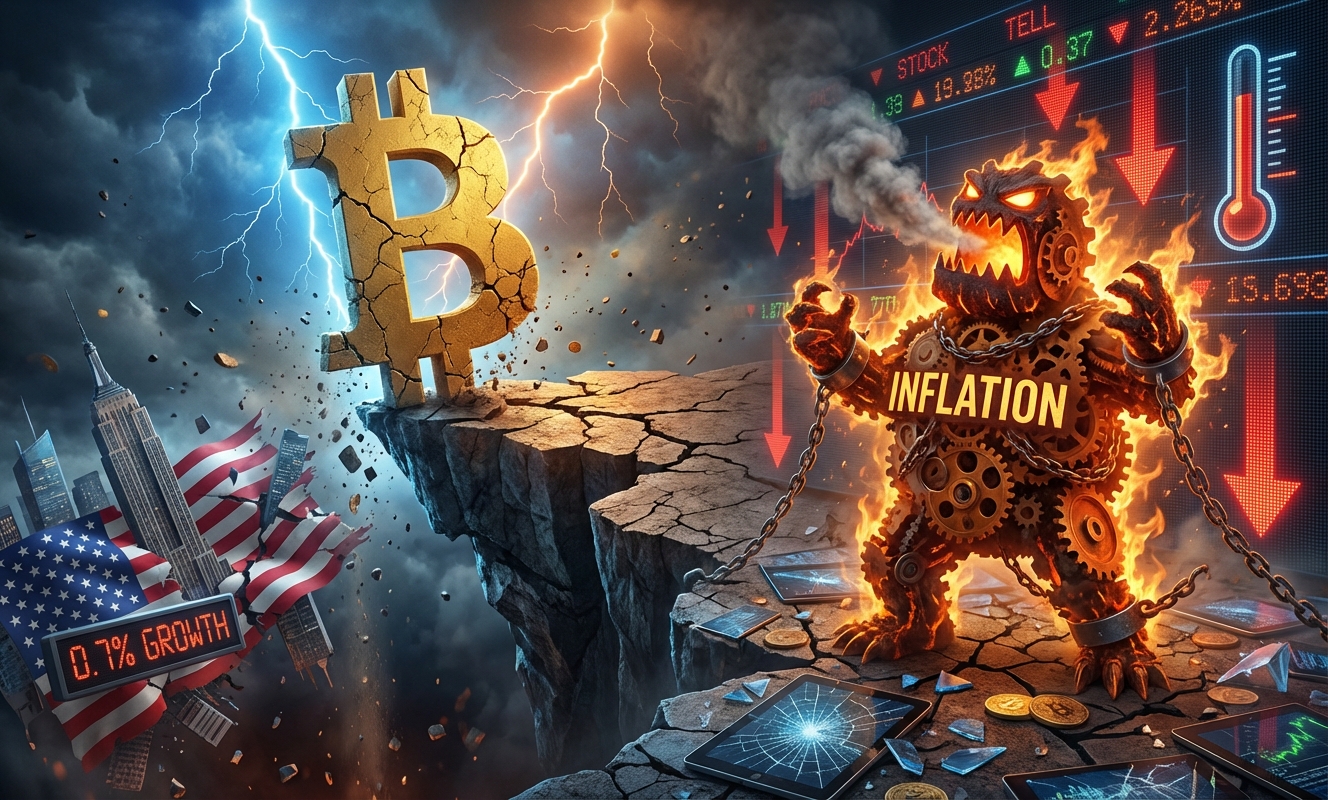
Let’s be real. A $583 million ETF inflow week sounds great until you zoom out and look at what the economy just confessed to. GDP cut in half. Core inflation stuck well above target. A war-driven oil spike that hasn’t fully worked its way through the data yet. And a Federal Reserve that, frankly, is trapped. This isn’t a setup for a clean bull run. This is a fragile asset trying to find its footing on quicksand.
The headline revision from 1.4% to 0.7% for Q4 2025 is bad enough. But the detail that really matters is real final sales to private domestic purchasers, which is the cleanest read you can get on actual underlying demand. That came in at 1.9%, down from an initial 2.4% and from 2.9% the prior quarter. A clear deceleration trend. Three quarters in a row, slowing.
Here’s the thing. These numbers don’t include the oil shock. Not a single data point from this dump captures what happens when gasoline costs 20% more. The backward-looking picture already looks uncomfortable, and the forward picture is almost certainly worse.
Goldman Sachs has modeled that a temporary move to $100 oil shaves 0.4% off global growth and adds 0.7% to headline inflation. We hit $119.50 this week. Do with that what you will.
Honestly, Powell might have the hardest job in finance right now. Cut rates and you pour fuel on an inflation fire that’s already burning at 3.1% core. Hold rates (or worse, signal “higher for longer”) and you risk tipping a stalling economy into something uglier, especially with an oil shock hitting consumer wallets in real time.
Markets have already scaled back rate-cut expectations for 2026 to roughly one quarter-point move by December, down from two cuts before the US-Israeli strikes on Iran began. That’s a meaningful shift in monetary policy expectations, and it happened fast.
The Mar. 17-18 FOMC meeting won’t bring a surprise cut. Everyone knows that. What actually matters is Powell’s tone in the press conference.
Look, there’s no clean path here. The Fed built a menu and every item on it tastes bad for risk assets right now.

Here’s where it gets interesting. Despite all of the above, Bitcoin’s on-chain and derivatives data tells a more nuanced story than pure panic.
Funding rates have turned negative. That means leveraged longs are getting flushed, not building. Options volatility has eased. ETF inflows returned with $583 million net from March 9-12. Glassnode flagged growing upside interest around $75,000 with a recognized demand zone at $60,000-$69,000.
That’s not the fingerprint of a market in full capitulation. It’s the fingerprint of a market that flushed out the weak hands and is now trying to figure out where the real buyers sit.
Compare that to a typical bull market top. Funding euphoric. Leverage stacked everywhere. Volatility compressed with everyone positioned the same way. We’re not there. The froth has been cleared, at least for now.
The problem is that “better internals” only matters if the macro backdrop doesn’t actively deteriorate further. Right now it is actively deteriorating further.
Between you and me, the range of outcomes here is unusually wide. That’s not vagueness, that’s an honest assessment of how much depends on oil and the Fed.
The black swan nobody wants to price in is a prolonged Strait of Hormuz disruption. That shifts the entire narrative from “temporary energy shock” to “structural inflation problem the Fed cannot solve.” In that scenario, Bitcoin stops trading like a risk-on store of value and starts trading like stressed equities. Not the narrative Bitcoin bulls want.

Risk Factor: Bitcoin’s January and February ETF demand was, in part, institutional players treating BTC as a macro hedge. The uncomfortable truth is that if this becomes a full stagflation narrative, where growth stalls while inflation stays high, institutional risk management frameworks will force portfolio managers to reduce exposure across all risk assets. ETF inflows can reverse fast. We saw $348.9 million flow out in a single day on March 6. That can happen again and it can be bigger. Don’t treat the recent inflow recovery as a structural shift. It’s a data point, not a trend confirmation.
The $60,000-$69,000 demand zone Glassnode flagged isn’t a floor. It’s a zone where buyers have historically shown up. Historical support zones break when macro conditions are bad enough. We’re not saying it breaks. We’re saying don’t assume it holds automatically.
Pro-Tip: The most actionable thing you can do right now is watch two things simultaneously: Powell’s exact language on March 18 and the weekly EIA oil inventory report. If Powell emphasizes inflation patience and oil data shows continued supply tightness, that’s the combination that puts the most pressure on Bitcoin in the near term. In that case, patient capital waits for a test of $63,000-$65,000 before adding exposure rather than chasing the current bounce near $70,600. If oil shows signs of meaningful retreat and Powell’s tone is neutral-to-cautious rather than hawkish, the $74,000-$75,000 resistance becomes the next real test worth watching for a breakout setup. Don’t front-run the Fed meeting. The macro is too messy for that to pay off cleanly.
The market isn’t in mania mode. Funding is negative, leverage is low, and real buyers are starting to show up in spot markets. That’s genuinely the stronger setup for a recovery. But “stronger setup” and “clean bull run” are two very different things when GDP just got cut in half, oil is near $100, and the Fed is boxed in. Bitcoin has better internals than the macro deserves right now. The question is whether the macro is about to collect what it’s owed.
References & Sources:
With US economic growth collapsing to a mere 0.7% and inflation remaining stubbornly high, the macroeconomic environment is flashing warning signs for risk assets, leading many to fear a crypto crash. The current stagflationary pressures are forcing Bitcoin into a crucial weekend test of its critical support levels. Prediction markets like Kalshi have recently reflected this anxiety, with traders giving high implied odds—up to 78 percent—that Bitcoin could face severe downward pressure and fall below the $65,000 mark this year. While a total “crash” depends heavily on how institutional investors react to this weekend’s sluggish GDP data, the combination of stalling growth and persistent inflation undeniably elevates the risk of a significant near-term market correction.
Despite the current macroeconomic headwinds—such as stalling US GDP growth and sticky inflation testing Bitcoin’s price today—historical long-term holders have experienced massive returns. Taking a buy-and-hold position in Bitcoin five years ago would have yielded approximately a 962% increase. This means a $1,000 investment made half a decade ago would be worth over $10,620 today. This historical perspective highlights Bitcoin’s resilience through various economic cycles, serving as a reminder to investors that long-term gains have historically outweighed short-term volatility, even as the market faces critical stress tests in today’s uncertain economic climate.
Warren Buffett has famously and consistently been a harsh critic of Bitcoin, arguing that it is a speculative asset rather than a productive investment. He asserts that Bitcoin’s price action is driven primarily by hype, trading costs, and the “greater fool theory” rather than real wealth creation. In Buffett’s view, true assets must deliver something tangible or productive over time, like a farm yielding crops or a business generating profits. While cryptocurrency proponents argue that Bitcoin is a necessary decentralized hedge against today’s alarming environment of 0.7% US economic growth and stubborn fiat inflation, Buffett fundamentally prefers productive, cash-flowing assets that generate intrinsic value regardless of macroeconomic turbulence.
While Bitcoin is currently facing a critical weekend price test triggered by the alarming combination of collapsed 0.7% US economic growth and persistent inflation, a total collapse to zero is highly unlikely. Unlike earlier, highly speculative boom-and-bust cycles, today’s Bitcoin market is structurally reinforced by major institutional allocators, Wall Street spot ETFs, and robust long-term custodial vehicles. For Bitcoin to go to absolute zero, it would require much more than a macro-induced bear market; it would necessitate a complete breakdown of legal frameworks, custodial infrastructure, and global long-term investor belief. Therefore, while sharp corrections remain possible during stagflationary periods, the “zero dollar” narrative is largely a thing of the past.