Subtotal $0.00


Magazines cover a wide array subjects, including but not limited to fashion, lifestyle, health, politics, business, Entertainment, sports, science,


Magazines cover a wide array subjects, including but not limited to fashion, lifestyle, health, politics, business, Entertainment, sports, science,

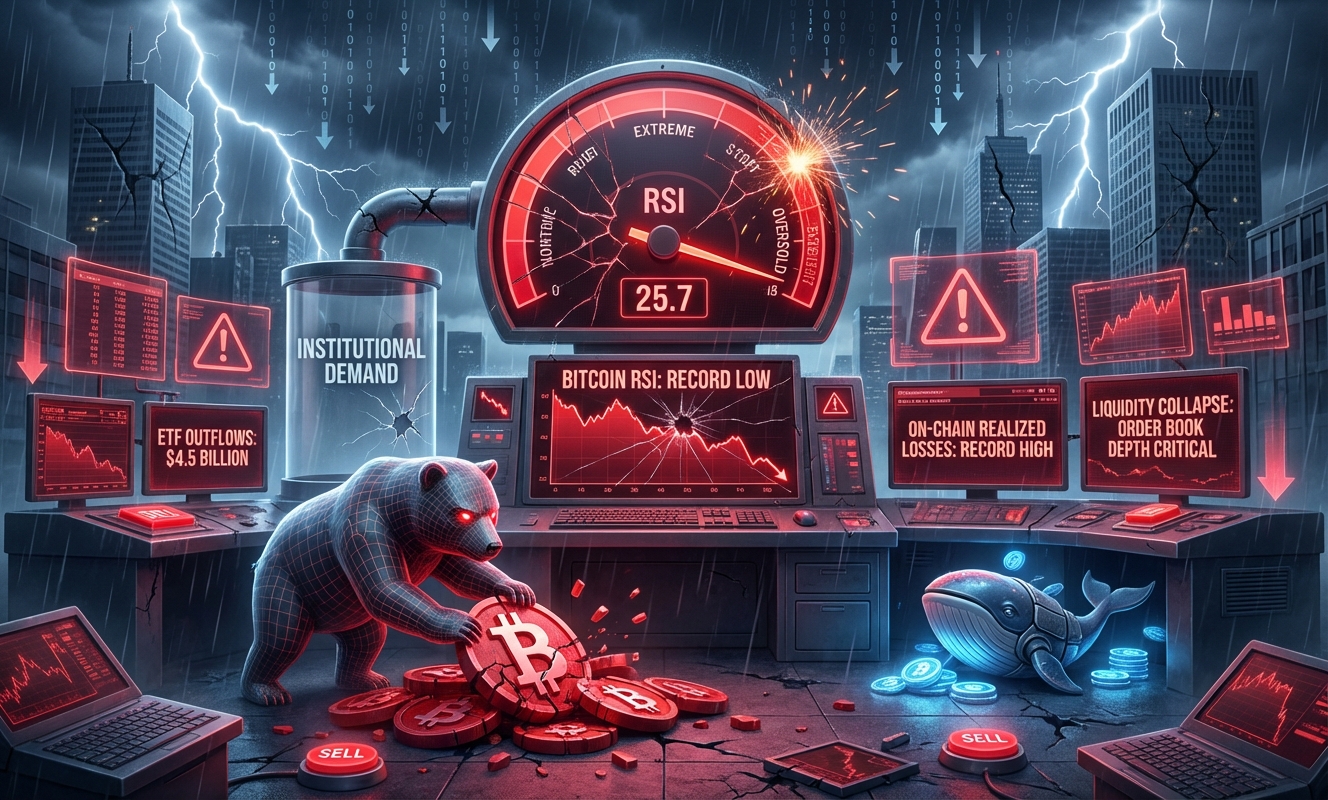
The weekly RSI on Bitcoin just printed 25.7. Let that sink in for a second. That’s lower than almost every reading since 2016, beaten only by the absolute carnage of late 2018 and the Genesis/Three Arrows collapse in mid-2022. Galaxy Digital’s head of research Alex Thorn called it “lower than any time except the darkest of bears.” And yet, here’s the uncomfortable truth most crypto Twitter influencers won’t tell you: an oversold signal is not a buy signal. Not automatically. Not in this market structure.
Look, the RSI headline is getting passed around like it’s a gift from the trading gods. But let’s be real about what RSI actually measures. It measures momentum exhaustion. It tells you sellers have been relentless. What it does not tell you is when they’ll stop.
The two prior instances Thorn referenced? Both were followed by extended, brutal, sideways-to-down periods before any meaningful recovery materialized. November 2018 saw BTC drop from $6,000 to $3,000 after similar readings. The June 2022 print coincided with contagion that hadn’t even fully hit the tape yet. Comparing those to today isn’t reassuring. It’s a warning.
Here’s the thing people miss about extreme RSI readings: they don’t occur because of emotional panic sellers hitting market orders at 3 AM. They happen because the selling has become mechanical and structural. Forced liquidations. Fund de-risking. Risk managers at TradFi desks cutting exposure because their models told them to. That type of selling doesn’t care about your support levels or your Fibonacci retracements.
Glassnode’s 90-day realized profit-and-loss ratio has dropped below 1. Translation: the market is realizing more losses than profits on a rolling basis. Sellers are still the ones setting the price at the margin. Not buyers. Sellers.
CryptoQuant goes further. It’s calling this the deepest pain phase of the current drawdown, with on-chain investors posting their largest realized losses on record. Active traders are bleeding. Retail has largely thrown in the towel.
That last point matters. Bitcoin might be approaching the zone where long-term asymmetry starts to improve. Alphractal says it’s close. But close is not the same as there. And in crypto, “almost at the bottom” can still mean another 15% to 20% of pain before the structure firms up.
CryptoQuant compares the current realized loss scale to November 2019, after which Bitcoin eventually moved higher. Treat that as a loose analog, not a roadmap. The macro backdrop in 2019 was completely different from a world now dealing with tariff shocks, a 206% equity bubble, and an institutional investor base that can pull billions from ETFs with a few keystrokes.
This is where this correction genuinely separates itself from prior ones. And honestly, this is the part of the story that most surface-level RSI takes completely ignore.
US spot Bitcoin ETFs have bled over $4.5 billion in net outflows across 12 funds since January. Five consecutive weeks of redemptions. In prior drawdowns, the ETF complex acted as a steady marginal buyer, the institutional “buy the dip” floor that many assumed was now permanently baked into Bitcoin’s market structure. That assumption is currently getting destroyed in real time.
Coin Metrics data shows average spot Bitcoin order book depth within 2% of mid-price has collapsed. It went from roughly $40 to $50 million between August and October 2025, then thinned to $15 to $25 million, and has since deteriorated further into February. What that means practically is that relatively modest sell orders are now moving price more aggressively than they would have a year ago. The air pockets you’re seeing on the chart? That’s a direct consequence of this thin liquidity environment.
The negative funding is a double-edged sword. On one hand, crowded short positioning can trigger a violent short squeeze if spot selling fades. On the other hand, the fact that funding flipped negative here (unlike the prior $80,000 bottom where it stayed positive) tells you the market’s conviction has shifted. Traders are now paying to be short Bitcoin. That’s not a small signal.
Even after Bitcoin bounced back above $66,000, options traders stayed defensive. Put demand remained elevated, concentrated in $60,000 to $50,000 strike prices. When traders buy downside protection aggressively after a bounce, they’re effectively saying: “I don’t trust this rally.” That’s the professional money talking. And right now, the professional money is not convinced this is the bottom.
Honestly, the “why” here isn’t complicated, but it is layered. This isn’t just crypto-native selling. The macro trigger is a credit stress environment building under an equity market that, by some measures, is trading at its most stretched valuations on record. When risk assets come under pressure globally, Bitcoin gets sold. Not because it’s fundamentally broken, but because it’s liquid, it trades 24/7, and fund managers can exit it at 2 AM when they can’t sell their illiquid positions.
Add to that the exit liquidity dynamic playing out with retail investors who bought the ETF narrative in late 2024 and early 2025 and are now watching their positions bleed. Those are real people with real pain thresholds. When they capitulate, they don’t just sell. They tell their friends, they post on Reddit, and they create a reflexive feedback loop of negative sentiment that keeps marginal buyers sidelined.
Meanwhile, whales accumulate quietly. That’s the oldest game in crypto. Shake out the weak hands, absorb supply at a discount, wait. The CryptoQuant data is showing exactly that pattern. But the shaking out process takes time. It is not a single-day event.
Here’s the actionable read if you’re trying to navigate this without getting wrecked.

The comparison to November 2018 is instructive in the worst possible way. Bitcoin’s RSI hit extreme oversold levels that month around $6,000. It then dropped to $3,000. The base-building phase took the better part of six months and involved multiple fake bounces that absolutely wrecked anyone trying to catch the knife early.
The current setup, with thin liquidity, persistent ETF outflows, negative futures funding, elevated put demand, and a macro environment that isn’t cooperating, has more in common with a prolonged bottoming process than a sharp V-shaped reversal. Anyone shilling you a “guaranteed bounce” based on the RSI number alone is either naive or has exit liquidity they need you to absorb.
The data from Glassnode, CryptoQuant, Coin Metrics, and Alphractal collectively describe a market in a late-stage repair process. That’s constructive for the medium term. It is not a clearance sale with a timer on it. Trade accordingly.