Subtotal $0.00


Magazines cover a wide array subjects, including but not limited to fashion, lifestyle, health, politics, business, Entertainment, sports, science,


Magazines cover a wide array subjects, including but not limited to fashion, lifestyle, health, politics, business, Entertainment, sports, science,

 Fact Checked by Coinsbeat Editorial Team | Expert Reviewed by Themiya
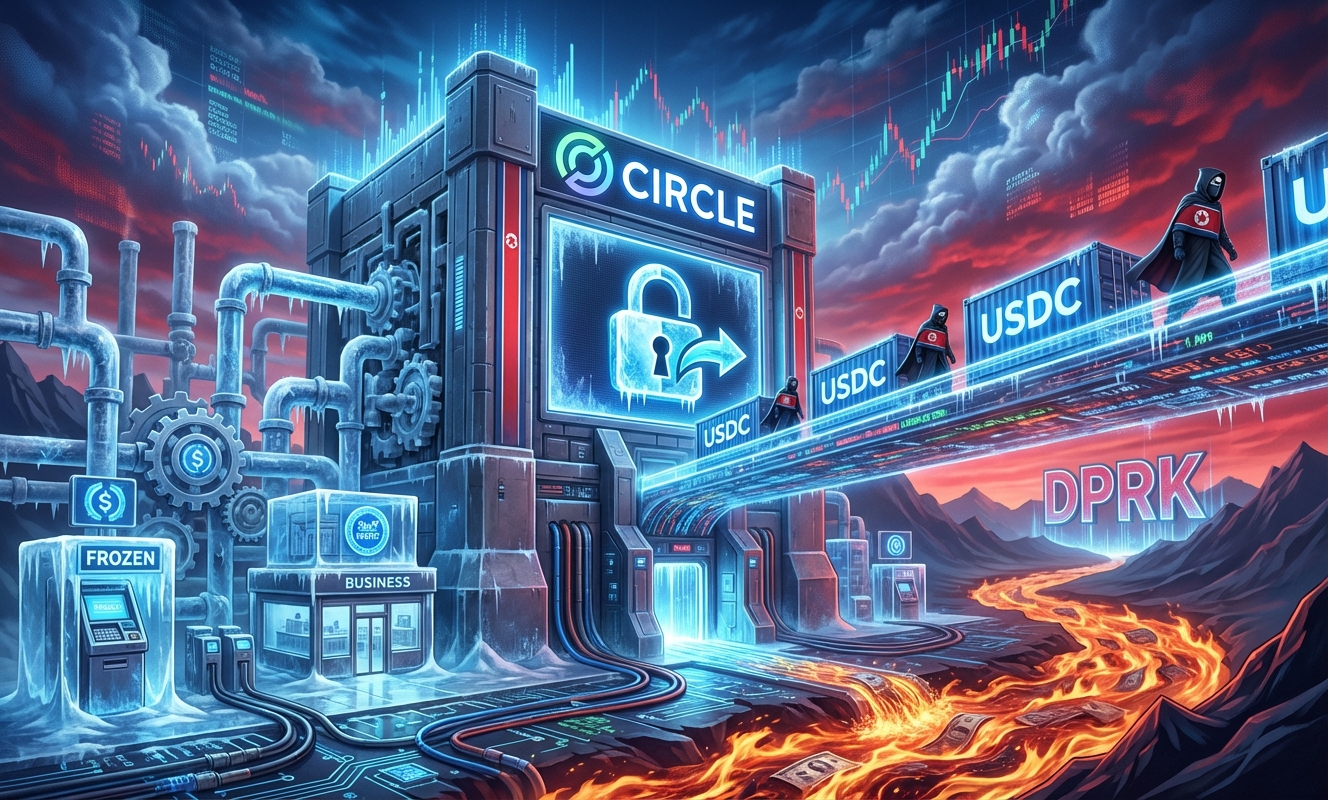
North Korea just robbed Solana’s biggest DeFi protocol for $285 million. And Circle, the company that controls USDC’s blacklist, watched $230 million of its own stablecoin flow through its own bridge, in broad daylight, during business hours. Then did absolutely nothing.
Let that sink in for a second.
Here’s the thing about the Drift Protocol exploit. It wasn’t a flash. The attackers didn’t grab the funds and disappear in a single block. According to ZachXBT’s on-chain trace, the hackers held the stolen USDC across multiple wallets for one to three hours before they even started bridging to Ethereum. Then they executed over 100 transactions through Circle’s own Cross-Chain Transfer Protocol (CCTP). Over several hours. During the New York business day.
Circle has a blacklist. They’ve used it 601 times, freezing roughly $117 million in USDC across wallets it deemed problematic, per Dune Analytics data. So the tool exists. The legal authority exists. The technical infrastructure exists.
They just chose not to use it here.
What makes this so infuriating to anyone paying attention is what happened nine days earlier. On March 23, Circle froze the USDC balances of 16 corporate hot wallets, disrupting legitimate exchanges, casinos, and payment processors, all tied to a sealed civil case. ZachXBT called it “potentially the single most incompetent” freeze he’d witnessed in five years. Legitimate businesses got nuked. A nine-figure Lazarus Group heist got a free pass.Go figure.
This is where it gets cold. The hackers deliberately avoided converting stolen funds into USDT. That wasn’t an accident. Tether has a well-documented history of blacklisting malicious wallets fast, including freezing $46 million connected to FTX at law enforcement’s request. The attackers knew this. They made a calculated bet that Circle would stay passive. And they were right.
Blockchain intelligence firms Elliptic, TRM Labs, and Diverg have all independently confirmed the same thing: the laundering methodology, on-chain behavior, and network-level indicators point directly to Lazarus Group, the DPRK’s most prolific state-sponsored hacking unit. The same crew behind the $1.5 billion Bybit hack. The same crew behind the $625 million Ronin bridge attack.
If confirmed, this would be the eighteenth DPRK-linked crypto theft in 2026 alone, pushing North Korea’s illicit haul past $300 million this year. Eighteen. This is not a random crime wave. This is a state-level, systematic looting operation, and our industry keeps serving up fresh exit liquidity.

The attack itself was weeks in the making. Weeks. This wasn’t some script kiddie clicking buttons.
SlowMist’s founder Yu Xian noted this durable nonce phishing technique has been circulating for at least two years. Two years. And a protocol sitting on half a billion dollars in TVL still got caught by it. Look, I’m not here to pile on Drift’s security team, because sophisticated state actors are genuinely hard to stop. But “this technique has been known for two years” is a rough thing to read in a post-mortem.
At least 20 third-party applications that plugged into Drift’s vaults for yield generation have confirmed financial damage. Prime Numbers Fi alone is staring at over $10 million in losses. The ripple effects across Solana’s DeFi ecosystem are still being counted.
Santisa, the pseudonymous CIO of Lucidity Cap, argued that Circle’s inaction was actually “quite cypherpunk” and that pushing for active blacklisting moves the industry further from decentralization. Honestly, it’s a coherent philosophical position in a vacuum.
But here’s the problem with that framing. Circle already abandoned the cypherpunk ethos the moment it built a blacklist and started using it. You don’t get to freeze a payment processor over a civil dispute on a Tuesday and then invoke decentralization principles on Thursday when state-sponsored hackers run $230 million through your bridge. That’s not a principled stance. That’s a convenient inconsistency.
The choice Circle appears to have made, whether intentionally or through process failures, is that compliance with legal pressure gets fast action, while catastrophic theft of user funds gets a shrug. That is the actual policy, revealed through behavior, regardless of what any PR statement will eventually say.
Let’s be real about the market implications here.
If you’re using any Solana DeFi application for yield, right now, go check whether it routes through Drift’s vaults. At least 20 protocols already confirmed exposure. More will emerge. The contagion from a hack like this spreads slowly through the yield stack, and most retail users don’t realize their “safe” stablecoin yield is three protocol hops away from a compromised multisig. Know your counterparty risk, all the way down.
Circle is in the middle of its IPO push and actively lobbying for favorable stablecoin legislation in Washington. This episode drops at the worst possible time for that narrative. Regulators who were already asking hard questions about stablecoin issuer responsibilities now have a very specific, very public data point: Circle froze legitimate businesses on civil court orders but took no action during the largest DeFi hack of the year. Expect that inconsistency to show up in Congressional hearings. If stablecoin legislation ends up requiring mandatory freeze protocols during confirmed exploits, Circle’s operational costs and legal liability exposure go up considerably. That’s a risk for anyone holding USDC as a long-term “safe” asset in their portfolio.
Bottom line. Centralized control and permissionless infrastructure are fundamentally incompatible over time. This exploit didn’t reveal a new problem. It just made an old one impossible to ignore anymore.
References & Sources:
Circle is under immense scrutiny because it failed to freeze $230 million in stolen USDC connected to a massive crypto exploit, allowing the hackers to freely move and launder the funds. This inaction sparked immediate outrage within the crypto community, particularly because Circle had just days prior aggressively frozen legitimate user accounts due to minor compliance triggers. Critics point to this as a glaring double standard in their security and compliance protocols.
Yes, Circle has both the technical capability and the legal authority to freeze USDC funds on a smart contract level. As the centralized issuer of the stablecoin, they maintain a built-in blacklist function that can permanently lock funds associated with illicit activities, major hacks, or direct law enforcement requests. The current controversy stems from their inconsistent application of this power—penalizing everyday innocent users while allegedly missing massive, high-profile exploits like the $230 million hack.
When Circle freezes a legitimate account, the user’s USDC funds become instantly locked and cannot be transferred, swapped, or cashed out to fiat currency. Innocent users caught in these freezes must typically go through a lengthy, stressful appeal process. This involves providing extensive KYC (Know Your Customer) documentation, transaction histories, and proof of funds to regain access. The crypto community argues this process is overly punitive toward retail users, especially when actual cybercriminals are slipping through the cracks.
This incident heavily damages USDC’s reputation as a secure, reliable, and fairly managed stablecoin. Trust in centralized stablecoins relies heavily on the issuer’s ability to protect the broader ecosystem from malicious actors while simultaneously safeguarding innocent, law-abiding users. By allowing massive illicit flows to go unblocked while simultaneously penalizing everyday retail users, Circle risks driving investors toward decentralized stablecoin alternatives or competitors boasting more transparent and equitable compliance policies.