Subtotal $0.00


Magazines cover a wide array subjects, including but not limited to fashion, lifestyle, health, politics, business, Entertainment, sports, science,


Magazines cover a wide array subjects, including but not limited to fashion, lifestyle, health, politics, business, Entertainment, sports, science,

 Fact Checked by Coinsbeat Editorial Team | Expert Reviewed by Themiya
Washington’s big crypto bill is not stalled because nobody cares. It’s stalled because too many people care, and every single one of them wants a different version of the prize.
The CLARITY Act was pitched as the clean solution to years of regulatory whiplash. One framework. Clear agency lanes. A lawful path for token issuance, exchange activity, custody, and decentralized protocol participation. Sounds great on paper. In practice, it walked straight into a four-way coalition war where each faction has enough leverage to slow the process, claim the moral high ground on consumer protection, and quietly gut whatever the other side just negotiated.
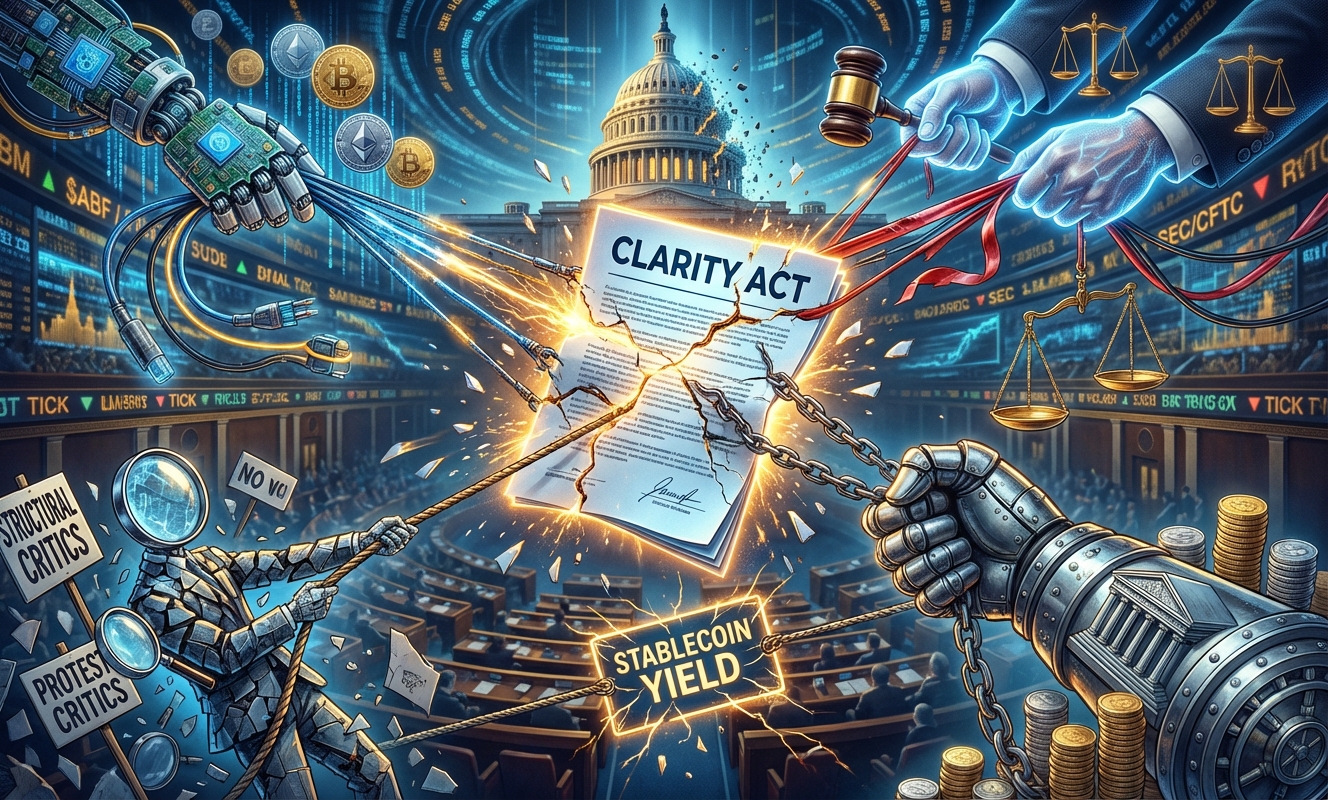
Let’s be real. This is not a policy debate anymore. It’s a fight over who controls the economics of digital dollars. And the banks, the regulators, the structural critics, and the industry itself are all pulling in opposite directions on the same rope.
Here’s the thing most coverage misses. The four camps fighting over CLARITY don’t fundamentally disagree that crypto needs rules. They disagree on who captures the revenue once the rules are written.
Break it down plainly:
Each camp has a veto. Not a formal legislative veto, but the kind of practical veto that comes from organized lobbying, committee relationships, and the ability to make a bill radioactive on legitimacy grounds before it hits the floor.
By March 2026, the stablecoin rewards fight had become the bill’s main pressure point. Everyone in Washington knew it. The question of whether compliant stablecoins can pass through interest, rewards, or yield-like returns to holders sounds like a technical footnote. It isn’t.
Honestly, this is the core economic battle. If you allow tokenized dollars to offer returns at scale, you’re giving crypto firms a direct line to compete with bank deposits and payment rails. That’s not a marginal competitive shift. That’s a structural threat to how commercial banks fund themselves.
The Bank Policy Institute made their position unusually explicit. Stablecoin structures that recreate deposit-like economics outside the banking perimeter need to be blocked. Full stop. Their argument wasn’t dressed up in consumer protection language. It was balance-sheet politics with the mask off.
The industry’s position is equally straightforward. If you strip out economic pass-through, you strip out the product. A stablecoin that can’t compete with a savings account on yield won’t displace bank deposits. That’s the whole point, say the banks. Exactly, says the industry. Which is why we need it.
Every concession made to one side drains utility from the bill as the other side imagined it. That’s not a drafting problem. That’s a structural conflict with no clean solution inside a single piece of legislation.
Look, this is where it gets interesting for anyone actually watching the power dynamics.
On March 11, the SEC and CFTC announced a new memorandum of understanding on crypto oversight coordination. On March 17, the SEC dropped a fresh interpretation clarifying how federal securities law applies to crypto assets. The CFTC aligned publicly. By March 20, the CFTC had added crypto FAQs extending the same logic.
None of this is a statute. But here’s the problem for CLARITY’s backers. The entire political argument for pushing through a complex, controversial, coalition-fracturing piece of legislation is that only Congress can deliver real clarity. The moment agencies start delivering pieces of that clarity themselves, that argument weakens in real time.
Katten’s March 19 analysis flagged the significance immediately, pointing to the SEC and CFTC guidance as a major event for how activities like airdrops, staking, mining, and wrapping get treated under securities law. Industry participants got operational breathing room without CLARITY moving an inch.
For lawmakers sitting on the fence, watching their constituents get partial relief through agency action, the pressure to accept politically costly concessions drops. Why take the heat if the market is already partly functional?
The regulatory camp doesn’t need to kill CLARITY to influence the negotiation. It just needs to be demonstrably less true that immediate passage is the only path to order. That’s already the case.
This is the part retail investors should be focused on right now.
If CLARITY stalls or gets narrowed beyond recognition, the short-term consequences split across asset classes in a pretty clear pattern:
The midterm calendar adds a compression dynamic that every camp is gaming, consciously or not.
As November approaches, the legislative bandwidth for a complex, contested financial bill narrows. The value of waiting rises for any faction that thinks the current deal costs more than the outcome is worth. Banks can wait. Structural critics can wait. Regulators are already moving in their own lane. Industry groups keep arguing delay has costs, but that message loses punch every time the SEC drops another piece of guidance that keeps the market functioning.
Between you and me, the narrowing path to passage doesn’t require any faction to actively blow up the bill. It just requires each camp to hold firm on their core demands long enough that the calendar runs out on everyone. That’s a coordination failure, not a conspiracy. But it produces the same result.
A workable reconciliation, if it comes, would probably look like a narrower framework focused on disciplined agency allocation, tight guardrails on stablecoin rewards to satisfy the banking camp, and stronger anti-fraud and disclosure language to give structural critics enough cover to stop screaming. The industry camp would get a framework, just not the maximal rewrite they originally wanted.
That’s a deal. Whether any of these four camps can actually live with it before November is the only question that matters now.

Here’s the risk most people are underweighting. The SEC and CFTC’s interpretive guidance is not durable architecture. It’s agency-level opinion that can be reversed by the next administration, the next commissioner, or the next enforcement action that tests the boundaries.
If CLARITY either fails or gets stripped down to a toothless shell, the industry ends up in a position where it celebrated short-term clarity from agency guidance without ever securing the statutory foundation that makes long-term capital commitment rational. That’s a trap. You get the relief without the protection, and then the relief gets taken back.
Institutions with 10-year investment horizons know this. A regulatory interpretation is exit liquidity for political patience. It feels like progress, functions as a substitute, and then expires the moment the political winds shift.
If you’re allocating capital based on the assumption that the current SEC posture on staking or airdrops is permanent, you’re building on sand. Congressional statute is concrete. Everything else is a mood.
Most of the CLARITY coverage follows Senate Banking Chairman Tim Scott’s committee. That’s the right place to watch for the main framework. But the Senate Agriculture Committee advancing its own related market-structure legislation in January is a signal worth tracking.
If the main CLARITY bill stalls in Banking, the Agriculture Committee’s CFTC-focused track could become the fallback vehicle for at least part of the market-structure framework, specifically the commodities jurisdiction piece. A split-track outcome, where some CFTC clarity moves through Agriculture while the broader framework stays stuck in Banking, is a realistic scenario that most retail investors aren’t pricing in.
Position accordingly. Don’t assume it’s all-or-nothing on CLARITY.
References & Sources:
The Crypto Clarity Act is a proposed legislative framework designed to establish definitive rules for digital assets in the United States. It aims to clearly define how cryptocurrencies are classified and regulated, addressing the long-standing regulatory uncertainty in the industry. According to SEC Chair Paul Atkins, the comprehensive legislation is expected to be passed as early as 2026, provided lawmakers can navigate the current political deadlocks surrounding the bill.
Yes, the Securities and Exchange Commission (SEC) has taken steps to remove significant roadblocks—such as rescinding the restrictive SAB 121 guidance—which previously made it highly difficult for traditional banks to offer custody services for Bitcoin and other cryptocurrencies. However, industry experts caution that while this is a positive step, it will not lead to immediate major changes. It will take more time, clear regulatory frameworks, and broader institutional readiness before traditional finance firms fully dive into digital asset custody.
Progress on US cryptocurrency legislation is currently mixed. Some legislation has successfully advanced, such as the GENIUS Act, which passed the House and was signed into law by President Donald Trump in July 2025. Two other cryptocurrency bills have also passed the House but are still awaiting Senate approval. Meanwhile, major comprehensive regulatory efforts like the Clarity Act are currently stalled in Congress due to a complex four-way political deadlock.
The US Clarity Act is currently stalled due to a four-way political deadlock among key factions in Congress. The impasse involves competing priorities from strict consumer protection advocates, pro-innovation crypto allies, traditional banking lobbyists, and legislators debating the jurisdictional split between the SEC and the CFTC. Because each of these four factions possesses enough political leverage to halt the bill’s progress, a delicate compromise must be reached before the Clarity Act can move forward.