Subtotal $0.00


Magazines cover a wide array subjects, including but not limited to fashion, lifestyle, health, politics, business, Entertainment, sports, science,


Magazines cover a wide array subjects, including but not limited to fashion, lifestyle, health, politics, business, Entertainment, sports, science,

 Fact Checked by Coinsbeat Editorial Team | Expert Reviewed by Themiya
DeFi had one job in Q1 2026. Don’t hand Wall Street a reason to win. It failed spectacularly.
While NYSE, Nasdaq, and a parade of regulators were quietly building a permissioned, on-chain financial system that institutions would actually trust, a $285 million exploit tore through Drift Protocol and radiated contagion across Solana DeFi in real time. The timing couldn’t have been worse. Honestly, it almost feels scripted.
Let’s be real about what happened here. This wasn’t just a bad week for one protocol. It was a stress test of DeFi’s core value proposition, and the results are not flattering.
Look at the Q1 2026 timeline and you’ll see a coordinated institutional land grab, whether it was intentional or not.
Every single one of these moves targets the same prize. A $330 billion on-chain capital pool, dominated by $317 billion in stablecoins, $13 billion in tokenized US Treasuries, and $1 billion in tokenized stocks. That number grows regardless of who captures it.
Here’s the thing most people are missing. The argument was never really “will finance go on-chain?” That debate is over. The actual fight is about who owns the rails when institutional capital floods in. And right now, Wall Street is winning that argument by building supervised, compliant infrastructure that strips out the parts CFOs lose sleep over.
The mechanics of the Drift attack are damning. Not because smart contract code failed. Because the control layer failed.
Drift confirmed the attack exploited durable nonces and a takeover of Security Council administrative powers through a compromised access-control layer. DefiLlama classified it as compromised admin access plus price manipulation. TVL dropped from roughly $550 million to below $250 million almost immediately.
That’s not a bug. That’s a governance catastrophe.
Post-mortems revealed the administrative transition relied on a 2-of-5 multisig with no timelock. No timelock. That configuration gave defenders essentially zero window to detect and respond before catastrophic changes went through. And because Drift’s infrastructure is composably connected to vaults, yield strategies, wrappers, and collateral positions across Solana DeFi, the damage didn’t stay contained.
Chaos Labs said it publicly: hidden dependencies kept surfacing in real time. The exposure map wasn’t visible until after the fact. That’s the part that should terrify anyone trying to pitch open DeFi to an institutional risk committee.
Composability is DeFi’s crown jewel. The ability to build interconnected financial products on shared, permissionless infrastructure is genuinely powerful. But composability is also a transmission channel for catastrophic losses when the control layer is soft. One compromised key shouldn’t reach the entire control surface. In Drift’s case, it did.
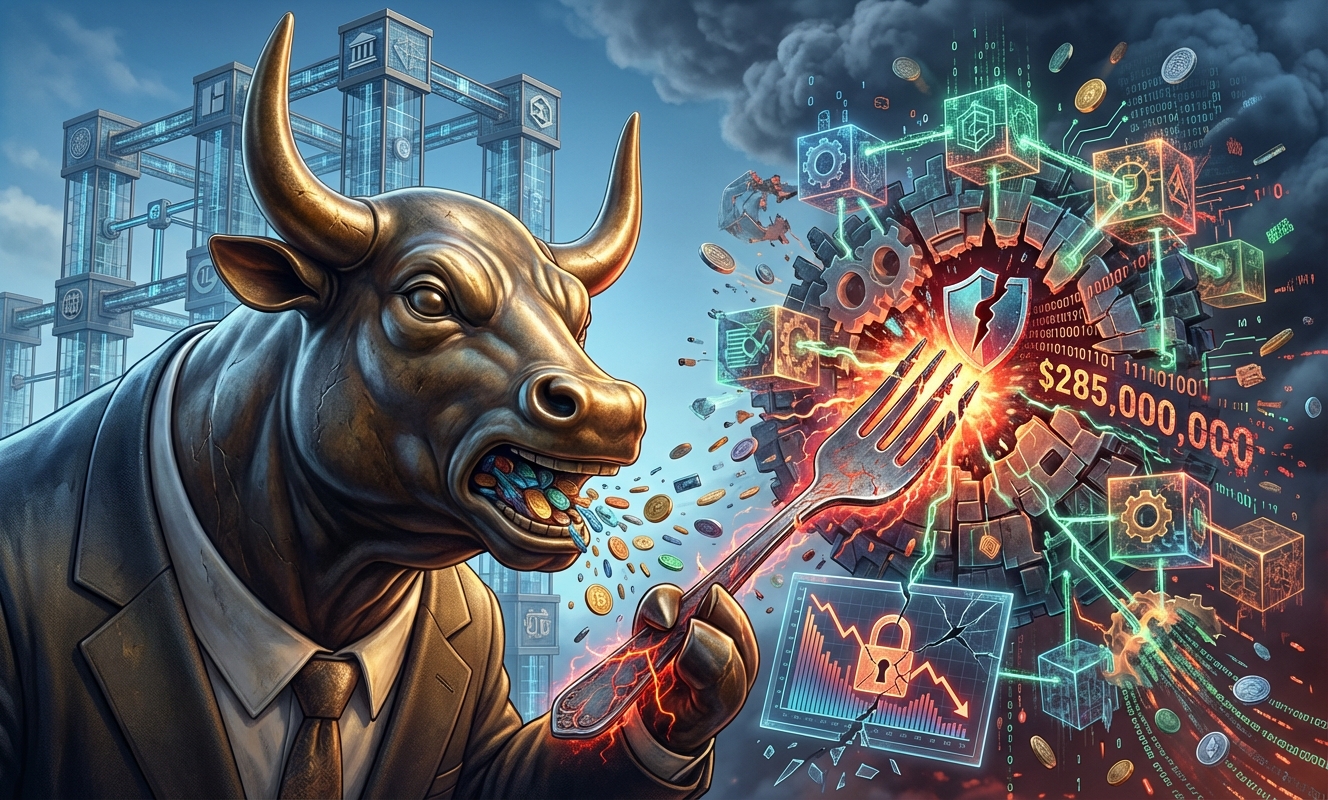
Chainalysis found private key compromises accounted for 43.8% of all stolen crypto in 2024. The single largest attack category tracked, full stop.
TRM Labs reported that attackers stole $2.87 billion across nearly 150 hacks in 2025, with infrastructure attacks targeting keys, wallets, and access control planes driving the majority of losses. Smart contract exploits are no longer the primary threat vector. Governance failures are.
The top 10 incidents alone accounted for 81% of all 2025 hack losses. Concentration of catastrophic risk at the top. Sound familiar? That’s the kind of tail-risk profile that makes institutional allocators very, very nervous.
DeFi’s security culture is still calibrated around contract audits and formal verification. Those matter, but the empirical record now says the access management and governance layers carry more systemic risk than contract code alone. The industry is still catching up to that reality.
Between you and me, the to-do list isn’t revolutionary. It’s just unglamorous operational discipline that the space has historically resisted because it feels like it undermines the “permissionless” ethos.
These fixes don’t generate hype. They won’t trend on Crypto Twitter. But they are the operational credibility that makes a risk committee comfortable routing institutional capital through open infrastructure instead of ICE or Nasdaq’s permissioned alternative.
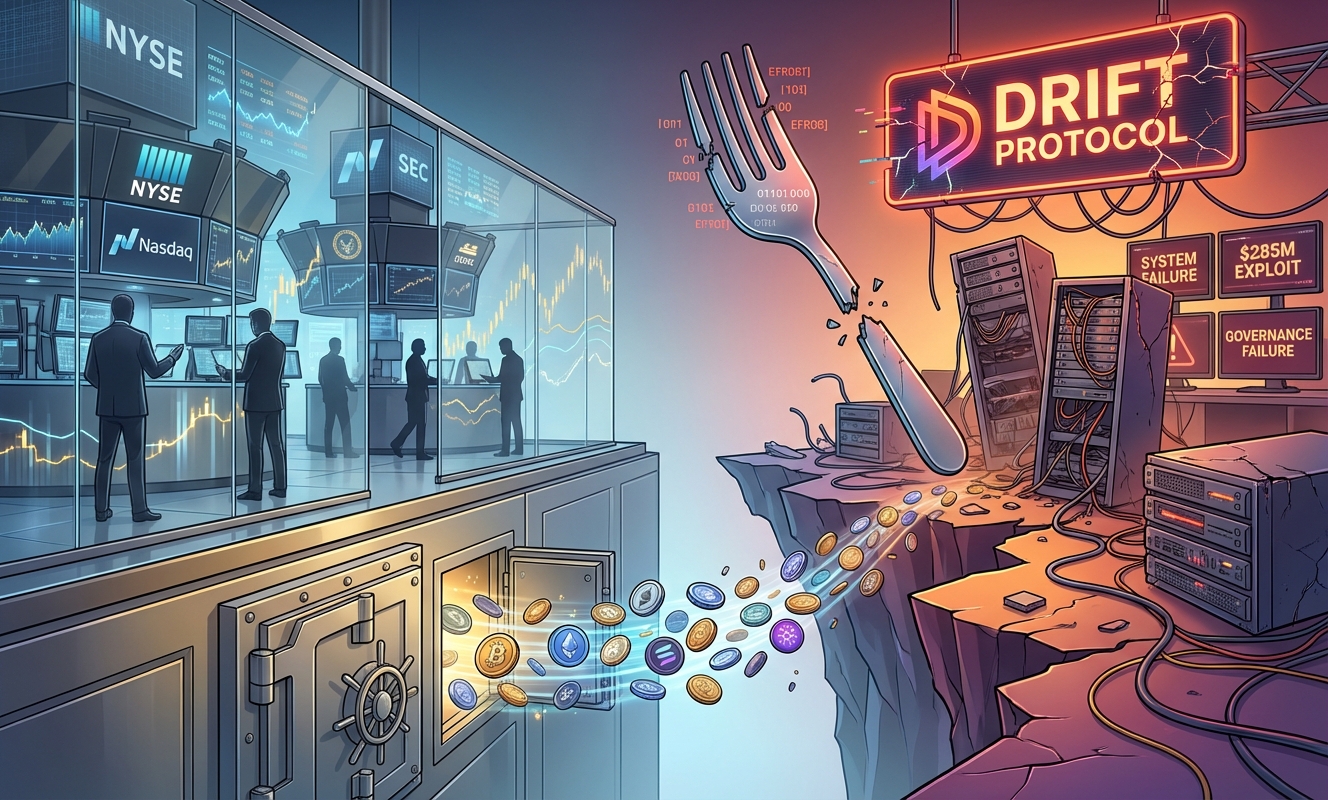
The $330 billion pool is growing. Tokenized securities and stablecoin adoption are expanding regardless of what DeFi does. The question is purely about market share.
In the bull case, open DeFi protocols ship a visible, sustained upgrade in governance discipline. Timelocks become standard. Teams publish dependency maps. Disclosure lags shrink from days to hours. Institutional allocators start using composability selectively for structured collateral, cross-protocol hedging, and yield strategies where the control layer is demonstrably stronger. Open DeFi captures 5% to 10% of the on-chain pool, somewhere between $16 billion and $33 billion.
In the bear case, every successive control-layer incident raises the perceived risk premium on open composability faster than governance gaps close. Tokenized securities and stablecoin volume expand inside permissioned venues. Open DeFi is left capturing retail flows and reflexive capital. Total open DeFi assets fall below $3 billion. Traditional finance takes the blockchain upside. DeFi gets the meme coins and the exit liquidity.
The Drift incident isn’t the cause of DeFi’s institutional problem. It’s the symptom. Wall Street didn’t need Drift to fail. They were already building. But that $285 million exploit gave every skeptical CFO and every cautious risk committee the data point they were looking for to justify staying inside supervised rails.
If you’re holding governance tokens for Solana DeFi protocols, here’s the uncomfortable reality. The composability that drives yield also drives contagion. Hidden dependencies in integrated protocols aren’t visible until they surface during an incident. That means your exposure isn’t just to the protocol you’re in. It’s to every protocol that protocol touches, and every protocol those protocols touch.
That’s a risk map most retail participants have never seen. And the teams running these protocols often don’t have it either, as Chaos Labs demonstrated in real time during the Drift post-mortem.
Pro-Tip: Before adding capital to any Solana DeFi protocol with significant TVL, check whether they have published dependency maps and timelock configurations on privileged functions. If neither exists, you’re essentially underwriting their governance risk with your own capital. That’s a position most people would decline if it were presented that plainly. Don’t be exit liquidity for a control-layer failure that was visible in the architecture before it happened.
References & Sources:
Blockchain technology challenges the traditional financial system by fundamentally changing how transactions are verified, recorded, and settled. Traditional Wall Street operations and banking networks rely heavily on intermediaries—such as clearinghouses, brokerages, and custodians—which add significant costs, delays, and centralized points of failure to everyday financial processes. By moving finance “on-chain,” blockchain introduces a decentralized, immutable ledger where transactions can be executed almost instantly. This technological shift drastically reduces the need for third-party gatekeepers, resulting in faster cross-border settlements and lowered systemic risks, which is exactly why traditional institutions are now adopting decentralized finance (DeFi) infrastructure.
Blockchain removes intermediaries through the innovative use of decentralized networks and automated smart contracts. Instead of relying on a centralized bank or clearinghouse to verify and process a transfer, blockchain enables secure, direct peer-to-peer settlement. Smart contracts automatically execute transactions the moment pre-defined conditions are met, offering near-instant transfers and an immutable, publicly verifiable ledger. In the context of Wall Street moving assets on-chain, this automation allows major institutions to bypass traditional middlemen, dramatically lowering transaction overhead and unlocking highly transparent, efficient, and cost-effective financial operations at scale.
The “$330 billion trust test” refers to the monumental challenge Decentralized Finance (DeFi) faces in proving its security, regulatory compliance, and operational reliability to institutional investors. As Wall Street aggressively moves assets on-chain to tap into greater market efficiency, DeFi protocols must demonstrate they can safely handle hundreds of billions of dollars without the risk of devastating hacks or liquidity crises. Overcoming this test requires mitigating smart contract vulnerabilities, building robust institutional-grade security guardrails, and navigating complex global regulatory frameworks to establish the unshakeable trust necessary for mass adoption by traditional financial giants.
Wall Street is moving its financial assets on-chain to capitalize on the unparalleled efficiency, transparency, and liquidity offered by blockchain technology. By tokenizing real-world assets (RWAs) like treasury bonds, equities, and private credit, traditional financial institutions can streamline clunky legacy operations, unlock 24/7 global trading, and achieve instantaneous atomic settlement. Embracing on-chain finance allows Wall Street to drastically cut operational overhead and tap into the rapidly growing Decentralized Finance (DeFi) ecosystem, provided the underlying protocols can pass rigorous institutional trust and security evaluations.