Subtotal $0.00


Magazines cover a wide array subjects, including but not limited to fashion, lifestyle, health, politics, business, Entertainment, sports, science,


Magazines cover a wide array subjects, including but not limited to fashion, lifestyle, health, politics, business, Entertainment, sports, science,

 Fact Checked by Coinsbeat Editorial Team | Expert Reviewed by Themiya
Most people read “Iran threatens US companies” and think geopolitics, oil prices, maybe some defense stocks. They don’t think Bitcoin. That’s a mistake.
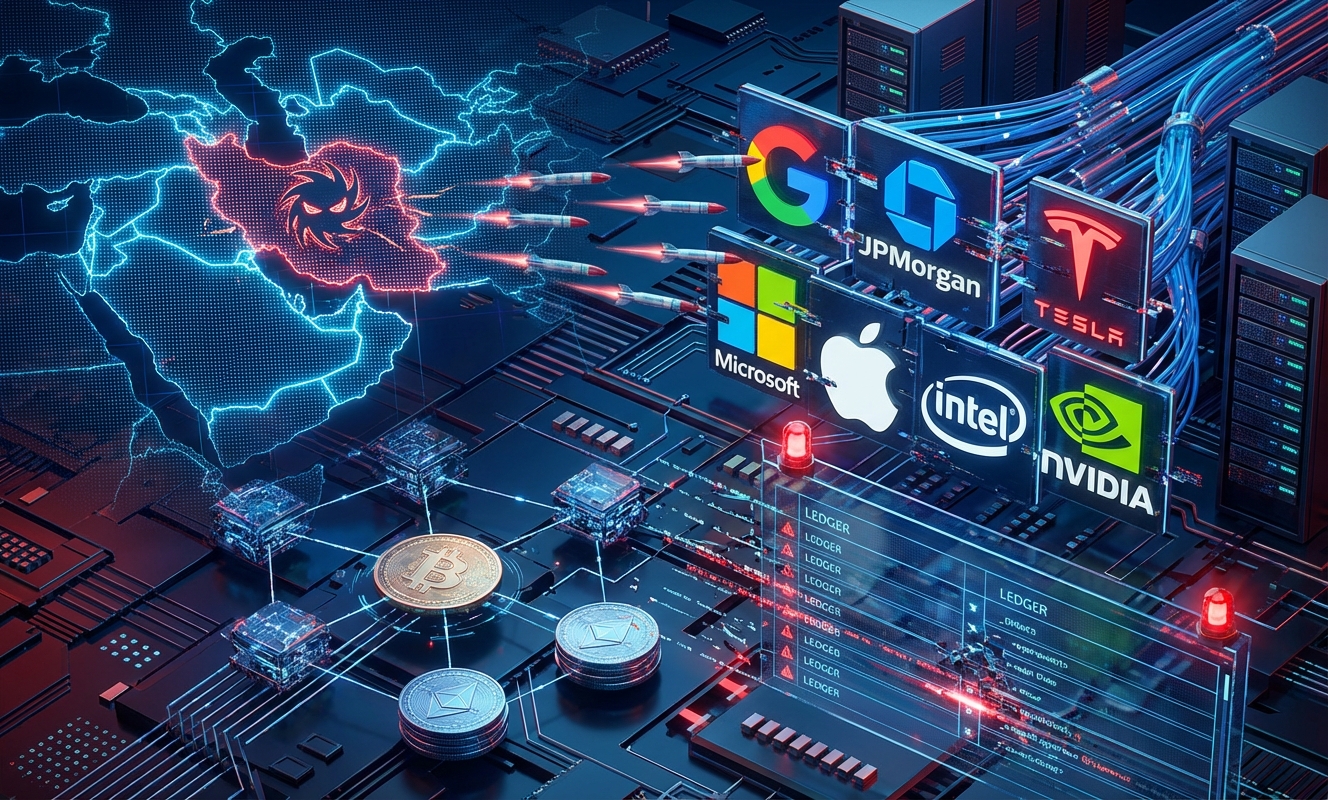
The IRGC officially named Microsoft, Google, Apple, Intel, IBM, Tesla, JPMorgan, Oracle, Palantir, Cisco, HP, and Nvidia as “legitimate targets” starting April 1, in retaliation for US and Israeli strikes on Iranian infrastructure. And look, at first glance, that reads like a Pentagon briefing. Not a crypto story.
But here’s the thing. Crypto isn’t just exchanges and token prices anymore. The industry has quietly stitched itself into the same cloud platforms, banking rails, and corporate treasury structures that Iran just put a bullseye on. That changes the risk calculus entirely.
Let’s be real about what’s actually happening here. The IRGC isn’t threatening to hack Binance or short ETH. They’re threatening the backbone companies that crypto now depends on to function at institutional scale.
This threat didn’t arrive in a vacuum either. Last month, Amazon Web Services data centers in the UAE and Bahrain took damage from drone strikes. Cloud services went down. Recovery dragged. That wasn’t a crypto story in the headlines, but every DeFi protocol, exchange, and blockchain analytics firm running on AWS infrastructure felt it. The Iran threat is a direct continuation of that pattern, now aimed at an even broader list of firms.
The wider conflict has already escalated well past a conventional military exchange. The US and Israel have struck Iranian energy infrastructure. Iran has launched more than 3,000 drones and missiles toward the UAE, Saudi Arabia, Bahrain, and Kuwait. This is no longer a skirmish. It’s a sustained, multi-front economic war. And the IRGC’s corporate hit list is the next logical chapter.
Google Cloud isn’t peripheral to this industry. It’s embedded in it. The platform provides managed node infrastructure, analytics tooling, and developer services to blockchain projects including Coinbase and the Cardano-backed Midnight network. Beyond that, Google recently launched the Google Cloud Universal Ledger, a Layer 1 blockchain built for cross-border payments and settlement. That’s not a side experiment. That’s a direct shot at SWIFT-style infrastructure.
Then there’s the mining angle. Google has quietly deployed at least $5 billion in disclosed credit support tied to Bitcoin miners pivoting toward AI data center operations. It’s helped reframe previously unrated miners as infrastructure-linked borrowers. Sophisticated stuff. If Google’s regional operations face disruption, the ripple into these financing arrangements could be real and fast.
JPMorgan’s Kinexys platform, launched in 2020, has processed over $3 trillion in transactions on its blockchain payment rail. The bank reportedly wants to double daily transaction values to $10 billion. It launched MONY on public Ethereum, giving qualified investors access to a tokenized money market fund. It’s piloting JPMD, a dollar-denominated deposit token, on Coinbase’s Base network.
Honestly, JPMorgan has become one of the most aggressively crypto-adjacent banks on the planet, even while publicly maintaining a skeptical face toward retail crypto. Any operational disruption to JPMorgan’s Middle East presence doesn’t just hurt their FX desks. It pressures the tokenized payment rails that institutional crypto players are increasingly routing settlements through.
Tesla holds 11,509 BTC on its balance sheet as of this writing, making it one of the top 20 public companies globally by Bitcoin exposure. It’s the only top-10 company by market cap that holds BTC. Full stop. If Tesla stock gets hammered by operational risk in the region, or if sentiment around the company sours sharply, that’s a direct link to Bitcoin price pressure through corporate treasury narratives.
Add in Musk’s ongoing DOGE cheerleading and Tesla’s acceptance of Dogecoin for merchandise, and you’ve got a company that touches multiple layers of crypto market sentiment simultaneously.
Nvidia’s direct involvement in crypto mining has faded, but its GPU dominance in AI compute means it’s still deeply intertwined with the data center infrastructure that crypto analytics and on-chain AI tools depend on. Any supply disruption or operational hit to Nvidia’s regional presence tightens an already squeezed compute market.
Microsoft’s crypto exposure is more institutional. Azure runs enterprise blockchain tooling. The company has explored decentralized identity through ION and has a $9.7 billion deal with Bitcoin miner IREN tied to AI infrastructure. Shareholders voted against adding BTC to the treasury, so there’s no direct balance sheet exposure there. But the infrastructure links are real.

Here’s where most analysts get lazy. They’ll tell you “Bitcoin dips on war news, then recovers.” That’s the surface read. The deeper problem is structural.
The market hasn’t priced any of this in with any real precision. Crypto traders are watching BTC’s chart and checking whether it holds $68,000 or $70,000. They’re not modeling what happens if Google Cloud’s UAE nodes go offline for two weeks during peak DeFi activity. They should be.
Standard crypto risk management assumes the threats are on-chain. Rug pulls, smart contract exploits, exchange insolvencies. Traders know how to position around those, more or less.
What they’re not prepared for is an off-chain infrastructure attack that degrades the rails crypto runs on without directly touching a single token or exchange. That’s the actual danger of this IRGC threat. It’s asymmetric and invisible until it isn’t.
Between you and me, the real danger here isn’t a dramatic single-day crash tied to a headline. It’s the slow degradation of the infrastructure confidence that institutional money needs to stay in this market.
Pro-Tip: If you’re holding significant altcoin exposure right now, this is the environment where you quietly reduce correlation risk and rotate toward BTC dominance as a partial hedge. Altcoins are the most vulnerable to sudden liquidity exits because they’re the first things institutions dump when risk sentiment cracks. Watch cloud infrastructure news out of the Gulf. If another AWS or Google Cloud data center takes damage, move before the token prices catch up.
The question isn’t whether Iran’s threats are credible in a military sense. The question is whether the infrastructure crypto now depends on can absorb the pressure if those threats escalate. We already saw what happened with AWS in the UAE. That was a preview. Nobody treated it as one.
References & Sources:
Iran’s geopolitical threats create widespread macroeconomic uncertainty, which traditionally causes high volatility across global markets. In the cryptocurrency sector, this tension can lead to sharp price fluctuations. As major US companies face operational risks, supply chain and energy disruptions could indirectly impact global Bitcoin mining operations. Furthermore, overall market fear often triggers rapid sell-offs of risk-on assets, while simultaneously driving a narrative for decentralized, borderless assets like Bitcoin as a potential hedge against fiat instability.
US tech, energy, and financial firms operate critical infrastructure across the Middle East, including massive data centers, banking hubs, and trade routes. Iranian cyber threats and physical posturing put these physical and digital assets at risk. For the cryptocurrency sector, any major disruption to Middle Eastern internet infrastructure or US-backed financial gateways can severely impact regional exchange liquidity, disrupt institutional trading volumes, and threaten local blockchain node operations.
Yes, escalated geopolitical conflicts almost always accelerate regulatory scrutiny. When hostile nations threaten US interests, regulatory bodies like the SEC, CFTC, and OFAC intensify their focus on how adversaries might utilize decentralized cryptocurrencies to evade international sanctions or fund illicit operations. Consequently, this heightens the compliance burden for global crypto exchanges, likely resulting in stricter Know Your Customer (KYC) and Anti-Money Laundering (AML) protocols worldwide.
Cryptocurrency’s role as a geopolitical hedge is complex and highly debated. While Bitcoin is often dubbed “digital gold” because it operates independently of central banks and government control—making it theoretically resistant to regional instability—its price remains heavily correlated with the traditional stock market. During severe geopolitical escalations involving the US and Iran, crypto often experiences immediate short-term volatility. However, long-term investors frequently turn to digital assets to protect wealth against the fiat currency devaluation that often accompanies international conflicts.