Subtotal $0.00


Magazines cover a wide array subjects, including but not limited to fashion, lifestyle, health, politics, business, Entertainment, sports, science,


Magazines cover a wide array subjects, including but not limited to fashion, lifestyle, health, politics, business, Entertainment, sports, science,

 Fact Checked by Coinsbeat Editorial Team | Expert Reviewed by Themiya
The Pentagon just dropped a $200 billion war funding request on the White House’s desk. At Bitcoin’s current price around $68,600, that’s roughly 2.9 million BTC. Not a metaphor. Not a rounding error. An actual number that dwarfs every major Bitcoin holder on the planet, combined.
Let’s be real for a second. Nobody in Washington is thinking about Bitcoin when they file these requests. But that’s exactly the point.
Here’s the thing about fiat war budgets: they’re designed to be abstract. “Two hundred billion dollars” is just a line in a spreadsheet to most people. So let’s make it concrete.
Oh, and there’s about 997,000 BTC left to ever be mined before the 21 million hard cap hits. This single war request is worth approximately 2.83 times all the Bitcoin that will ever exist again. Read that sentence one more time.
This is the uncomfortable truth the mainstream financial press won’t frame properly. The US government can request $200 billion for a war because the dollar system literally lets them conjure it. They don’t need to “have” the money. They issue Treasury bonds, the Fed absorbs them into the system, total federal debt ticks past $39 trillion, and nobody blinks.
Bitcoin doesn’t work that way. There is no executive order that prints 2.9 million new BTC into existence. No emergency authorization. No debt ceiling negotiation that magically creates supply. Every single satoshi entering circulation requires time, electricity, hardware, and the slow grind of block-by-block issuance.
That asymmetry is the entire thesis. Honestly, it’s been the thesis since the genesis block. Fiat systems expand supply to fund priorities, wars included. Bitcoin’s supply schedule doesn’t care about geopolitics, congressional budgets, or whatever the Pentagon needs this week.
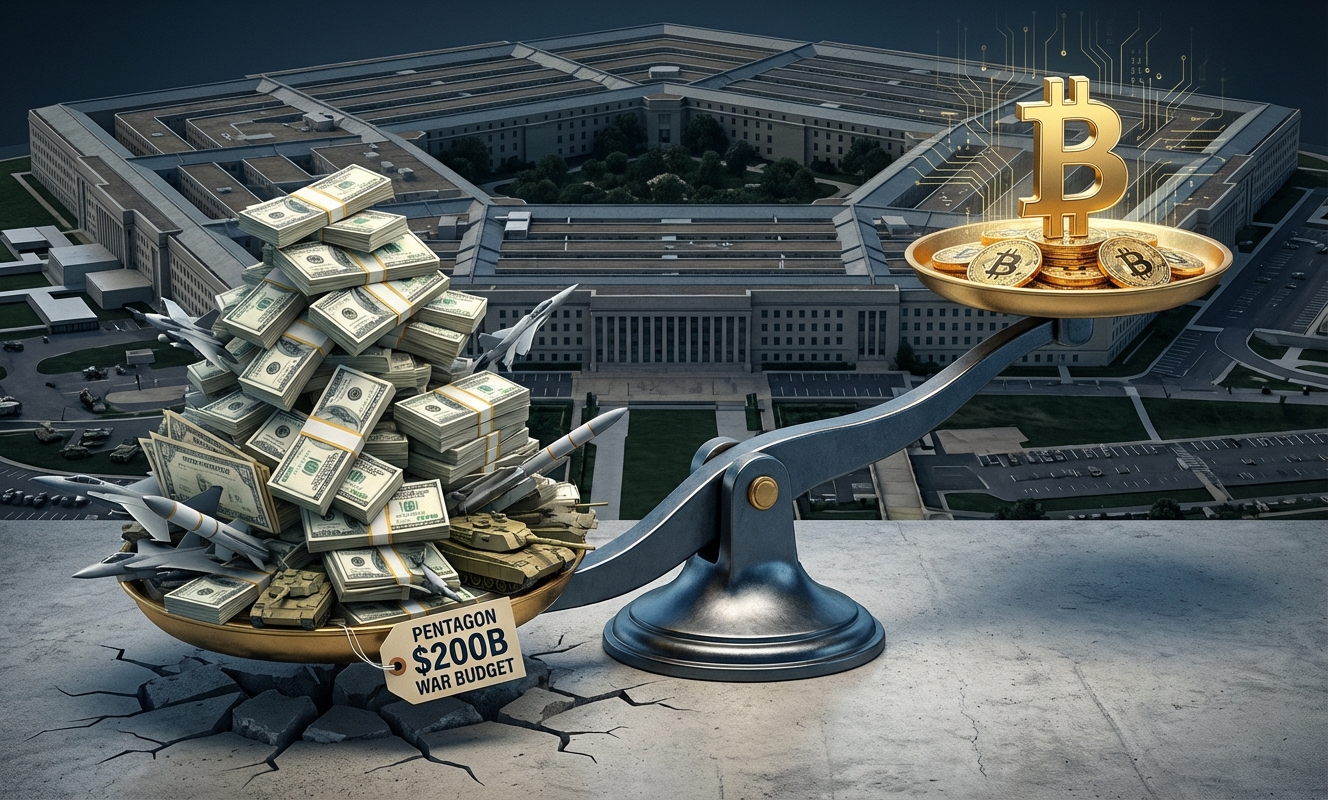
Here’s where it gets interesting from a market perspective. This isn’t just a philosophical debate about monetary systems. It’s a live stress test of the macro Bitcoin bull case, happening in real time.
Coinbase CEO Brian Armstrong put it plainly: “Bitcoin is a check and balance on inflation. When spending gets too far out of hand, capital moves to Bitcoin.” That quote isn’t just feel-good crypto boosterism. It describes a capital rotation mechanism that institutional desks are actively modeling right now.
Consider the sequence of events compressing into a single timeline right now:
Look, the short-term price action is messy. War news creates volatility. Traders panic-sell first and ask questions later. Bitcoin dropped sharply when US strikes on Iran escalated. That’s normal risk-asset behavior in a crisis spike. But the medium-term pressure building underneath that noise is genuinely bullish for the long-term fixed-supply argument.
Every war budget, every debt ceiling extension, every Treasury issuance adds another brick to the wall of evidence that fiat supply is structurally infinite and Bitcoin supply is structurally not.

Between you and me, this is where a lot of retail gets wrecked. They hear the macro case, it sounds airtight (and honestly, it is), and then they lever up into a war escalation cycle and get liquidated on the short-term volatility before the thesis plays out.
Risk Factor:
Pro-Tip: If you believe the macro thesis, which the math above makes pretty hard to argue against, the intelligent play isn’t to chase price spikes on war headlines. It’s to treat geopolitically-driven selloffs as dollar-cost averaging opportunities into a fixed-supply asset while the fiat system keeps proving the bull case for you, one $200 billion request at a time.
The Pentagon doesn’t need Bitcoin. But every time they prove they can spend like this, Bitcoin’s argument writes itself.
References & Sources:
If a direct conflict between the U.S. and Iran occurs, Bitcoin could initially experience significant downside risk. Geopolitical escalation typically leads to surging oil prices and global risk aversion. Although some investors view Bitcoin as “digital gold,” it historically behaves more like a risk asset during sudden macroeconomic shocks. Therefore, an attack could trigger a short-term sell-off as market participants liquidate risky assets and flee to traditional safe havens like physical gold or U.S. Treasuries.
There is an active legislative push for the U.S. government to acquire a massive Bitcoin reserve. In July 2024, Senator Cynthia Lummis introduced the BITCOIN Act, which proposes the creation of a U.S. Strategic Bitcoin Reserve and the gradual acquisition of 1,000,000 BTC. Additionally, political figures like Donald Trump have publicly promised to support the idea of holding Bitcoin as a national strategic asset, aligning with the growing institutional acceptance of cryptocurrency as a hedge against national debt.
Comparing an Iran war bill to “3 million Bitcoin” is a powerful way to illustrate the monumental financial costs of modern geopolitical conflicts. Depending on market fluctuations, 3 million BTC represents hundreds of billions of dollars. By denominating proposed military expenditures in Bitcoin rather than fiat currency, financial analysts emphasize the immense economic burden of a Middle East conflict. It creates a stark contrast between unchecked government deficit spending and the fixed, scarce supply economics of cryptocurrency.
Yes, funding a massive war deficit could inadvertently accelerate U.S. Bitcoin adoption. Financing a large-scale conflict with Iran would likely require the federal government to print more money, expanding the national debt. This inflationary pressure historically drives both institutional and retail investors toward hard-capped, scarce assets like Bitcoin to protect against currency debasement. As fiat purchasing power drops, the macroeconomic case for adopting Bitcoin—both individually and as a Strategic National Reserve—becomes significantly stronger.