Subtotal $0.00


Magazines cover a wide array subjects, including but not limited to fashion, lifestyle, health, politics, business, Entertainment, sports, science,


Magazines cover a wide array subjects, including but not limited to fashion, lifestyle, health, politics, business, Entertainment, sports, science,

 Fact Checked by Coinsbeat Editorial Team | Expert Reviewed by Themiya
Six accounts. $1.2 million in profit. All funded hours before the strikes that killed Iran’s Supreme Leader. That’s not edge. That’s a leak wearing a trading interface.
And yet, somehow, Polymarket and Kalshi are both reportedly in early talks to raise money at roughly $20 billion valuations each. That number would put them in the same conversation as top-tier consumer fintech names. In the middle of congressional hearings, CFTC rulemaking, and a class action lawsuit over unpaid winnings. Let’s be real about what’s actually happening here.
Here’s the thing most retail observers miss entirely. The actual product Wall Street is pricing at $20 billion isn’t the prediction market itself. It’s the data layer sitting on top of it.
A live contract price on a geopolitical event behaves like a quote. It moves in real time. It aggregates distributed information. It signals what a large, financially motivated crowd thinks is about to happen. That’s not a bet slip. That’s a Bloomberg terminal function that hasn’t been built yet.
The media deals make this crystal clear:
Once those probabilities are sitting next to earnings reports and Fed rate decisions in the WSJ, they stop being novelty. They become infrastructure. Readers start treating a Polymarket percentage the same way they treat a futures price. That’s the distribution story investors are paying $20 billion for.
Honestly, the valuation makes sense on that framing alone. The problem is everything attached to it.
Look at the raw numbers from the Iran contracts and they tell a specific story about who was actually using these platforms and why.
Multiple reports also flagged newly created accounts making unusually well-timed bets as the conflict escalated. That pattern doesn’t look like a lucky crowd. It looks like insider front-running with a financial instrument that has no surveillance infrastructure robust enough to catch it in real time.
This is the core tension. Prediction markets are most valuable when the event is high-stakes and uncertain. A contract on whether a central bank will raise rates by 25 basis points is useful but boring. A contract on whether a foreign leader survives the week is where the real information premium lives. And that’s exactly where the incentive to leak classified material becomes financially rewarding.
Washington noticed. Fast.
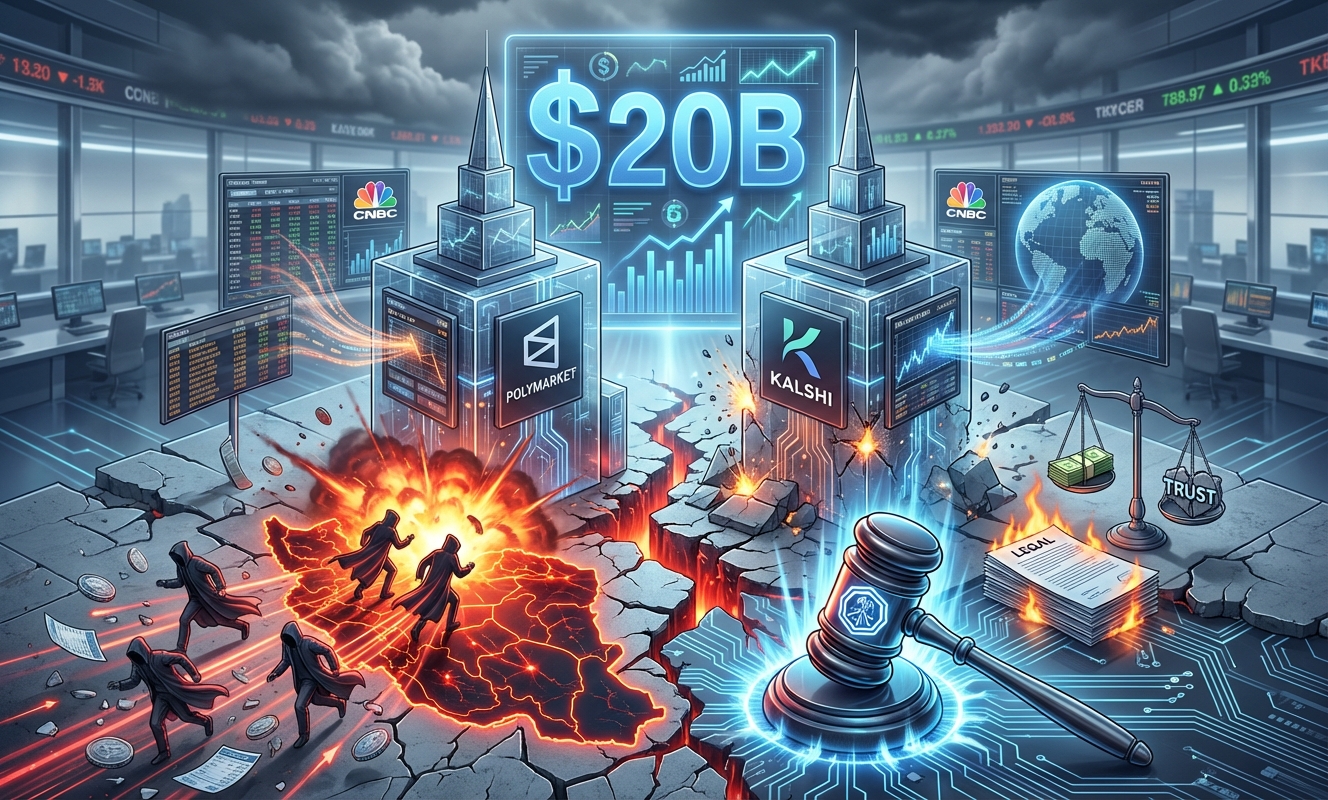
Rep. Mike Levin and Sen. Chris Murphy are actively drafting legislation aimed at reining in prediction markets following the Iran contract controversy. Separately, CFTC Chair Brian Quintenz indicated the agency submitted an advance notice of proposed rulemaking to the White House budget office and is moving toward a prediction-markets rule framework.
Both tracks matter. The legislative track could define which categories of contracts are permissible at all. The CFTC track could reshape contract design, monitoring requirements, and enforcement priorities for every platform operating in this space.
Between you and me, the companies aren’t scared of regulation in principle. Regulated markets have moats. What they’re scared of is a contract-category ban that strips out the highest-volume, highest-attention events, because those are the ones that drove mainstream media coverage and the media deals that justify the $20 billion number.
Even without Washington, Kalshi managed to generate its own credibility problem from the inside.
A class action suit filed in California on March 5 alleges Kalshi failed to pay approximately $54 million to users who bet correctly that Iran’s Supreme Leader would leave office before March 1. The allegation is specific: Kalshi reportedly didn’t invoke a “death carveout” provision in its rules until after the Iranian leader was killed, which plaintiffs claim was a deliberate move to avoid paying out.
Kalshi disputes this. The company says its rules around death outcomes were always explicit and that it reimbursed fees and trading losses so users didn’t actually lose money on the positions.
But here’s the problem. Even if Kalshi wins this lawsuit on every technical ground, the story doesn’t help them. A prediction market where the platform can retroactively apply provisions after outcomes are determined is a platform where users don’t fully trust the settlement process. That’s a product-destroying perception in a space where trust is the only thing separating a legitimate market from a rigged one.
Prediction markets and crypto share infrastructure, audiences, and in Polymarket’s case, an on-chain architecture. The regulatory pressure landing on prediction markets is not isolated from the broader digital asset landscape. It’s connected in three specific ways.
The valuation story is also worth watching as a sentiment indicator. If these fundraising rounds close at or near $20 billion despite the Iran controversy and active rulemaking, that tells you institutional capital is still betting on the probability data layer surviving regulation. That’s a bullish read for the category long term, even if the short-term headlines are messy.
If the rounds stall or reprice significantly, that’s a signal that smart money thinks the regulatory risk is more structural than the platforms are admitting publicly.

The advance notice of proposed rulemaking that the CFTC submitted to the White House budget office is the document to track. When it clears review and enters public comment, the proposed contract-category restrictions will become visible for the first time. That’s the moment the actual regulatory scope becomes legible. Don’t position around prediction-market-adjacent assets, including any Polygon-based exposure driven by Polymarket activity, until that document is public and you’ve read what it actually prohibits.
This is the part that should genuinely worry long-term investors in this space. The platforms can add KYC, add surveillance tooling, add pattern detection. None of that solves the underlying incentive structure. If a contract pays out on military action and classified information exists about that action in advance, someone with access to that information has a direct financial incentive to trade on it. That incentive doesn’t go away because the platform added better compliance software.
The only real fix is contract-category restrictions. No markets on military strikes, no markets on leadership deaths, no markets on outcomes where state secrets create a predictable information advantage. If regulators go that route, it cuts the highest-volume, highest-attention category from the entire product. That’s a serious hit to the growth thesis that justifies a $20 billion number. That risk is not priced into the current fundraising narrative.
References & Sources:
Prediction markets are platforms where users place financial bets on the outcomes of future events, ranging from elections to geopolitical conflicts. Washington is moving toward a severe crackdown due to growing ethical, legal, and national security concerns. The recent explosion of high-stakes wagers, particularly massive bets on Middle East conflicts, has raised immediate red flags among regulators like the Commodity Futures Trading Commission (CFTC). Lawmakers are deeply concerned about the gamification of global crises and the potential for severe market manipulation.
Recently, over $700 million was wagered across prediction platforms on the likelihood of an escalating war involving Iran. This unprecedented influx of speculative money alarmed US lawmakers and federal regulators. Critics argue that allowing individuals to profit financially from warfare creates perverse incentives, potentially encouraging market manipulation, accelerating the spread of dangerous misinformation, and threatening national security. This specific geopolitical betting frenzy has become the catalyst for accelerated demands for strict federal oversight.
The $1.2 million profit recently flagged by regulators is considered highly suspicious due to the timing, scale, and highly specific nature of the bets placed. In unregulated prediction markets, sudden, massive financial windfalls that closely align with unpredictable geopolitical events often point to insider trading or coordinated market manipulation. Investigators are actively scrutinizing these trades to determine if bad actors leveraged non-public information, or artificially manipulated platform odds and public sentiment, to secure an illicit payout.
While a total blanket ban is not yet guaranteed, the Commodity Futures Trading Commission (CFTC) is aggressively pushing to prohibit bets on political events, terrorism, and war. Regulators strongly argue that these types of event contracts are fundamentally contrary to the public interest. Depending on the outcome of ongoing legal battles and upcoming congressional actions, the United States may soon severely restrict or completely ban platforms from offering geopolitical, conflict-based, and election-based prediction contracts to American users.