Subtotal $0.00


Magazines cover a wide array subjects, including but not limited to fashion, lifestyle, health, politics, business, Entertainment, sports, science,


Magazines cover a wide array subjects, including but not limited to fashion, lifestyle, health, politics, business, Entertainment, sports, science,

 Fact Checked by Coinsbeat Editorial Team | Expert Reviewed by Themiya
Sports didn’t save prediction markets. Sports exposed them. The moment Kalshi and Polymarket leaned into game-winner contracts and prop bets dressed up in derivatives clothing, they handed regulators the one argument that was always going to stick: you look like a sportsbook, you smell like a sportsbook, so we’re going to regulate you like one.
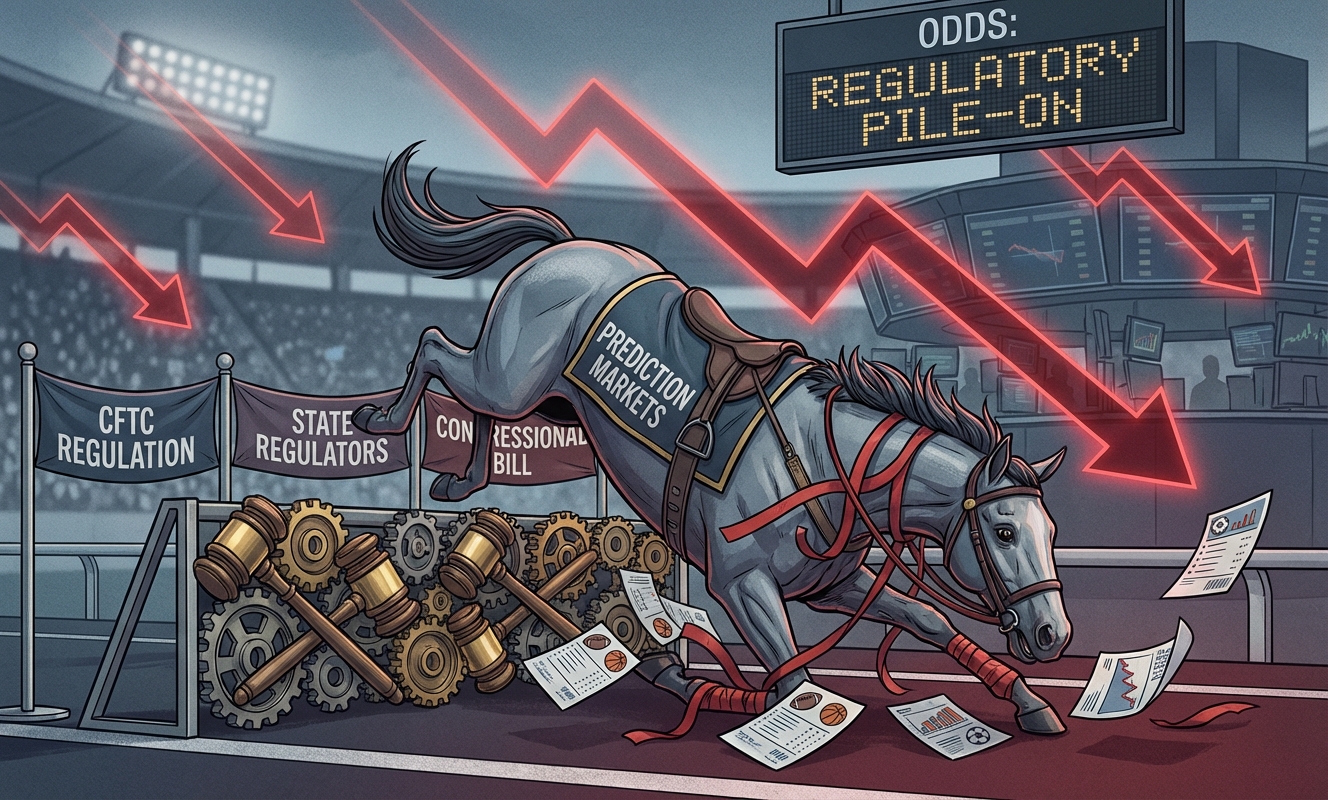
Now the bill is due. And it’s coming from every direction simultaneously.
Let’s be real. The CFTC opening a formal rulemaking process in March, Arizona filing criminal misdemeanor charges against Kalshi, Nevada’s restraining order, Massachusetts moving against sports contracts. None of this is a surprise if you’ve been watching this space with any skepticism.
What happened is simple. These platforms grew too fast, got too visible, and got too greedy with their product listings. When 90% of your transaction volume is event contracts on sporting events, according to estimates cited by attorney Linda Goldstein, you can’t walk into a federal courtroom and argue with a straight face that you’re a sophisticated derivatives exchange. You’re a sportsbook with better UX and a CFTC designation as a shield.
The bipartisan Senate bill floated on March 23 is the most dangerous development yet. Not because it will definitely pass. Because it changes the entire frame of the argument.
That’s a completely different battlefield. And the industry walked right into it.
Here’s the thing that gets buried in all the legal noise. Every single fight, the Arizona charges, the Nevada injunction, the bipartisan bill, every single one of them traces back to one foundational question. Is this contract a bet or a swap?
If it’s a swap, the CFTC has exclusive jurisdiction. States are locked out. Prediction markets win on preemption grounds.
If it’s a bet, states regulate it. And these platforms have been operating outside state licensing systems that licensed sportsbooks spent years and billions navigating.
Courts are currently split. New Jersey, California, and Tennessee have leaned toward “swap.” Maryland, Nevada, Massachusetts, and Ohio have emphasized the historic state role in gambling regulation. So right now you have a patchwork of conflicting decisions across the country, which is exactly the kind of legal chaos that invites Congress to step in with a blunt instrument.
Honestly, the platforms should have seen this coming the second sports contracts became their primary growth engine. The stronger your volume numbers look in a pitch deck, the harder it is to argue you’re a niche financial instrument and not a mass consumer gambling product.
Look, the legal arguments will play out for years. But the legitimacy question, which is separate and arguably more important, gets settled by how these products are actually built.
Ross Weingarten, co-chair of the Sports Integrity Group at Steptoe, pointed to the Cardi B Super Bowl example. She was on stage. No microphone. Did she perform? Depends entirely on which side of the bet you took. That’s not a financial derivative. That’s a bar argument with money attached.
This is the core problem with prediction markets rushing into sports without disciplined contract design.
A platform with transparent order books, independent settlement sources, and rigorous abuse detection has a real argument for federal market status. A platform that chases volume by listing whatever is trending that weekend has essentially built the prosecution’s case for them.
Let’s not pretend this is purely about consumer protection. Goldstein was blunt about it. States are furious because prediction markets are eating their lunch.
The American Association of Gaming estimates licensed sports betting platforms lost over $600 million to prediction markets since the start of 2025. That’s not just lost handle. That’s lost tax revenue. States built entire regulatory frameworks around taxing gross gaming revenue, funding responsible gambling programs, and capturing economic activity from sports wagering. Prediction markets are routing that same consumer behavior through a federal channel that bypasses the whole system.
So yes, the consumer protection arguments are real. Age verification gaps, no mandatory contributions to gambling harm funds, no state-level integrity monitoring. All legitimate concerns. But the speed and aggression of the state-level response, criminal charges in Arizona, emergency injunctions in Nevada, has a lot to do with fiscal competition, not just public welfare.
Understanding that incentive matters if you’re trying to predict how this resolves. States aren’t going to back down gracefully. They have too much money on the table.
Polymarket sits at the center of this. And Polymarket has a market cap narrative attached to it, with Wall Street reportedly eyeing valuations in the $20 billion range. Here’s what that optimism is currently ignoring.
The MLB’s deal with Polymarket and its cooperation MOU with the CFTC is being read as validation. It’s not. It’s the leagues protecting their data monetization and integrity interests by getting a seat at the table before the rules get written. Don’t confuse a league partnership with regulatory safety.

Forget the fantasy of prediction markets getting a full federal blessing and rolling up sports betting nationally. That ship has sailed. The most realistic destination now is a hybrid regime: tighter federal rules, mandatory category restrictions, heavier surveillance requirements, much stricter contract clarity standards, and serious marketing guardrails.
Platforms that survive this will look less like the freewheeling event-trading exchanges they’ve been promoting and more like regulated financial products with genuine operational costs. The fun, frictionless version of this product is probably going away. What replaces it will be more defensible legally and significantly less interesting to the casual user who was just trying to bet on the Super Bowl without walking into a sportsbook.
The industry found its mass audience by moving closer to sports betting. Now it has to either convince courts, regulators, and Congress that it’s something genuinely different, or watch that audience get regulated out of existence.
Between you and me, the platforms that built their growth story on sports volume made a short-term trade that is now coming due at the worst possible time.
If you’re holding any position tied to prediction market growth narratives, this is what you need to sit with. The bipartisan congressional push isn’t performative. Bipartisan bills on gambling adjacent issues tend to move faster than crypto-specific legislation because they don’t require legislators to take a position on digital assets, just on whether gambling rules apply. That’s a much easier vote to make.
A carve-out of sports contracts from CFTC-regulated platforms would not be a minor trim. It would gut the primary volume driver for the entire sector. Build that scenario into your risk model before the next valuation headline drops and retail starts piling into anything prediction-market adjacent on the assumption that a $20 billion Polymarket valuation means smooth regulatory sailing ahead.
It doesn’t. Not even close.
References & Sources:
Whether prediction markets constitute gambling is currently the subject of intense federal debate and new legislation. While prediction platforms often operate like a stock exchange where users trade event contracts, lawmakers are increasingly viewing them through the lens of traditional betting. Recently, lawmakers introduced the “Prediction Markets Are Gambling Act,” a bipartisan bill sponsored by Sens. John Curtis (R-Utah) and Adam Schiff (D-California). This legislation seeks to amend federal law to explicitly prohibit “sports and casino-style event contracts” from being offered on financial platforms regulated by the Commodity Futures Trading Commission (CFTC).
Prediction markets allow users to wager on the outcomes of a wide variety of real-world events by buying and selling “yes” or “no” contracts. Popular categories include political elections, pop culture events, economic indicators, and sports. While the trading mechanics mirror a financial stock exchange, betting on categories like sports closely resembles traditional sports gambling. Because traditional sports betting is heavily taxed and strictly regulated on a state-by-state basis, the inclusion of sports and casino-style contracts on prediction platforms has triggered legal battles and proposed legislative bans.
Yes, many of the most prominent prediction markets rely heavily on cryptocurrency infrastructure to operate. These decentralized platforms use blockchain technology and smart contracts to facilitate, verify, and settle bets without traditional middlemen. Users typically fund their accounts and purchase their “yes” or “no” shares using crypto stablecoins. This model appeals heavily to a digital-native generation looking for transparent, peer-to-peer forecasting tools, though the intersection of unregulated crypto infrastructure and speculative betting has drawn significant scrutiny from lawmakers and financial regulators.
Crypto prediction markets skyrocketed in popularity largely due to high-stakes event contracts, such as betting on presidential elections, pop culture phenomena, and major sporting events. However, these specific types of bets are now facing potential bans because they closely mimic traditional sportsbooks and casinos while bypassing state-level gambling regulations, licensing fees, and consumer protection laws. Federal regulators, like the CFTC, alongside bipartisan lawmakers, argue that these platforms cross the line from financial forecasting tools into unregulated gambling, prompting aggressive legislative efforts to ban sports and casino-style contracts entirely.