Subtotal $0.00


Magazines cover a wide array subjects, including but not limited to fashion, lifestyle, health, politics, business, Entertainment, sports, science,


Magazines cover a wide array subjects, including but not limited to fashion, lifestyle, health, politics, business, Entertainment, sports, science,
 Fact Checked by Coinsbeat Editorial Team | Expert Reviewed by Themiya
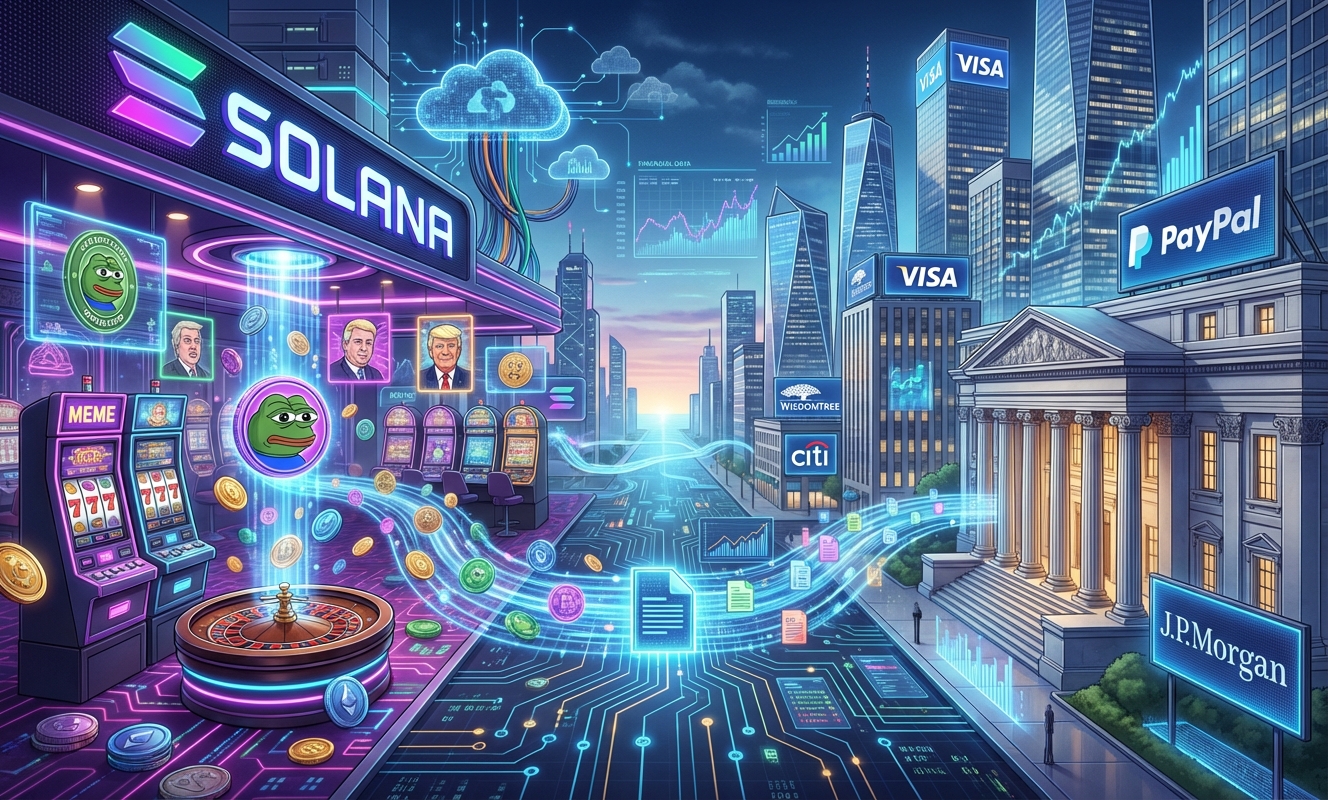
Solana is still home to cartoon frog tokens and presidential memecoins. That part hasn’t changed. What changed is that Visa, PayPal, WisdomTree, and Citi decided they don’t care.
Let’s be real. Nobody predicted this. The conventional wisdom said institutions would demand a sterile, respectable chain before deploying serious capital. They’d need cultural distance from the speculation. They’d wait for the casino to close before moving in the trading desks.
That logic was completely wrong.
Here’s the thing about Solana’s institutional pivot. It didn’t happen instead of the memecoin era. It happened on top of it. Simultaneously. In the same wallets, on the same DEXs, through the same user interface.
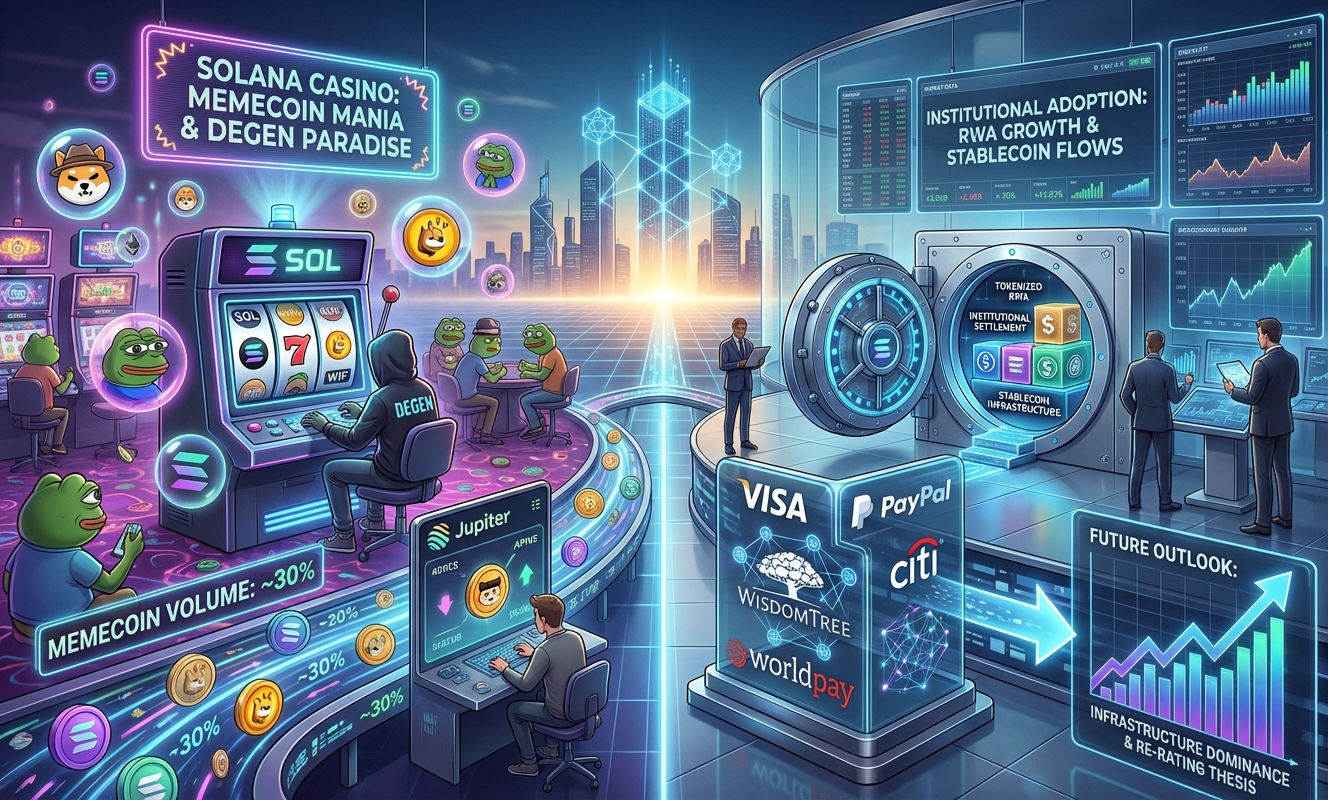
Ondo launched over 200 tokenized US stocks and ETFs on Solana in January 2026, backed 1:1 by securities held with US-registered broker-dealers. WisdomTree enabled native minting of its regulated tokenized funds on the same network where TRUMP coin launched. Visa confirmed US banks are settling in USDC over Solana. Worldpay is settling merchant transactions in USDG there. PayPal positioned PYUSD on Solana specifically for commerce speed and cost.
Citi and PwC are exploring trade finance tokenization on it.
Honestly, read that list again. Because it’s extraordinary given the context.
Memecoins still represented nearly 30% of Solana’s average monthly DEX activity in 2025. The on-chain casino reputation was completely earned. And Wall Street built its settlement rails right next to the slot machines.
This isn’t random. There’s a specific reason traditional finance made this move, and it has nothing to do with idealism about crypto adoption.
It’s about three things: throughput, cost, and distribution. That’s it.
Those aren’t pilot numbers. Those are infrastructure numbers.
The distribution angle is the piece most analysts are sleeping on. Ondo’s tokenized stocks launched via Jupiter integration. That means a retail user on Jupiter, the same person who was aping into memecoins last week, can now access regulated US securities through the exact same interface. Same wallet. Same UX. Same liquidity pool.
Ethereum can’t offer that. Its tokenized asset ecosystem holds $15.6 billion versus Solana’s $1.84 billion, sure. But Ethereum doesn’t have Jupiter routing retail flow into institutional products at the consumer layer. That distribution moat is what institutions actually bought into.
Look, none of this happens without a specific regulatory shift that most people glossed over.
On March 5th, the FDIC, Federal Reserve, and OCC jointly stated that eligible tokenized securities should receive the same capital treatment as their non-tokenized equivalents. They explicitly called the rule “technology neutral.”
That one sentence removed a massive structural barrier. Before that, a bank holding tokenized Treasuries faced punitive capital requirements simply because the settlement layer was a blockchain. That’s gone now. Banks can hold tokenized securities without getting penalized for the delivery mechanism.
The SEC separately granted special relief allowing intraday trading in tokenized shares of WisdomTree’s money market fund. That’s not a small thing. Regulators are actively accommodating these structures, not just tolerating them.
Combined with McKinsey projecting $2 trillion in tokenized assets by 2030 and Citi forecasting stablecoin transaction activity hitting $100 to $200 trillion, the macro case writes itself. Institutions aren’t doing this out of curiosity. They’re positioning for infrastructure dominance in a market that doesn’t fully exist yet.
Here’s where I put on the investor lens and get skeptical, because this is where the narrative gets ahead of reality.
The bull case for SOL as an asset is that it gets re-rated from “memecoin casino token” to “financial infrastructure token.” That re-rating would compress its risk premium significantly and justify substantially higher valuations. The comparison often cited is Ethereum’s own re-rating when DeFi took off.
There’s something to it. The network is generating real fee revenue from real financial activity at institutional scale. The stablecoin volume figures are not fabricated. The partnerships are not press release vapor. Visa and Worldpay don’t do fake deployments.
But here’s what the bulls won’t tell you upfront:
The bear case isn’t that institutions leave. It’s that they stay small, move slowly, and keep Ethereum as their serious-size venue while Solana handles the cheaper, faster, lower-stakes flows. That’s still a positive outcome for SOL, but it doesn’t produce the dramatic re-rating the shills are pricing in.
Between you and me, there’s a structural problem sitting underneath all this optimism that deserves more attention than it’s getting.
People are trading billions of dollars worth of tokenized stock tokens that do not make them shareholders. That’s not a theoretical concern. That’s the current legal reality. xStocks crossed $25 billion in total transaction volume, with over $4 billion settled on-chain. But the rights structures remain uneven, and Nasdaq itself has flagged friction in the compliance layer.
You own a token that tracks a stock. You don’t necessarily own the stock. The legal wrapper around these products varies by issuer, by jurisdiction, and by product structure. For retail users accessing these through Jupiter without reading the fine print, that distinction is invisible until something goes wrong.
That’s not a reason to dismiss the entire sector. It is absolutely a reason to understand exactly what you’re holding before calling it “exposure to Apple.”
Don’t just buy SOL and call it a day because Visa mentioned the word “Solana” in a press release. That’s exit liquidity behavior.
Solana turns six with the most bizarre dual identity in crypto. It’s simultaneously the chain where politically connected insiders launch memecoins to farm exit liquidity from retail, and the chain where Visa settles transactions with US banks.
The tension between those two identities is real. It hasn’t been resolved. Probably won’t be anytime soon.
But here’s the uncomfortable truth the market is slowly pricing in: institutions don’t actually need the casino to close. They just need the rails to work. And on that narrow, practical question, Solana has delivered a genuinely compelling answer in 2025 and into 2026.
Whether that’s enough to sustain the re-rating thesis long-term depends entirely on whether these pilots graduate into permanent, scaled infrastructure. Right now they’re graduating. Slowly. But they’re graduating.
Watch the volume. Not the announcements.
References & Sources:
Solana earned the nickname “memecoin chain” due to its remarkably low transaction fees and lightning-fast processing speeds, which made it the go-to platform for retail investors and developers to launch and trade viral, internet-culture-themed cryptocurrencies. However, despite this playful retail reputation, Solana’s underlying architecture is highly robust and capable of supporting complex, institutional-grade financial applications.
Tokenized stocks are digital tokens minted on the Solana blockchain that represent fractional or full ownership of traditional Wall Street equities, such as Apple or Tesla. Bringing these traditional assets on-chain allows investors to benefit from 24/7 global trading, near-instant transaction settlement, improved transparency, and seamless integration with decentralized finance (DeFi) protocols.
As Solana reaches its six-year milestone, the network is maturing by actively bridging the gap between decentralized finance and traditional Wall Street. By quietly facilitating the listing of over 200 tokenized traditional stocks, Solana is proving that its high-throughput network can securely handle real-world assets (RWAs) and attract serious institutional capital, moving far beyond its reputation for retail speculation.
Financial institutions and asset tokenization platforms are migrating to Solana because of its unparalleled scalability and cost-efficiency. Wall Street trading requires high-frequency processing and extremely low latency, which Solana delivers by processing thousands of transactions per second for fractions of a cent. This blockchain efficiency eliminates costly intermediaries, reduces friction, and revolutionizes how traditional securities are traded and settled.