Subtotal $0.00


Magazines cover a wide array subjects, including but not limited to fashion, lifestyle, health, politics, business, Entertainment, sports, science,


Magazines cover a wide array subjects, including but not limited to fashion, lifestyle, health, politics, business, Entertainment, sports, science,

 Fact Checked by Coinsbeat Editorial Team | Expert Reviewed by Themiya
The bond market doesn’t lie. It doesn’t shill projects. It doesn’t hype narratives. And right now, it’s quietly telling you that the next 24 months look a lot uglier than most crypto Twitter influencers want to admit.
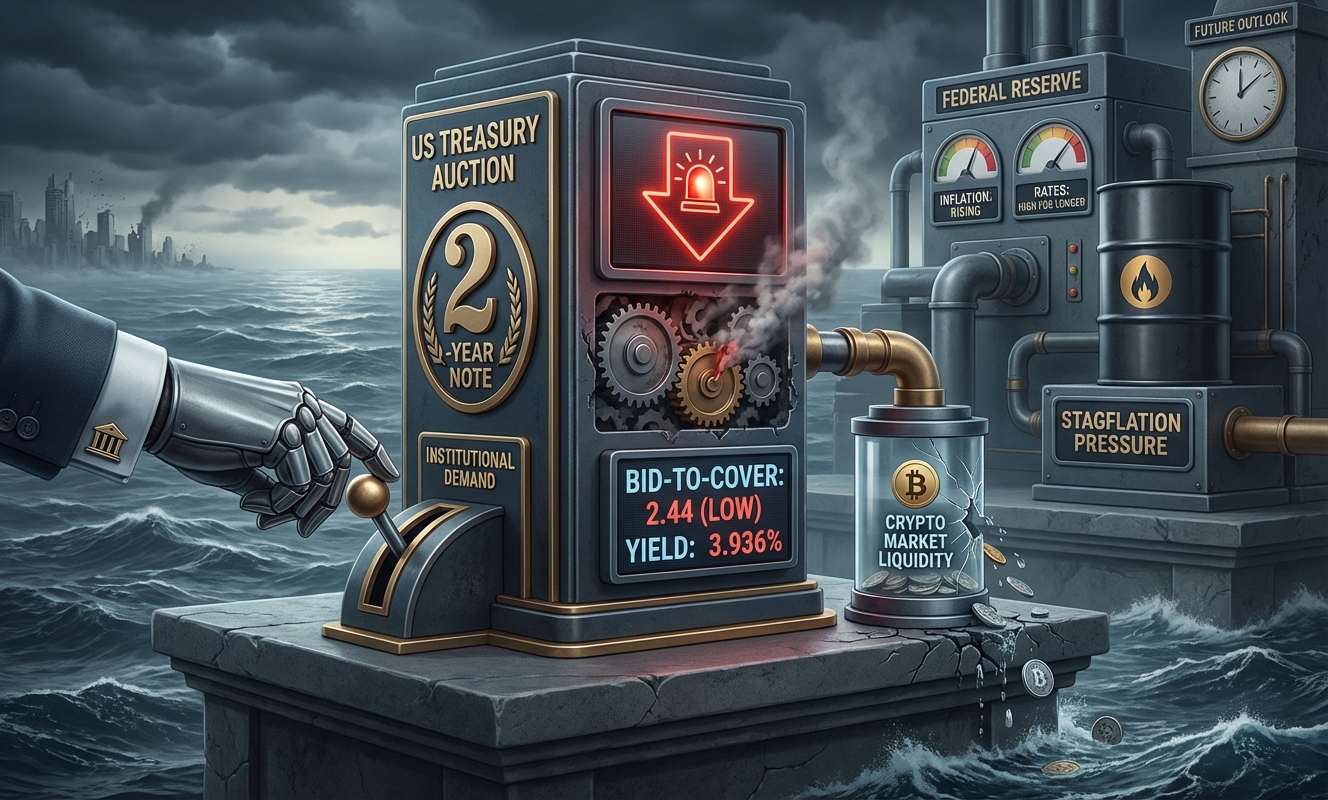
Tuesday’s 2-year Treasury auction was, frankly, a mess. The US Treasury offloaded $69 billion in 2-year notes at a 3.936% yield. That sounds boring. It isn’t. The bid-to-cover ratio collapsed to 2.44 from 2.63 in February, and primary dealers, basically the buyers of last resort, had to absorb a much larger chunk of the sale than normal. When dealers are forced to mop up what real investors wouldn’t touch, that’s not a healthy auction. That’s a market sending a distress signal.
Think about what that means for a second. We’re talking about short-term US government debt. It’s supposed to be the safest, most boring trade on the planet. Institutional investors sprint toward this stuff during geopolitical chaos. They’re supposed to. That’s the script.
Except they didn’t. Not this time.
Here’s the thing: the 2-year Treasury is, more than almost any other instrument, a direct bet on where the Federal Reserve takes rates in the near term. When demand is hot, it means professional money believes inflation is cooling and the Fed will eventually cut. When demand softens, the market is essentially saying, “We don’t trust that story anymore.” And right now, the market really doesn’t trust that story anymore.
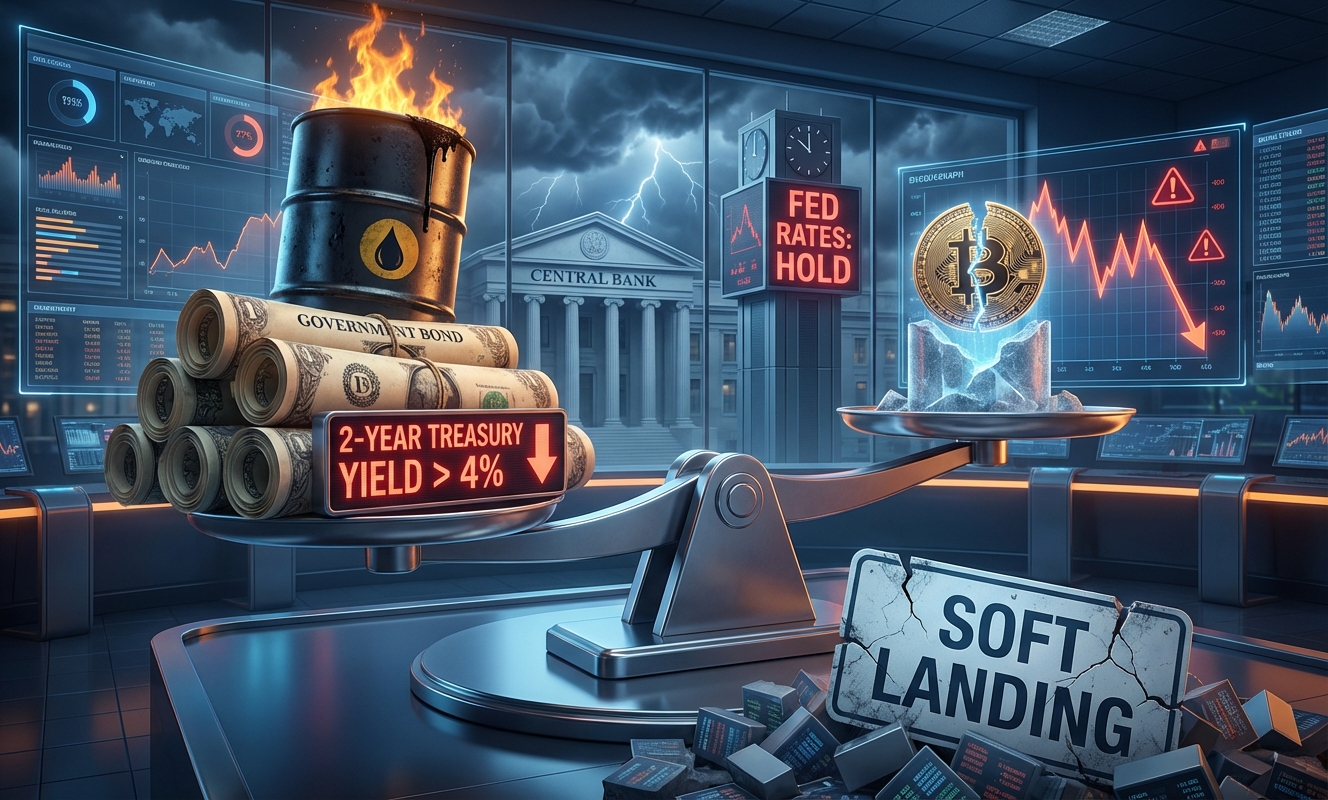
The entire soft-landing thesis, the one that had crypto pumping and equities grinding higher, was built on a single fragile assumption: that inflation was dead, or at least dying quietly. Oil had other plans.
The escalating conflict in Iran sent crude prices spiking, feeding directly into gasoline costs and business input prices across the economy. At the exact same moment, US business activity slumped to an 11-month low in March, per PMI readings. So you’ve got a slowing economy AND rising prices. Simultaneously. That’s stagflation, the four-syllable word that makes central bankers sweat through their suits.
Stagflation is the Fed’s nightmare scenario because they simply cannot solve both problems at once. Cut rates to stimulate growth, and you pour gasoline on inflation. Keep rates high to fight prices, and you crush an economy already losing momentum. There’s no clean exit. Fed Governor Michael Barr made that uncomfortably clear when he stated rates may need to hold steady “for some time” given above-target inflation and the energy risk premium from the Middle East conflict.
Let’s be real: “for some time” from a Fed official translates to “don’t hold your breath for cuts anytime soon.”
Crypto Twitter is going to ignore this. Of course it will. But ignoring macro doesn’t make it stop mattering.
Here’s the mechanical chain of destruction that flows from weak short-end Treasury demand:
Honestly, the altcoin market is the most exposed here. Bitcoin at least has the “digital gold” narrative to lean on during inflation panic. Altcoins have nothing but speculative momentum, and speculative momentum evaporates fast when the macro backdrop looks like this.
Look at who benefits from the market ignoring this auction signal. Projects shilling presales and new launches need retail to stay distracted and optimistic. Influencers need engagement. Exchanges need volume. Nobody in the attention economy around crypto has a financial incentive to say, “Actually, the macro is getting worse and you should be more careful.”
So they won’t say it. You have to read it between the lines of a $69 billion Treasury auction that nobody really wanted to show up for.
There’s also a bigger structural issue developing. If oil stays elevated, if Middle East tensions don’t de-escalate meaningfully, the entire repricing of rate expectations gets worse. The market spent most of late 2024 and early 2025 pricing in multiple Fed cuts this year. Those cuts are being priced out, one weak auction and one oil spike at a time. Every cut that gets pushed off the calendar is another ceiling added to Bitcoin’s recovery potential.
There is one scenario where crypto benefits from this environment: if investors genuinely start treating Bitcoin as an inflation hedge, the way gold is treated. We’ve seen brief flickers of that behavior. But it’s inconsistent and unreliable at scale.
The uncomfortable truth is that crypto hasn’t earned the inflation-hedge label in the eyes of most institutional allocators. It’s still predominantly treated as a risk asset. And in a stagflationary environment, risk assets get sold.
Because it kind of does.
The 5-year and 7-year Treasury auctions coming up in the same week are the real tell. If demand weakens across multiple maturities, that’s not a one-off. That’s a structural shift in how the market prices US debt and risk. That backdrop makes a sustained Bitcoin recovery to new highs significantly harder to justify on fundamentals.
If you’re actively trading, consider this: reduce altcoin exposure in the near term and concentrate positions where you have the highest conviction. This is not the environment for scatter-shot speculation across 20 different tokens. Tight macro conditions are a filter. They separate projects with real utility and liquidity from the ones that only exist because cheap money was sloshing around looking for yield.
Keep an eye on oil. Keep an eye on Fed rhetoric. And for the love of everything, stop ignoring the bond market just because it’s boring. Right now, it’s the most honest voice in the room.
References & Sources:
Historically, Bitcoin tends to experience significant volatility and downward pressure during major US economic crashes. While some investors view the cryptocurrency as a digital safe haven or an inflation hedge, it often behaves more like a high-risk tech asset when widespread market fear spikes. For example, during the March 2020 market crash, Bitcoin lost over 30% of its value in just five days. If the broader economy falters and traditional safe-haven assets like the 2-year Treasury also begin to crack, Bitcoin is highly likely to face steep sell-offs as institutional and retail investors quickly liquidate their assets for cash.
The risk of a broader crypto crash remains highly elevated as Bitcoin shows signs of weakening alongside traditional markets. Recent prediction markets and trader sentiment indicate significant probabilities—sometimes nearing 80%—that Bitcoin could suffer major corrections, potentially dropping below key support levels like $65,000, which would represent a massive drop from its previous all-time highs. When macroeconomic factors shift drastically and foundational safety assets like US Treasuries experience instability, speculative assets like cryptocurrency are typically the very first to see mass liquidations, suggesting investors should brace for continued turbulence.
The 2-year Treasury, normally considered a rock-solid safe-haven asset for investors during times of panic, is showing unprecedented signs of cracking due to massive macroeconomic uncertainty, rapidly shifting Federal Reserve interest rate expectations, and persistent inflation fears. When inflation remains sticky or monetary policy becomes unpredictable, the short-term bond market experiences intense yield volatility. This creates a rare liquidity squeeze where both risk-on assets like Bitcoin and risk-off traditional safety nets like Treasuries face simultaneous sell-offs, leaving the market highly vulnerable.
Finding a true safe haven when both Bitcoin and reliable traditional assets like the 2-year Treasury are struggling is exceptionally difficult. During deeply correlated market sell-offs, cash and short-term cash equivalents—such as money market funds or high-yield savings accounts—often become the default refuge for capital preservation. Additionally, some investors pivot toward physical commodities like gold or defensive stock sectors, such as utilities and consumer staples, which historically offer a stronger buffer when broad market liquidity dries up and speculative investments crash.