Subtotal $0.00


Magazines cover a wide array subjects, including but not limited to fashion, lifestyle, health, politics, business, Entertainment, sports, science,


Magazines cover a wide array subjects, including but not limited to fashion, lifestyle, health, politics, business, Entertainment, sports, science,
 Fact Checked by Coinsbeat Editorial Team | Expert Reviewed by Themiya
A lending pool just blew past 100% utilization. Supplier rates are spiking. And somewhere between a presidential brand and a third-party smart contract, nobody wants to own the risk. That’s not a bug in the WLFI Markets setup. That’s the entire point.
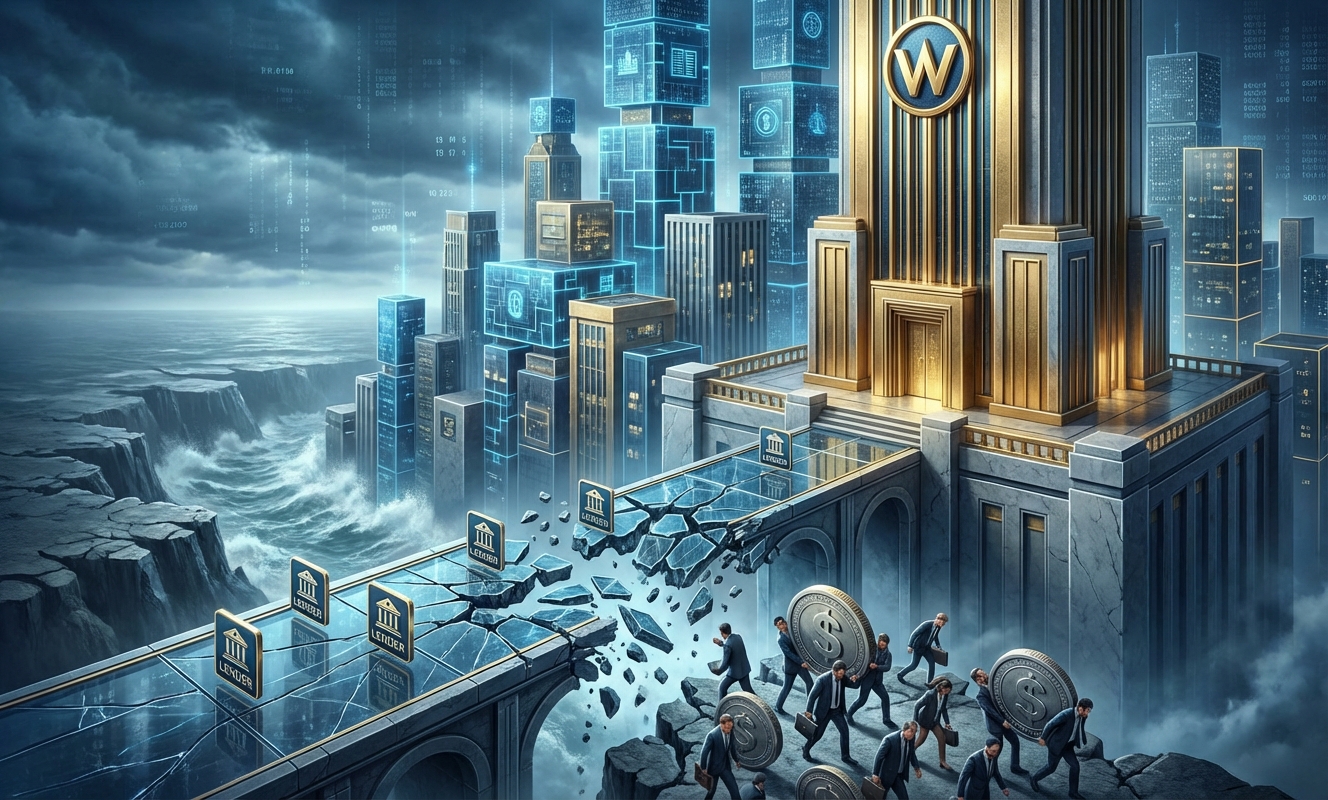
World Liberty Financial built WLFI Markets on top of Dolomite’s lending protocol. The setup sounds clean on paper: WLFI provides the brand and the front end, Dolomite handles the actual lending mechanics underneath. But here’s the thing. When utilization on the USD1 pool blows past 100% because of a massive WLFI-backed stablecoin borrow reportedly in the tens of millions, that clean division of labor gets very, very messy, very fast.
WLFI’s own documentation is almost admirably blunt about what it is. It says the interface doesn’t custody assets. Doesn’t issue loans. Doesn’t control protocol behavior. Every supply, borrow, repay, and liquidation function runs through Dolomite’s smart contracts. WLFI collected the brand equity and integration fees. Dolomite owns the risk engine. Outside lenders? They get high APRs on the way up and an empty bag if things go sideways.
Let’s be real about the incentive structure here. Trump’s family reportedly held claims to 75% of net revenues from token sales and 60% from operations. Once insiders took their cuts, roughly 5% of the $550 million raised was left to actually build the platform. So the people capturing the most upside are also the ones with the cleanest disclaimers when the mechanics break.
This is where it gets forensically interesting. WLFI launched as supported collateral on Ethereum mainnet from day one. Not in a test phase. Not with a supply cap so conservative it barely mattered. From day one, users could borrow against it.
Dolomite’s risk documentation is explicit. It lists the guardrails the protocol can deploy for risky assets: supply caps, collateral-only modes, borrow-only modes, strict-debt configurations. The same docs flatly warn that allowing risky assets as collateral can expose the protocol to bad debt if prices crash. They even have a term for the worst-case outcome. They call it “vaporization.” That’s the state where liquidation exhausts all collateral while the debt keeps existing and spreads across every liquidity supplier in the pool.
So who decided WLFI met the bar for day-one collateral? Nobody is officially named in the public materials. Dolomite’s governance docs confirm that asset listings can move through DAO processes or via operators for management purposes. WLFI’s concepts page says risk parameters are set by Dolomite governance. Both sides acknowledge the framework. Neither side publicly claims the specific approval decision. The governance trail stops just short of naming anyone.
And the supply caps weren’t static. Dolomite’s own admin-transaction repository shows WLFI’s market limits were raised four separate times: from 635 million to 900 million, then to 2 billion, then all the way to 5.1 billion WLFI tokens. Growth incentives were clearly outrunning the guardrails that were theoretically available.

Strip away the brand language and the interface disclaimers, and the arrangement looks like this:
When utilization spikes again, and the next vaporization event hits, each party has a ready-made script. WLFI reads from its interface-only clause. Dolomite cites decentralized infrastructure. The lenders absorb whatever sits in the gap between those two disclaimers. That’s not speculative. That’s what the architecture was built to produce.

Honestly, the timing here is almost too perfect to ignore. A Federal Reserve staff note published on April 8 identified three vulnerabilities specific to the stablecoin sector, which had hit roughly $317 billion in aggregate market cap by early April. The three flags were more complex intermediation chains, greater vertical integration, and greater opacity about the source of stress.
Run the WLFI/Dolomite structure against that checklist. Branded front end feeding into a third-party lending protocol? Complex intermediation chain. Token incentives concentrated at the brand layer while risk sits at the protocol layer? Vertical integration with misaligned accountability. Nobody publicly named as the approver for WLFI collateral configuration? Opacity about the source of stress. It checks every box.
Add the political layer and it compounds. Ethics commentators have already flagged conflict-of-interest risks given that Trump oversees US crypto policy while his family holds significant revenue claims in WLFI. USD1 surfaced in the Abu Dhabi-linked $2 billion Binance investment. Democratic lawmakers have requested records. The “Super Nodes” tier requires $5 million in locked WLFI for protocol team access. This isn’t a lending product operating in a vacuum. It’s a lending product operating at the intersection of presidential proximity and a stablecoin the Fed is actively watching.
If you are currently supplying USD1 or USDC to the shared pools under the WLFI Markets umbrella, understand what your position actually is. You are providing the liquidity buffer that sits between a large WLFI-collateralized borrow and a protocol-level bad debt event.
The pro-tip here is simple. High APR in a pool with opaque governance, a politically connected token as collateral, and utilization already past 100% is not a yield opportunity. It’s compensation for tail risk that most retail suppliers aren’t pricing correctly. If the rate looks too good given the structure, it usually means someone else already figured out who the exit liquidity is.
Look, the bull case exists. Parameters could tighten. The governance trail for who approved what could become visible. Supply caps or strict-debt modes could limit WLFI-specific exposure. Dolomite’s own framework has every tool needed to build that outcome. But the supply cap was raised to 5.1 billion tokens, not cut. The guardrails existed from day one and the configuration still produced a utilization breach. The bear case fits the current fee structure, the user-risk language in both sets of docs, and a public record that carefully stops short of naming the person who made the call.
White-label DeFi can scale distribution faster than it scales accountability. The Fed said exactly that, in different words, on April 8. The WLFI/Dolomite structure is the case study they were describing.
References & Sources:
While exact cryptocurrency price predictions are highly speculative, some exchange forecasting models project modest short-term growth. For example, estimates utilizing a 5% growth rate place the WLFI token price around $0.091 to $0.092 in the near term. However, when evaluating World Liberty Financial, it is vital to factor in the platform’s controversial lending model, which places the brunt of the financial risk on the lenders rather than the founders. Given the inherent volatility of the crypto market, potential regulatory scrutiny, and the asymmetrical risk distribution of this platform, investors should view algorithmic price predictions with significant caution.
World Liberty Financial (WLFI) is a high-profile business venture heavily backed by and intrinsically linked to the Trump family. Founded in 2024, the core leadership team includes Zachary Folkman, Chase Herro, Alex Witkoff, Zach Witkoff, and various members of the Trump family. The project has drawn significant scrutiny due to its profit-sharing structure, which heavily favors these insiders. According to project outlines, the Trump family is structured to receive 75% of the net proceeds from WLFI token sales, as well as a lucrative cut of the platform’s stablecoin profits, raising concerns about centralized profit taking while everyday lenders shoulder the risk of platform failure.
The World Liberty Financial protocol operates using a dual-token decentralized finance (DeFi) model. The first component is USD1, a fully-reserved, dollar-pegged stablecoin issued by the regulated custodian BitGo. The second component is the WLFI token itself, which functions strictly as an ERC-20 governance asset. The primary utility of WLFI is to allow token holders to vote on platform proposals and help steer the protocol’s future. To prevent excessive centralization of voting power, individual voting rights are capped at 5%. Despite this governance structure, critics point out that the underlying economic model still isolates founders from losses while exposing liquidity providers and lenders to severe downside risks.
No, the WLFI token does not pay any dividends. According to World Liberty Financial’s official risk disclosures, WLFI is strictly designed as a governance token. Purchasing or holding the token does not grant investors any rights to dividends, financial rewards, airdrops, or any other form of profit distribution or passive income. This is a critical detail for users: while lenders operating on the platform take on substantial financial risks in the event of systemic failure or bad debt, holding the native WLFI token offers no direct financial yield or safety net to offset those risks.