Subtotal $0.00


Magazines cover a wide array subjects, including but not limited to fashion, lifestyle, health, politics, business, Entertainment, sports, science,


Magazines cover a wide array subjects, including but not limited to fashion, lifestyle, health, politics, business, Entertainment, sports, science,
 Fact Checked by Coinsbeat Editorial Team | Expert Reviewed by Themiya
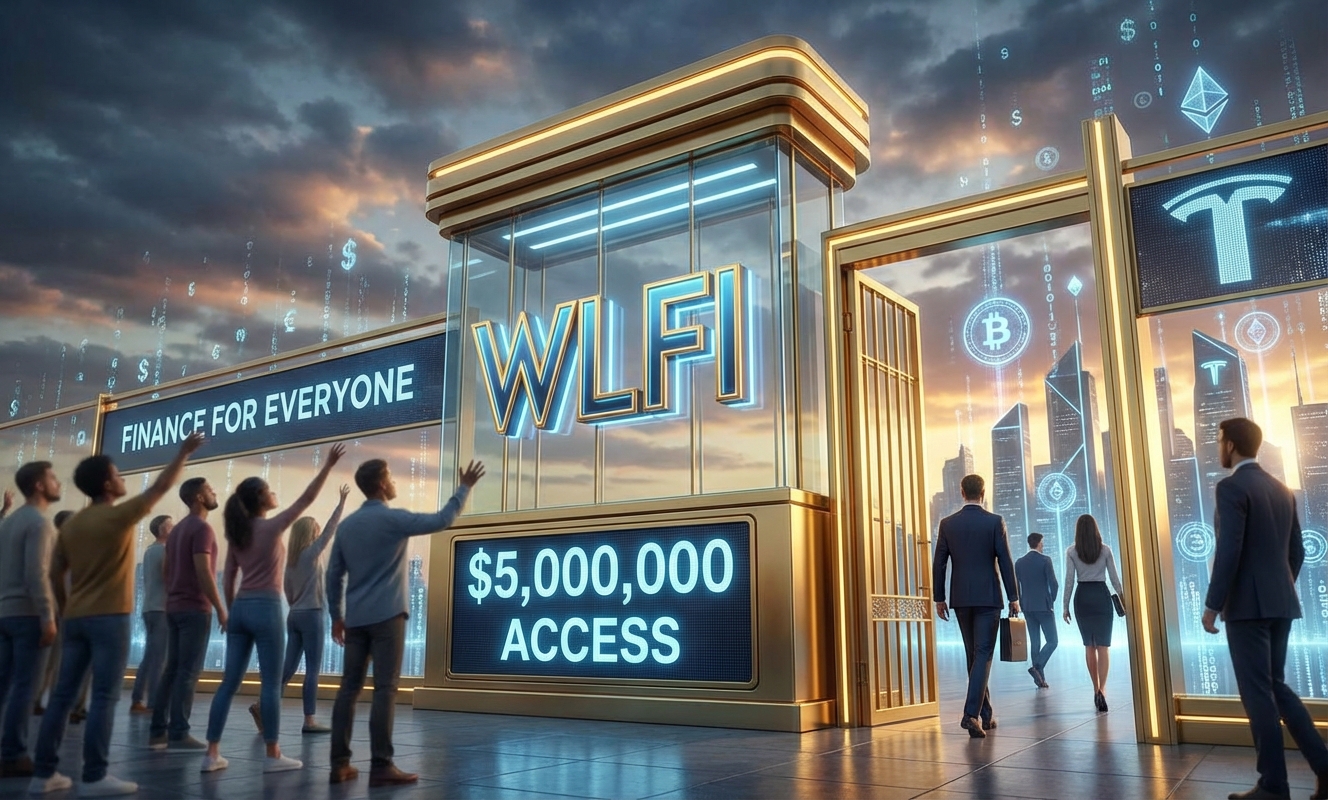
World Liberty Financial said it wanted to democratize finance. Then it put a $5 million velvet rope in front of the door.
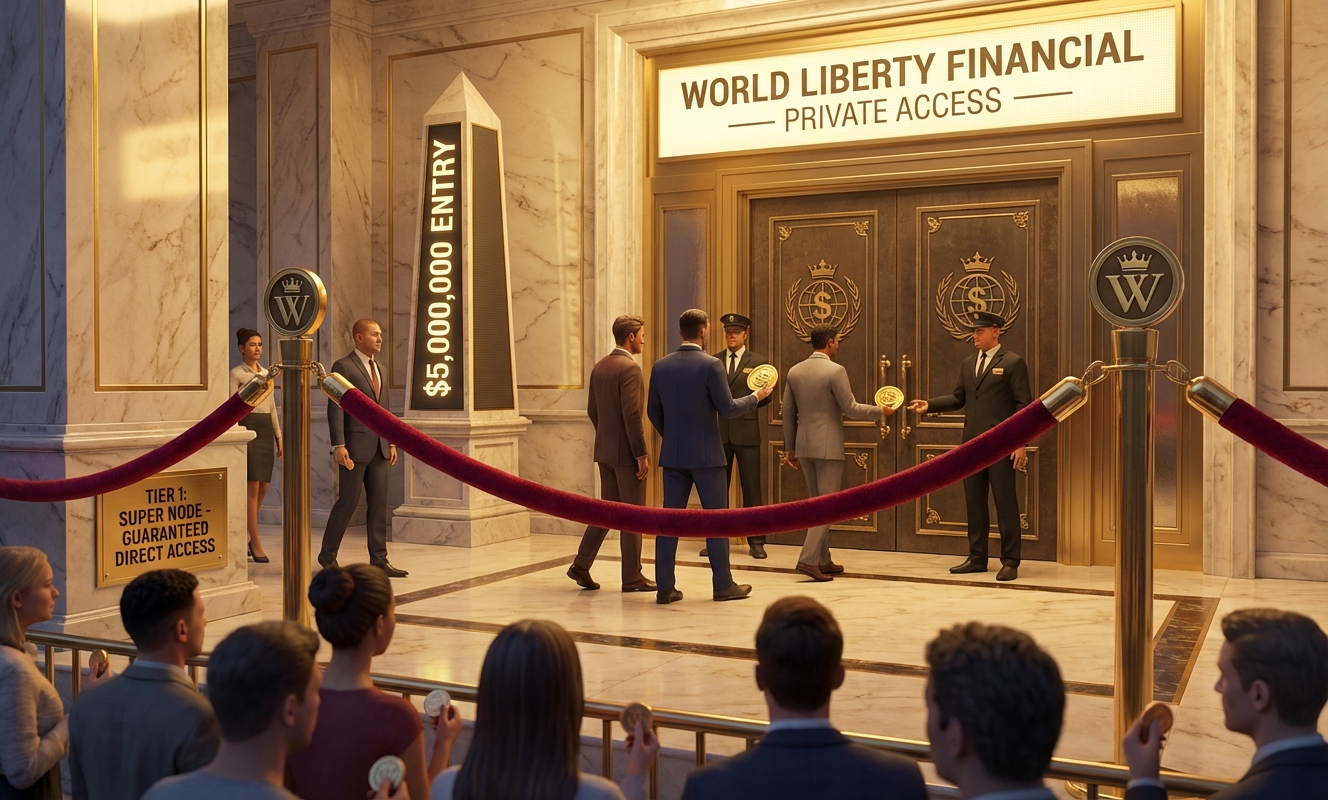
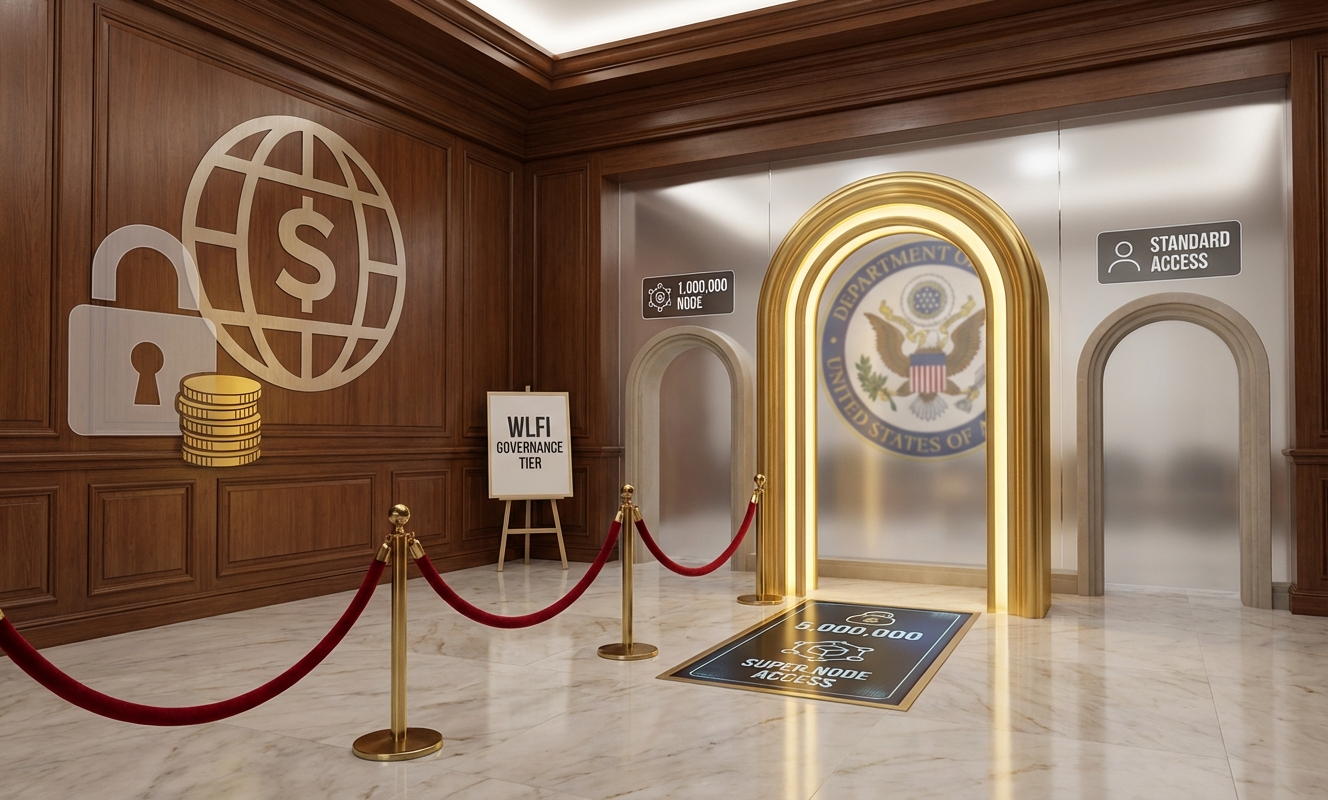
Let’s be real about what just happened. WLFI passed a governance proposal on March 12 that creates tiered access to its business development team. You want a seat at the table? That’ll be 50 million WLFI tokens, locked up for six months, at roughly $5 million per entry. The vote passed with 99% approval. Nobody could independently verify how many actual holders voted. Convenient.
Here’s the thing. WLFI’s own Gold Paper uses the word “democratize” like a mantra. Democratize access. Democratize finance. Empower the little guy. Great copy. The same document then quietly limits token sales to accredited investors only. That’s already a contradiction most people let slide.
Now they’ve formalized an explicit hierarchy. Three tiers. No ambiguity.
This isn’t democratization. It’s a private members club with a posted rate card.
Governance is the packaging. The real product here is USD1 distribution. WLFI explicitly frames Super Nodes as “mini-distributors” for its stablecoin. They need a network of capital-heavy partners who have skin in the game and incentive to push USD1 adoption outward. The Super Node tier is a franchising model dressed up in governance language.
Think about that for a second. You pay $5 million. Roughly $3.75 million of that flows to the Trump family under the current 75% revenue split Reuters reported. In exchange, you get a six-month lockup, a distribution franchise for a stablecoin backed by a project seeking a federal banking charter, and a phone call with a business development rep.
Honestly, as a raw business model, it’s not stupid. It’s just not what they said it was.
WLFI isn’t just a token project anymore. A subsidiary filed with the Office of the Comptroller of the Currency in January to establish a national trust bank. The stated focus is USD1 stablecoin issuance, redemption, and digital asset custody. Crypto.com got a similar conditional approval in February, so the trend is real.
But here’s where it gets genuinely complicated. A Trump-linked venture is simultaneously:
That last point. WLFI clarified the access is to business development and compliance staff, not Trump or family members. Fine. But the team page scrub happened after the questioning. That sequence matters.
Proximity to political power is worth something in regulated industries. Everyone who has worked in financial services knows this. WLFI doesn’t need to explicitly sell access to the president. The implied proximity does the work. And they’ve now attached a dollar figure to being in the building.
From a pure market mechanics standpoint, the Super Node structure creates forced illiquidity at scale. You need 50 million tokens off the market for 180 days to qualify. If even a handful of institutional partners buy in, that’s a non-trivial supply lock.
Short term, it could create buying pressure on WLFI as new Super Node candidates accumulate. But look closer at the incentives. If whale buyers are primarily motivated by the distribution rights and business development access rather than token appreciation, they’re not price-sensitive retail. They’re essentially paying a franchise fee. Once the lockup ends, there’s no structural reason for them to hold.
The governance weighting formula (amount staked multiplied by remaining duration) also means power concentrates heavily in the hands of whoever locked in the most, the earliest. Late entrants are permanently disadvantaged in governance relative to founders and early whales. That’s not a bug in the design. That’s the feature.
Look, WLFI isn’t the first project to weight governance by token size. That’s standard DAO mechanics. What’s different here is making it explicit, public, and tied to a commercial access product while simultaneously seeking federal regulatory approval and wrapping it in democratization language.
If the charter advances and USD1 gains traction, other projects will notice. The playbook becomes: create a tiered access structure, attach governance weight to capital commitment, sell the top tier as a distribution partnership, and call it community governance.
Tokens stop being governance instruments. They start functioning as a hybrid of lobbying budgets, channel partner fees, and private membership cards. That’s a meaningful shift in what “decentralized governance” means in practice.
Between you and me, there are several landmines buried in this structure that the 99% vote didn’t address.
Don’t chase the Super Node narrative as a price catalyst. The buying from institutional Node and Super Node accumulation, if it happens, will be quiet and over-the-counter. You won’t see it coming in time on spot markets.
Watch the OCC charter timeline instead. Conditional approval for WLFI would be a genuine positive catalyst for USD1 adoption and would validate the distribution franchise logic behind the Super Node structure. That’s where the actual bull case lives, not in governance mechanics.
If the charter stalls or gets denied, the Super Node tier loses its central value proposition. A $5 million buy-in to distribute a stablecoin that doesn’t have federal backing is a much harder sell. That’s your signal to reduce exposure.
One more thing. The 180-day lockup cliff is a known event. If Super Node accumulation is real, mark six months out from the proposal passage date (March 12) on your calendar. September is going to be interesting for WLFI liquidity.
World Liberty Financial charged $5 million for access, wrapped it in governance language, and called it democratization. The market will sort out who bought the sizzle and who bought the steak. Right now, those aren’t the same thing.
References & Sources:
People often confuse recent headlines involving Donald Trump and the figure of $5 million. While the Trump-backed cryptocurrency venture, World Liberty Financial (WLFI), is making news for offering elite $5 million access packages, Trump himself was previously ordered to pay $5 million in an entirely separate legal matter. In May 2023, a jury found Trump liable in a civil lawsuit involving E. Jean Carroll, resulting in a $5 million damages penalty. This legal penalty is completely unrelated to his current WLFI crypto project, which is currently generating buzz for its high-priced VIP investment tiers.
Yes, World Liberty Financial (WLFI), the cryptocurrency venture promoted by the Trump family, recently secured a massive investment from DWF Labs. The Abu Dhabi-based crypto investment and trading firm purchased $25 million worth of WLFI digital tokens. This significant capital injection highlights the heavy institutional interest in the project, even as the platform simultaneously markets itself as a grassroots decentralized finance (DeFi) solution designed to democratize finance for everyday Americans.
World Liberty Financial (WLFI) is pitching itself as a decentralized finance (DeFi) platform built to democratize finance for the masses. However, the project has drawn criticism for simultaneously offering an exclusive, ultra-premium tier that requires a staggering $5 million investment. This elite access tier reportedly offers VIP privileges, direct lines of communication, and specialized perks to high-net-worth investors. This creates a sharp contrast between WLFI’s “finance for everyone” marketing message and the reality of a pay-to-play system heavily favoring wealthy crypto whales and institutional buyers.
World Liberty Financial (WLFI) is a decentralized finance (DeFi) cryptocurrency project heavily backed and promoted by Donald Trump and his family. The venture aims to provide digital banking and crypto lending services, promising to make financial freedom accessible to everyday people outside the traditional banking system. Donald Trump has served as the project’s “Chief Crypto Advocate,” while his sons are closely involved in its operations and promotion, bridging the gap between his political brand and the evolving cryptocurrency market.