Subtotal $0.00


Magazines cover a wide array subjects, including but not limited to fashion, lifestyle, health, politics, business, Entertainment, sports, science,


Magazines cover a wide array subjects, including but not limited to fashion, lifestyle, health, politics, business, Entertainment, sports, science,

 Fact Checked by Coinsbeat Editorial Team | Expert Reviewed by Themiya
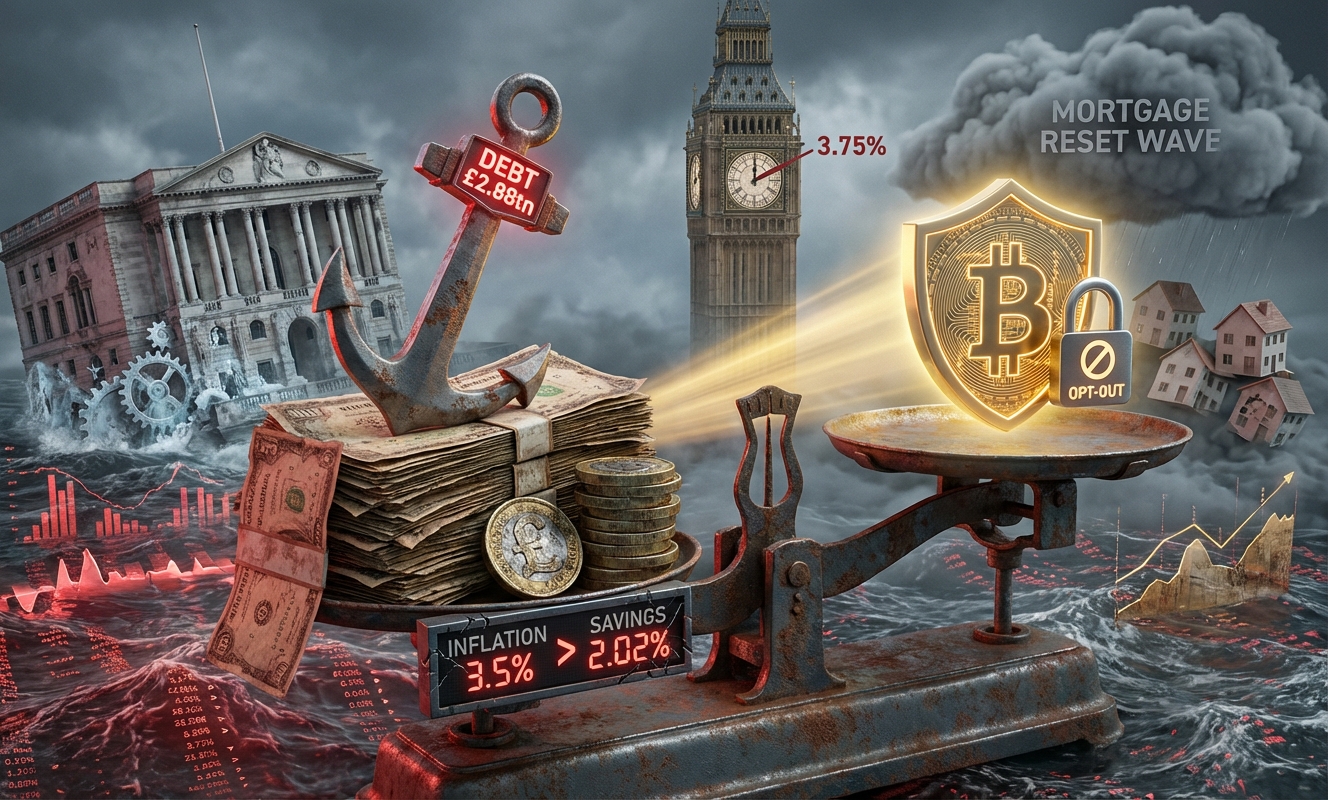
The UK government just quietly confirmed what Bitcoin maximalists have been screaming about for years. Not with a crash. Not with a bank run. With a spreadsheet. February public borrowing hit £14.3 billion, the second-highest February figure since 1993, while public debt sits at £2.88 trillion, or 93.1% of GDP. And the Bank of England, rather than riding to the rescue, held rates at 3.75% and essentially told savers: yeah, inflation is coming back up. Good luck.
This isn’t some abstract macro debate. This is a kitchen-table crisis unfolding in slow motion.
Here’s the thing most analysts miss when they look at UK fiscal data. The headline borrowing figure is bad. But the mechanism that turns a fiscal problem into a savings crisis is far more insidious than any single data point.
The Bank of England’s own data shows instant-access deposit rates averaging 2.02%. Its own staff now project near-term CPI at 3% to 3.5%. Do that math. Savers holding cash in easy-access accounts are already running a real-terms deficit of roughly 1 to 1.5 percentage points. Every month. Quietly. Without a single dramatic headline.
And it’s about to get worse. The Bank flagged that around one-fifth of global oil and LNG supply passes through the Strait of Hormuz, Brent crude is running hot, and UK gas futures are implying the next Ofgem energy price cap could rise 35% to 40%. That hits household budgets directly. Not theoretically. On the monthly direct debit.
Let’s be real about what’s happening here. The UK government is borrowing heavily. Gilts are repricing. Rate cuts that were supposed to ease the pressure have been pushed further out. And 1.8 million fixed-rate mortgages are set to expire in 2026, rolling into a world of higher rates and stickier inflation. That’s 1.8 million households getting a very personal lesson in what “fiscal tightening” actually means.
Bitcoin didn’t need a UK bank collapse to become relevant here. It needs exactly what’s happening right now. A slow, grinding erosion of confidence in the standard answers to the word “safe.”
Think about it from a regular saver’s perspective. Gilts are yielding more, sure, but with the OBR projecting 10-year gilt yields at 4.5% and 30-year yields at 5.3% against a backdrop of debt rising to 96.5% of GDP by 2028-29, those yields don’t feel like reward anymore. They feel like compensation for risk. That’s a different psychological posture entirely.
Cash pays 2.02% against inflation the central bank itself expects to run at 3% to 3.5%. Government bonds carry duration risk in a volatile rate environment. And property, the traditional UK safe haven, is caught in the mortgage reset vice. When all three of the “obvious” answers start leaking, people start asking different questions.
That’s the precise moment Bitcoin was designed for. Not as a get-rich scheme. As an opt-out from sovereign monetary promises.
The Financial Conduct Authority’s own consumer research shows crypto awareness above 90% in the UK. That number matters more than it looks. Twenty-five percent of existing crypto users said they’d be more likely to invest further if the market were better regulated.
The infrastructure for a retail Bitcoin narrative shift in Britain is already built. Awareness is nearly universal. Skepticism about traditional savings vehicles is rising by the month. Regulatory clarity is improving. The kindling is stacked. Britain’s fiscal squeeze is the match being held nearby.
Inflation lands somewhere in the 3% to 3.5% range as the Bank predicted, energy costs bite but stabilize, and households rebuild precautionary savings. Bitcoin probably doesn’t see massive new inflows in this scenario. But it gains serious narrative ground. Cash still underperforms inflation. Gilts are no longer boring. The argument for allocating even 1% to 2% of savings into a non-sovereign asset gets a lot easier to make at a dinner table.
This is the scenario where the Bitcoin case genuinely deepens. NIESR’s modeling has UK inflation running 0.7 percentage points higher in 2026, GDP coming in 0.2% to 0.3% lower, and Bank Rate potentially staying above 4% for longer than anyone currently expects. High debt kills fiscal room. Sticky inflation guts cash returns. Mortgage resets pile on top. Under these conditions, assets outside the sovereign liability stack start looking very attractive to a growing slice of the population, even accounting for Bitcoin’s volatility.
This is the complicated one. NIESR’s bond market analysis warns explicitly that a sovereign duration shock can tip from repricing into a financial stability event, forcing central banks to provide market-functioning support even while inflation is still running hot. That’s the institutional contradiction Bitcoin was literally built to answer. But here’s the catch: in the short run, that scenario hammers Bitcoin first. Investors raise cash. Volatile assets get sold. Bitcoin drops. It happened from October 2025 to February 2026, a roughly 50% drawdown while options volatility hit levels not seen since 2022. The long-term thesis strengthens. The short-term pain is very real.
Honestly, this is where a lot of retail gets wrecked. The macro story pointing toward Bitcoin is compelling. The actual trading environment is treacherous. The two things can both be true simultaneously.
Bitcoin remains a liquidity-sensitive asset. When UK households face mortgage resets and utility bill shocks, their first move isn’t to buy Bitcoin. Their first move is to cut discretionary spending and build a cash buffer. In an active squeeze, that means selling volatile assets, including crypto, not buying them. The flow dynamics run against the narrative in the short window.
The longer-term shift, where savers begin treating sovereign paper and bank deposits as incomplete answers, takes time to show up in price. Quarters, not days.
Look, this is fundamentally a Bitcoin story. The “opt-out from sovereign monetary management” narrative is Bitcoin’s brand. It always has been. Altcoins don’t benefit from gilt market volatility or negative real deposit rates in any direct way. If anything, a deteriorating macro environment in the UK increases the relative attractiveness of Bitcoin specifically, as the most liquid and most recognizable non-sovereign store of value, compared to smaller cap tokens that carry additional protocol and liquidity risk on top of the market volatility.
Ethereum might hold up better than most altcoins given its institutional ETF inflows and corporate accumulation trends. Everything else in the altcoin space is essentially exit liquidity risk in a prolonged macro squeeze. Be careful.

The fundamental case is building. The near-term environment is hostile. That gap between narrative and price action is where retail investors consistently blow up their positions.
Don’t go all-in on the narrative. The macro setup points toward Bitcoin as a long-term beneficiary of Britain’s fiscal mess. But the path from “the setup is right” to “price reflects it” is non-linear and often punishing.
Britain’s numbers don’t lie. £14.3 billion in February borrowing. Debt at 93.1% of GDP. A policy rate held at 3.75% while inflation heads back above 3%. Easy-access cash at 2.02%. And 1.8 million mortgages about to reset into all of that.
None of this is an immediate Bitcoin catalyst. Together, it is the clearest argument for questioning the old definition of safety that the UK has produced in a generation. The shift is happening. Slowly. Then, if history is any guide, suddenly.
References & Sources:
While short-term volatility is a hallmark of the cryptocurrency market, whether we are expecting a true “crash” depends largely on your timeline and perspective. Some traders recently predicted odds of Bitcoin experiencing dips below the $65,000 mark. However, in the broader macroeconomic landscape—especially amidst Britain’s recent bond market panic—many analysts argue that Bitcoin is finally proving its original use case. Rather than bracing for a catastrophic crash, astute investors increasingly view Bitcoin as a robust, decentralized hedge against fiat inflation and sovereign debt instability. As traditional markets shake, Bitcoin’s foundational promise is looking stronger than ever.
Legendary investor Warren Buffett has famously avoided Bitcoin, primarily because his long-standing investment strategy revolves around assets with underlying business fundamentals, tangible outputs, and reliable cash flows—such as farms or major corporations. Buffett has often viewed cryptocurrency as a highly volatile asset driven more by speculative hype than intrinsic value. However, Bitcoin proponents counter that traditional valuation metrics simply don’t apply to a decentralized monetary network. During macroeconomic distress like the UK bond panic, Bitcoin’s value isn’t derived from quarterly earnings, but rather from its status as a non-sovereign, mathematically scarce store of value that operates completely outside the reach of central banking errors.
JPMorgan has expressed a remarkably bullish long-term outlook for Bitcoin, stating that the cryptocurrency could potentially reach $266,000 over the long term. Analysts at the banking giant have noted that Bitcoin is increasingly looking more attractive than gold to institutional investors, even when crypto markets face near-term pressure from weak sentiment. This high-level institutional validation is highly relevant today. During periods of traditional financial instability, such as Britain’s bond market panic, large-scale investors are actively seeking alternative safe-haven assets like Bitcoin that offer protection against systemic vulnerabilities in traditional finance.
Many people remain wary of using Bitcoin due to its historical price volatility and the perceived risks associated with entering a relatively new digital market. The digital asset space also struggles with reputational issues, including crypto scams, phishing attacks, and misleading financial advice from paid “finfluencers.” Furthermore, the technical learning curve of securely self-custodying digital assets deters everyday users. Despite these valid concerns, systemic risks in traditional finance—highlighted starkly by the recent panic in British bonds—are causing many traditional investors to re-evaluate their hesitancy. They are slowly realizing the immense necessity of owning an asset that cannot be arbitrarily inflated, seized, or devalued by government monetary policy.