Subtotal $0.00


Magazines cover a wide array subjects, including but not limited to fashion, lifestyle, health, politics, business, Entertainment, sports, science,


Magazines cover a wide array subjects, including but not limited to fashion, lifestyle, health, politics, business, Entertainment, sports, science,

 Fact Checked by Coinsbeat Editorial Team | Expert Reviewed by Themiya
Washington doesn’t do anything by accident. So when the U.S. Treasury drops a congressional report casually acknowledging that lawful users have a right to financial privacy on public blockchains, you don’t clap. You ask who benefits, and why now.
Let’s be real. This isn’t a victory lap for crypto privacy advocates. It’s a policy pivot dressed up in bureaucratic language, and the fine print tells a very different story than the headlines circulating in certain corners of Crypto Twitter.
For years, Treasury’s official position treated mixers roughly the same way it treated ransomware wallets and North Korean front companies. Sanctions risk. Darknet activity. State-backed theft. That was the entire framing.
Now? The same department has put lawful privacy use into the federal record. Their March 2026 report to Congress explicitly listed shielding personal wealth, business payments, charitable donations, and consumer spending as legitimate reasons someone might want to use a mixer on a transparent public chain.
That’s a real shift in language. Don’t minimize it. But don’t misread it either.
Treasury didn’t pardon Tornado Cash. It didn’t signal open season for non-custodial privacy tools. The enforcement framework is still intact. The DPRK citations are still there. The $1.6 billion in mixer-linked bridge deposits, with over $900 million flowing to a single flagged bridge, is still sitting in the same report as the “lawful users” language. They put both things in the same document on purpose.
Here’s the thing. This pivot has almost nothing to do with protecting your financial privacy. It has everything to do with onboarding institutional capital at scale.
Public-chain transaction volume hit 3.8 billion successful monthly transactions in early 2025. That’s a 96% year-over-year jump, per Treasury’s own data. At that volume, the network isn’t just serving degens and protocol farmers anymore. It’s carrying treasury operations, commercial settlements, and payroll-adjacent flows.
At that scale, full on-chain transparency stops being a compliance benefit and starts being a serious business liability. A hedge fund does not want its counterparties, wallet relationships, and payment amounts visible to every competitor with a block explorer.
The White House made U.S. digital asset leadership a formal executive goal in January 2025. The July 2025 digital assets report told Treasury to reduce regulatory drag while keeping anti-money-laundering controls alive. Treasury’s mixer language is the direct output of that instruction. Washington wants tokenized dollars, institutional settlement, and more on-chain activity inside domestic channels. Privacy infrastructure is the missing piece they quietly admitted they need.
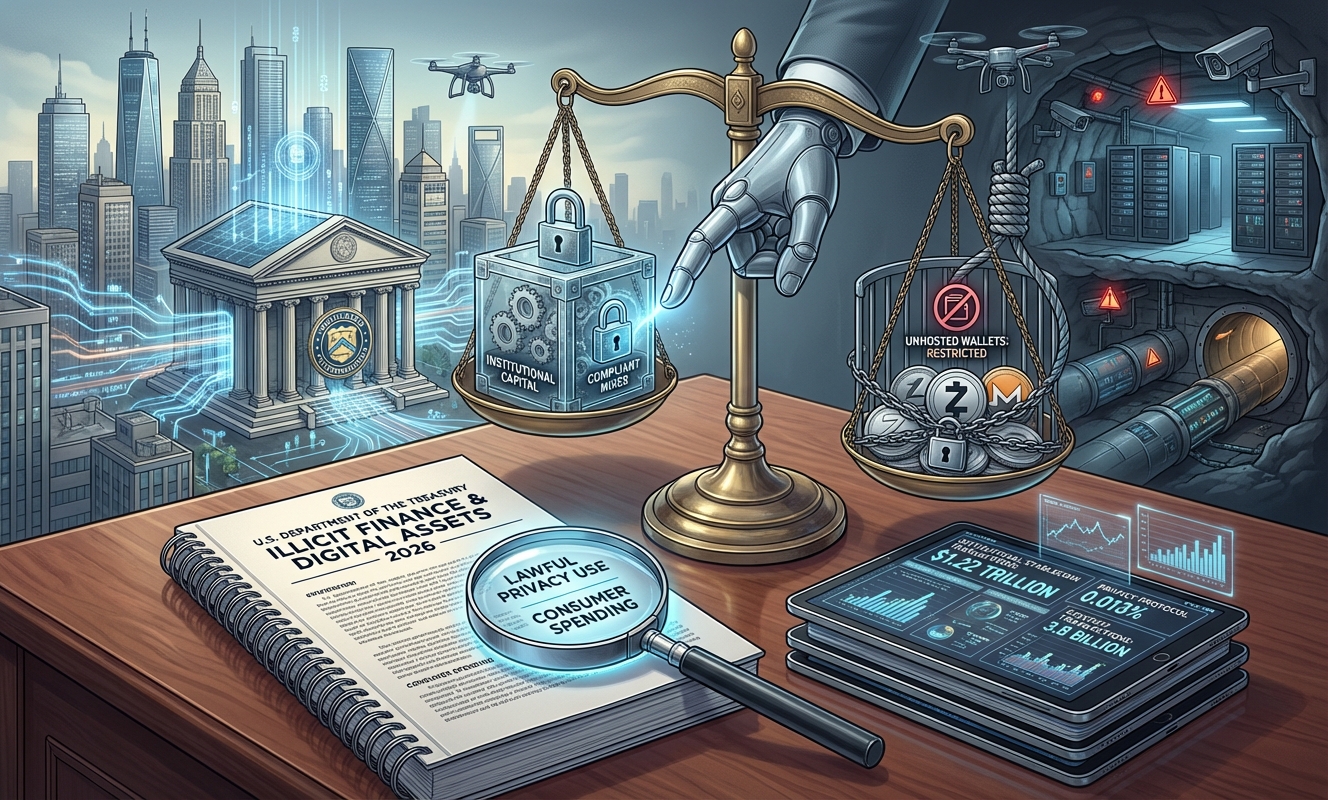
Cambridge’s February 2026 analysis dropped a number that should stop you cold. Institutions moved $1.22 trillion in stablecoin transactions over two years. Only 0.013% of that touched privacy protocols.
Honestly, that one stat tells the whole story. Either institutional demand for privacy tools is essentially zero in practice, or there’s a massive, untapped gap between the value institutions are already moving on-chain and the tools they’re currently cleared to use. Both readings can be true simultaneously.
Meanwhile, roughly $1.7 billion flowed into spot Bitcoin ETFs in a single late-February to early-March window. Large U.S. capital pools are already comfortable with regulated Bitcoin exposure. The policy debate has moved past “will institutions come?” and landed squarely on “what does the infrastructure look like when they’re already here?”
Bitcoin’s position here is interesting and indirect. The asset sits inside ETF wrappers, reserve policy, and institutional allocation frameworks. Its base layer remains fully transparent. If the U.S. wants public-chain settlement to become standard commercial infrastructure, the privacy gap around Bitcoin transactions becomes a real friction point for corporate treasury operations.
That doesn’t mean Bitcoin pumps on this news tomorrow. It means the long-term regulatory environment for Bitcoin-adjacent privacy solutions, think zero-knowledge proof layers, compliant privacy middleware, and ZK-rollup settlement, just got a slightly friendlier backdrop.
For dedicated privacy tokens like Zcash or Monero? Don’t get excited yet. Treasury’s favorable language is laser-targeted at custodial, compliant providers who register as money services businesses, maintain records, do screening, and file suspicious activity reports. Open-source, permissionless privacy tools that operate outside those controls are still very much in the crosshairs. FATF’s 2026 review specifically flagged unhosted wallets and peer-to-peer stablecoin transfers as growing concerns. The noose isn’t loosening there.
Look, the bear case isn’t paranoia. It’s reading the room. Treasury releasing privacy-friendly language in the same breath as a new money-laundering risk assessment is a classic regulatory two-step. One hand extends an olive branch. The other tightens the perimeter.

Here’s where investors are getting the narrative badly wrong. The celebration circulating in some crypto communities frames this as a win for crypto privacy broadly. It’s not. It’s a win for supervised privacy, meaning privacy as a product controlled by regulated intermediaries who remain “legible to the state,” in Treasury’s own words.
If banks and custodians end up owning the privacy layer, that’s a centralization trade-off wearing a libertarian costume. The outcome could look like institutional adoption thriving while the permissionless privacy ecosystem gets quietly strangled through enforcement and developer prosecution. We’ve seen that playbook before.
The sharpest question isn’t whether privacy tools get legitimized. It’s who gets to provide them. A narrow circle of licensed intermediaries versus a broader approval framework represents two fundamentally different futures for this market. Treasury’s report opened the door. The next round of agency guidance decides who’s allowed through it.
Don’t chase privacy tokens on this headline. The signal here isn’t about Monero or Zcash catching a regulatory tailwind. The real positioning opportunity is in the infrastructure layer that sits between institutional capital and public-chain compliance.
Treasury has acknowledged that public blockchains need privacy infrastructure to function at commercial scale. That’s genuinely significant. But the government accepting that privacy is a feature of market structure is very different from the government accepting that you get to choose your own privacy provider. That distinction is where the real money will be made or lost in the next 12 months.
References & Sources:
The US Treasury has historically approached cryptocurrency privacy with strict caution due to national security concerns, primarily regarding money laundering and illicit finance. However, recent signals indicate a potential shift toward accepting “regulated crypto privacy” in the United States. This evolving framework suggests that privacy-enhancing technologies, such as zero-knowledge proofs, could have a legitimate future in the US financial system. By integrating compliance mechanisms like Anti-Money Laundering (AML) and Know Your Customer (KYC) protocols directly into privacy protocols, the Treasury aims to strike a balance between protecting individual consumer data and preventing financial crimes.
Yes, a U.S. government shutdown can significantly impact the cryptocurrency market. Shutdowns delay vital economic data releases and stall important policy decisions, including the advancement of regulatory frameworks by the US Treasury. This administrative bottleneck creates broader economic uncertainty. Consequently, investors often reduce their exposure to risk-on assets, leading to increased volatility or sell-offs in the crypto market. Conversely, when shutdown fears ease, the market generally reacts positively, as institutional and retail confidence in steady economic and regulatory progression is restored.
The U.S. government is progressively moving toward integrating major digital assets into its national strategy. On March 3, 2025, President Trump announced the formation of a U.S. Strategic Crypto Reserve intended to include powerhouse cryptocurrencies such as Bitcoin (BTC), Ethereum (ETH), Solana (SOL), Cardano (ADA), and Ripple (XRP). By holding and utilizing these specific digital assets, the administration aims to solidify the United States as the “Crypto Capital of the World,” driving domestic industry growth while parallel agencies like the US Treasury work on establishing safe, regulated environments for digital asset privacy and transactions.
Cryptocurrencies backed by the US Treasury generally take the form of specialized stablecoins and tokenized Treasury bills, rather than traditional decentralized coins. According to recent market capitalization data, top US Treasury-backed stablecoins include Noble Dollar (USDN), Solayer USD (SUSD), USDM1, and MANTRA USD (MANTRAUSD). These assets are backed directly by U.S. Treasury securities and cash equivalents, providing crypto investors with a regulated, low-volatility haven that bridges the gap between traditional government debt yields and decentralized finance (DeFi).