Subtotal $0.00


Magazines cover a wide array subjects, including but not limited to fashion, lifestyle, health, politics, business, Entertainment, sports, science,


Magazines cover a wide array subjects, including but not limited to fashion, lifestyle, health, politics, business, Entertainment, sports, science,

 Fact Checked by Coinsbeat Editorial Team | Expert Reviewed by Themiya
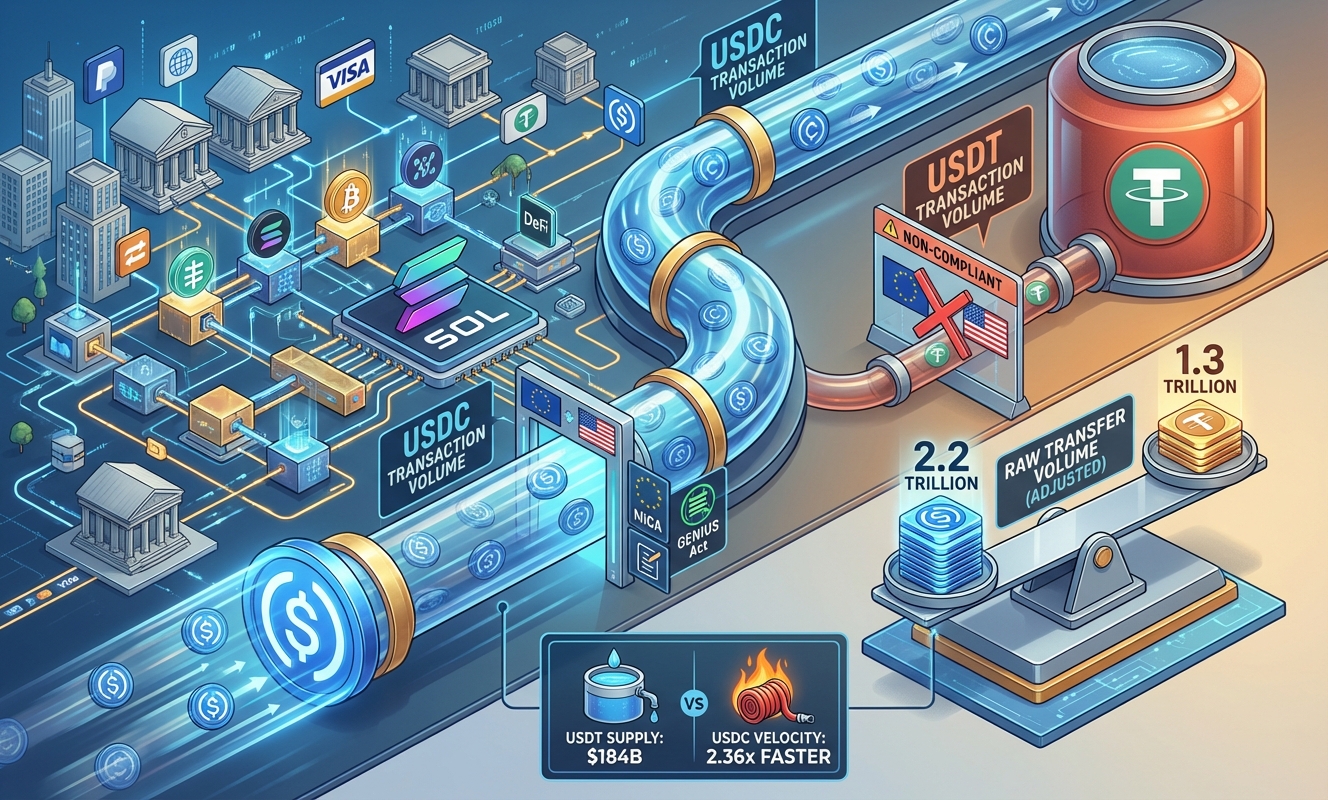
Tether still has more money sitting in wallets. USDC is winning where it actually matters now. For the first time since 2019, Circle’s USDC beat USDT in raw transfer volume, and the margin wasn’t even close. We’re talking $2.2 trillion versus $1.3 trillion in adjusted transaction volume, according to Mizuho research. That’s not a statistical blip. That’s a structural shift.
Let’s be real about what the numbers actually show. USDT still commands a massive $184 billion in circulating supply against USDC’s $79 billion. Tether is, on paper, 2.36 times larger. So how is USDC moving more money?
The answer is transaction velocity. USDC isn’t just sitting in cold wallets being used as a store of value. It’s spinning. Constantly. Through DeFi protocols, market maker desks, cross-border payment rails, and algorithmic routing engines that execute dozens of hops in a single trading session.
Think of it this way. USDT is a massive reservoir. USDC is a high-pressure fire hose. Both hold water. Only one is actually being used to fight fires right now.
Mizuho noted that adjusted stablecoin volumes grew over 90% year-over-year. That’s not organic retail adoption slowly creeping up. That’s institutional infrastructure coming online at speed.
You can’t explain the USDC volume surge without talking about Solana. Full stop.
In February 2026, Solana processed $650 billion in stablecoin transactions. More than doubling its own previous record. The number that makes your jaw drop, though, is the base it generated that volume from. The entire stablecoin pool sitting on Solana is just $15.7 billion. USDC accounts for roughly $8.4 billion of that.
So you have $8.4 billion in USDC generating $880 billion in monthly transfer volume on Solana alone, a 300% year-over-year jump per Token Terminal data. That’s extreme capital recycling. Every dollar is being put to work dozens of times over inside a single month.
Why Solana specifically? The fee structure is almost obscenely cheap. The median transaction fee dropped to $0.00047 during that same period. When routing costs that little, algorithmic market makers and payment processors can split orders across 15 venues instead of 2. Every single leg of that journey gets counted as a transfer. The velocity compounds fast.
Here’s something worth paying attention to. In late 2024 and early 2025, memecoins were running the show on Solana’s DEXs. We’re talking over 60% of all on-chain DEX activity was speculative garbage tokens. The network was essentially a casino with faster slot machines.
That phase is over. Blockworks data now shows stablecoin-related swaps account for roughly 70% of all Solana blockchain activity. The casino became a clearing house. Honestly, that’s a more durable foundation for network value than whatever dog-themed token was trending that week.
This composition change is precisely why transfer totals are so enormous. Stablecoin workflows are inherently multi-hop. A single institutional trade might touch five or six wallets before it settles. Memecoin speculation, by contrast, is usually just a retail buyer swapping SOL for a joke token and crying about it later.
Look, technical advantages only explain part of the story. The policy environment is doing enormous work here that doesn’t get enough credit.
Two moves changed the competitive landscape permanently. First, the US passed the GENIUS Act in July 2025, creating a federal payment stablecoin framework. Second, Circle secured its MiCA license in Europe in January 2025. Tether had neither.
The consequence was brutal and immediate. Binance and other major platforms delisted non-compliant stablecoin pairs, specifically targeting USDT, ahead of the March 31, 2025 deadline. Within the European bloc, USDT’s trading access got severely restricted overnight. All that flow had to go somewhere. It went to USDC.
This isn’t Circle “winning” on merit alone. Tether got regulatory squeezed out of key markets and USDC was the only compliant alternative ready to absorb the volume. The timing was perfect for Circle. Whether that’s skill or luck is a philosophical debate. The market share gains are real either way.
It gets even more interesting on the TradFi side. Visa announced in December that US issuer and acquirer partners started settling fiat obligations directly in USDC over the Solana blockchain. Cross River Bank and Lead Bank were the first participants. A broader rollout is scheduled through 2026.
Circle’s Payments Network already has 55 institutional members and hit $6 billion in volume this year, allowing traditional banks to send USDC internationally and convert it into local fiat via banking partners. That’s not crypto infrastructure anymore. That’s actual monetary plumbing.
Between Visa settling on Solana and JPMorgan reportedly exploring the same rails, the network is quietly becoming the backend for transactions that consumers will never even know touched a blockchain.

Don’t misread this as a simple “buy SOL” signal, though that implication is hard to ignore completely.
Before you get too excited about USDC’s rise, pump the brakes for a second.
A significant chunk of that $880 billion in monthly Solana volume is not organic human trading. It’s bots. Algorithmic market makers. High-frequency routing strategies that split and re-split the same dollar hundreds of times per hour to capture microscopic spreads. The nearly-zero fee environment on Solana specifically incentivizes this behavior at industrial scale.
That matters because inflated volume metrics can and do misrepresent actual economic activity. When regulators, institutional allocators, or journalists cite these transfer numbers as proof of mainstream adoption, they may be looking at a hall of mirrors. Some of it is real. Some of it is a bot farm in a data center somewhere executing a circular arbitrage strategy that benefits nobody except the operator running it.
Mizuho’s use of “adjusted” volume is the tell here. Raw stablecoin volume figures are even larger and even less representative of genuine human economic activity. The adjustment methodology matters enormously and it’s rarely disclosed in the headline number.
Additionally, Tether isn’t dead. Not even close. It still has a $184 billion supply base, deep liquidity in Asian markets where US regulatory pressure is largely irrelevant, and a user base that simply doesn’t care about MiCA compliance because they aren’t operating within EU jurisdiction. The volume flip is real. Calling it Tether’s death notice is premature and frankly a little sloppy.
Pro-Tip: If you’re a trader who uses stablecoins actively for DeFi strategies, migrating primary liquidity to USDC on Solana right now is the path of least resistance. The fee environment is favorable, the institutional liquidity depth is improving weekly, and the regulatory risk of holding USDT on centralized exchanges in regulated jurisdictions is not zero. That said, keep some USDT available for trading pairs in Asian markets where the liquidity spread on USDC alternatives is still noticeably wider.
References & Sources:
While Tether (USDT) maintains a larger overall market capitalization and cash reserve, Circle’s USDC is currently moving more transaction volume on-chain. This shift is largely driven by USDC’s widespread adoption in Decentralized Finance (DeFi) ecosystems, automated smart contracts, and institutional clearing. USDC is highly favored for its regulatory transparency and seamless integration across major blockchain networks, making it the preferred stablecoin for high-frequency trading, lending protocols, and large-scale institutional crypto transfers.
Yes, Tether currently holds significantly more cash and cash-equivalent reserves than Circle. As the largest stablecoin by market capitalization, Tether manages tens of billions of dollars in assets—including US Treasury bills, money market funds, and fiat cash—to back the circulating supply of USDT. While Circle also maintains fully transparent and heavily audited reserves for USDC, Tether’s historical first-mover advantage and massive retail dominance globally contribute to its much larger overall treasury.
The primary difference between USDT (Tether) and USDC (Circle) lies in their market usage, ecosystem dominance, and regulatory footprint. USDT dominates the broader retail market, offshore centralized cryptocurrency exchanges, and peer-to-peer payments in emerging markets acting as a digital dollar. In contrast, USDC focuses heavily on US-based regulatory compliance, institutional trust, and serving as the backbone for the DeFi (Decentralized Finance) space. Therefore, while Tether is the undeniable leader in total market cap and stored value, USDC frequently acts as the primary settlement layer for active on-chain crypto economics.
Safety in stablecoins largely depends on user priorities. Circle’s USDC is generally considered the safer option for institutional investors and users who prioritize strict regulatory compliance. It undergoes rigorous monthly attestations by top-tier accounting firms and holds reserves exclusively in cash and short-term US Treasuries. Tether (USDT), while historically facing scrutiny over the transparency of its asset backing, has vastly improved its reporting and holds a massive, highly liquid reserve. Ultimately, USDC leads in verifiable transparency, while USDT leads in battle-tested global market liquidity.