Subtotal $0.00


Magazines cover a wide array subjects, including but not limited to fashion, lifestyle, health, politics, business, Entertainment, sports, science,


Magazines cover a wide array subjects, including but not limited to fashion, lifestyle, health, politics, business, Entertainment, sports, science,

 Fact Checked by Coinsbeat Editorial Team | Expert Reviewed by Themiya
Sixty percent of the circulating supply is underwater. Let that sink in for a second.
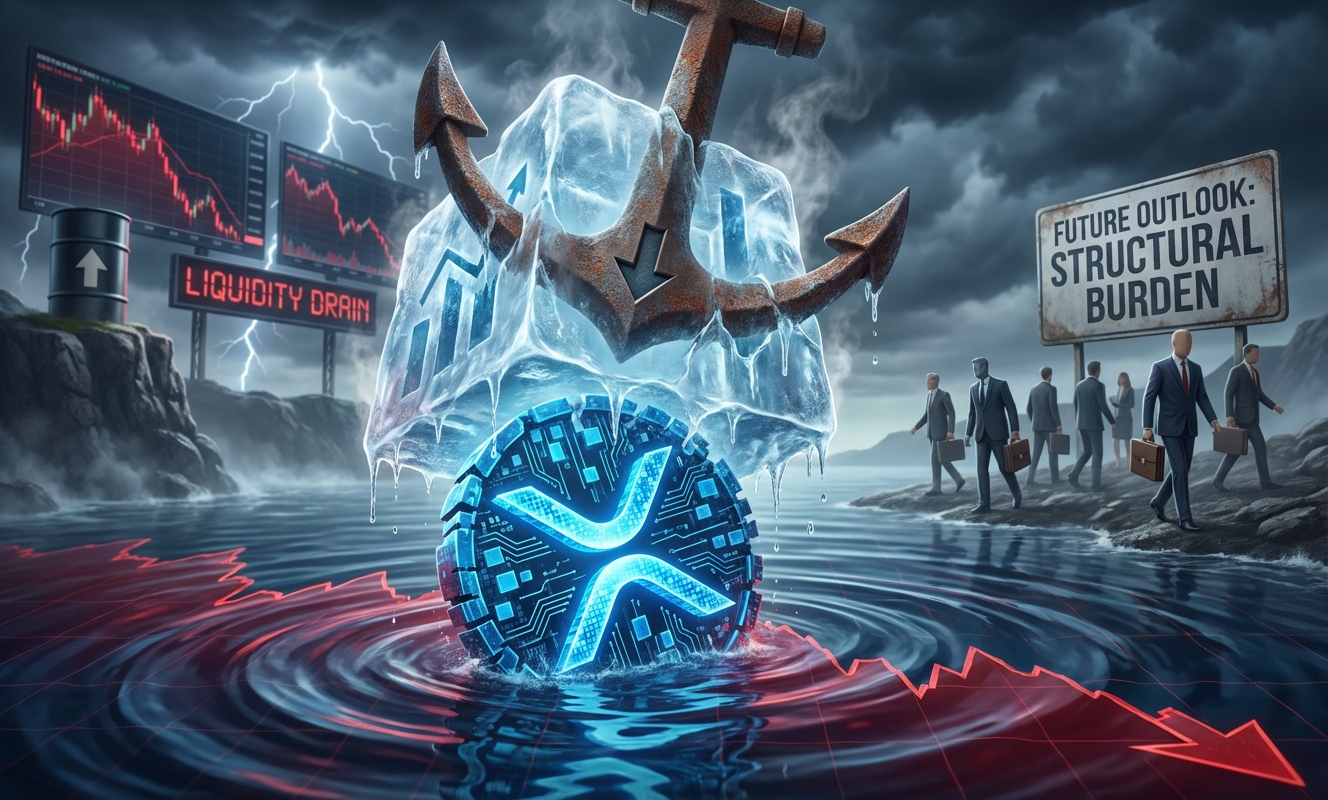
XRP isn’t just going through a rough patch. It’s structurally trapped. The data from Glassnode shows roughly 36.8 billion XRP tokens are being held at a loss right now, representing about $50.8 billion in unrealized pain sitting in wallets across the network. That isn’t a dip. That’s a distribution problem with legs, and it’s the core reason every bounce in XRP gets sold into oblivion before it can breathe.
Here’s the thing about XRP’s realized price sitting at $1.44. Most analysts will mention it as a technical level. What they don’t tell you is what it actually represents behaviorally.
Every time spot XRP creeps toward $1.44, you’ve got a massive cohort of holders who bought somewhere between $1.44 and higher, who have been sitting on losses for months, staring at their portfolios and waiting for the moment they can escape near breakeven. That’s not bullish momentum. That’s exit liquidity formation at its most textbook.
With XRP trading around $1.35 as of March 9, the market is still 6.6% below that realized price ceiling. The path to a genuine recovery requires new demand strong enough to absorb all of that overhead supply from holders who are done waiting. Right now, that demand simply doesn’t exist.
Look, these metrics don’t mean XRP is going to zero tomorrow. But they do tell you the structural burden here is enormous. A sustained rally needs to do two things simultaneously: attract fresh buyers AND absorb a nine-figure wave of sellers trying to cut losses. That’s a tall order in any market, let alone one getting hammered by macro headwinds.
The macro backdrop couldn’t have arrived at a worse time. Oil surging past $115 per barrel has triggered a broad repricing of risk assets. Traders are getting defensive fast. And when institutions start trimming exposure across the board, they don’t sell their least liquid positions first. They sell the liquid ones, the ones with deep enough order books to absorb size quickly.
XRP, as a top-five asset by market cap, is exactly that. It’s the first thing that gets thrown overboard when the ship starts rocking. This is the brutal irony of liquidity in crypto. Being liquid enough to attract institutions also means being liquid enough to get dumped first when those same institutions need to raise cash.
Honestly, the oil shock didn’t cause XRP’s problems. It just accelerated a process that was already well underway internally.

This is where it gets really ugly. Let’s be real about what the derivatives market is saying.
That taker ratio is particularly telling. In a healthy bull structure, aggressive buyers dominate the tape. They’re the ones sending market orders, lifting offers, signaling conviction. When sellers are the aggressive side of the flow, it means the people with conviction are the ones getting out. Buyers are just providing a resting target, absorbing supply but not generating upward pressure.
A market can hold at a level this way. It cannot meaningfully rally this way.
Here’s where I want you to pay close attention, because this part gets glossed over constantly.
CryptoQuant’s 30-day volume z-score on Binance is sitting at -1.16. Daily volume has dropped to roughly 27 million XRP. Active wallet counts depositing and withdrawing across 15 major exchanges have fallen to their lowest levels since early 2025.
What does this mean practically? The order book is thin. Very thin.
When volume dries up and active participants pull back, the market becomes fragile in both directions. It looks stable on the surface. The chart shows a consolidation. But underneath, there’s less cushion to absorb a sudden flush of sell orders or, for that matter, a sudden surge of buy orders if sentiment flips. A single large market event, a macro shock, a whale entering or exiting, can move this price much further than the recent daily ranges suggest is normal.
Between you and me, this is how a slow bleed turns into a sharp capitulation. Not with a dramatic announcement. Just a quiet order book that suddenly can’t handle the weight.
Here’s the cynical irony layered on top of all this. While XRP the token bleeds out, Ripple the company is genuinely making moves. They’ve quietly integrated into Wall Street’s stock-clearing infrastructure. XRP developers are proposing a 200x leverage trading sidechain. The XRPL is seeing real adoption growth.
And yet the token is down 26% year-to-date and 54% over six months.
This is what’s known in the space as a value capture failure. The underlying network can grow, partnerships can multiply, and institutional rails can get built, but if the token’s economic design doesn’t force demand through the asset itself, all that activity is just marketing. It benefits Ripple as a company. It doesn’t automatically benefit XRP holders.
Retail investors conflate Ripple’s business success with XRP price appreciation. Historically, that correlation has been weak. Keep that in mind when you’re reading the next round of bullish headlines about Ripple landing a new banking partner.
Let’s get practical. Here’s the honest risk assessment before anyone considers a position in XRP at current levels.
The one scenario that changes this picture is a genuine macro reversal. If oil pulls back sharply, risk appetite returns broadly, and fresh capital enters crypto with XRP as a top-five target, the thin order book cuts both ways. A rapid squeeze through $1.44 with volume confirmation would be the signal to watch. Until then, the path of least resistance is still down.
Don’t get shilled into catching this knife without a clearly defined entry thesis. The on-chain data isn’t giving you permission to be a hero here.
References & Sources:
While technically possible in the distant future, reaching $100 is highly unlikely in the near term. To hit such a milestone, XRP would require trillions in new capital and unprecedented activity on the Ripple network. Given the current market conditions—where XRP faces over $50 billion in unrealized losses, intense market competition, and heavy resistance from underwater holders—achieving a $100 price point would require a massive shift in global crypto adoption and flawless regulatory clarity.
The recent drop in XRP’s price is heavily influenced by strict macroeconomic conditions, including persistent inflation and high interest rates set by the Federal Reserve. When traditional borrowing costs are high and cash yields are attractive, investors tend to pull money out of speculative assets like cryptocurrency. Furthermore, with 60% of the XRP supply currently underwater, widespread fear and immense sell pressure are compounding the $50 billion in unrealized losses, driving the price down further.
When 60% of the XRP supply is “underwater,” it means that the majority of the circulating tokens were purchased by investors at a price higher than the asset’s current market value. This directly equates to the massive $50 billion in unrealized losses currently haunting the network. Being underwater creates a strong psychological barrier for the market; as the price begins to recover, many of these holders are likely to sell off their assets just to break even, creating strong resistance that limits future price rallies.
A recovery for XRP is possible but hinges on several critical macroeconomic and fundamental factors. A reversal of current economic tightening—such as the Federal Reserve cutting interest rates—could drive institutional and retail capital back into speculative assets. Additionally, XRP needs continuous positive momentum through increased utility on the Ripple network, favorable legal and regulatory developments, and a broader crypto market bull run to absorb the sell pressure from underwater holders and offset the $50 billion deficit.