Subtotal $0.00


Magazines cover a wide array subjects, including but not limited to fashion, lifestyle, health, politics, business, Entertainment, sports, science,


Magazines cover a wide array subjects, including but not limited to fashion, lifestyle, health, politics, business, Entertainment, sports, science,
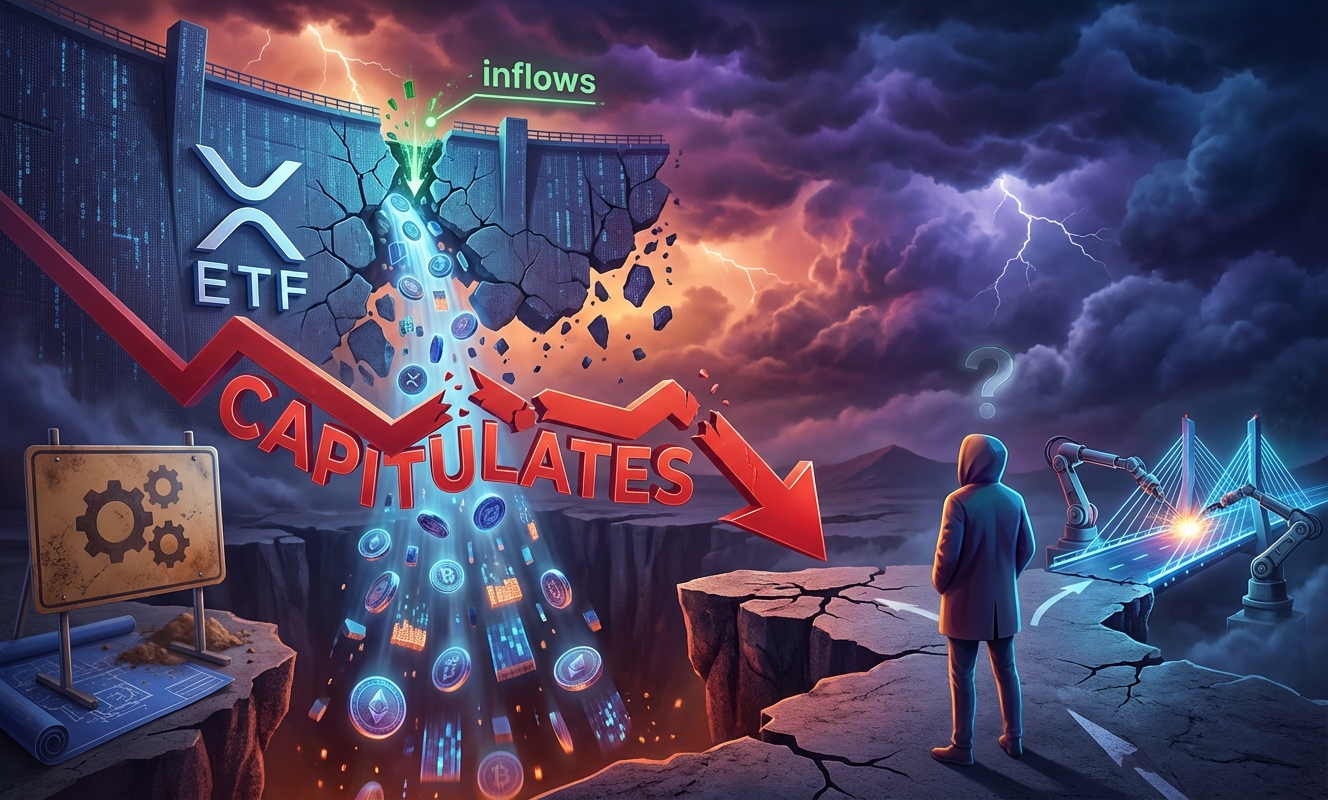
Nearly a billion dollars in realized losses just printed on XRP’s on-chain ledger. Retail is panic-selling. Whales are quietly routing millions of tokens to Binance. And everyone on crypto Twitter is suddenly an “XRP maxi” calling the bottom. Let’s be real. The data tells a much more complicated story.
Santiment’s data just flagged XRP’s largest realized-loss spike since the November 2022 washout. We’re talking roughly negative $908 million in a single weekly read. That number sounds catastrophic. In one sense, it is. But here’s the thing, traders who’ve been in this market long enough know that capitulation events are necessary, not sufficient conditions for a bottom.
The last comparable print, around negative $1.93 billion back in late 2022, was followed by a 114% price increase over the next eight months. So bulls are already dusting off that chart, screenshotting it, and posting it everywhere. Fine. But they’re conveniently ignoring the most important part of that comparison.
Capitulation clears supply overhang by shaking out weak hands. That part is accurate. But it doesn’t automatically attract new buyers. Two completely different dynamics. Confusing them is how retail becomes exit liquidity for the next leg down.
Glassnode’s cost-basis data cuts through the noise here. XRP’s realized price, which is essentially the aggregate average purchase price across all circulating supply, sits at approximately $1.45.
This is not just a technical support level. It’s a psychological and structural dividing line. Above it, the average holder is in profit and has less incentive to sell into strength. Below it, every modest rally becomes a relief valve for underwater holders trying to recover losses. That’s the trap XRP is currently sitting in.
Two supporting metrics reinforce the same read.
Honestly, the setup here is binary and pretty unforgiving. Either XRP reclaims $1.45 and holds it with conviction, at which point SOPR flipping back above 1.0 would be your confirmation signal, or it doesn’t. And if it doesn’t, every bounce gets sold by the same cohort of bagholders trying to cut exposure at better prices. That dynamic can persist for months.

Here’s where it gets uncomfortable for the bulls. CryptoQuant data shows over 31 million XRP was routed to Binance in a single day, with the lion’s share coming from the largest wallet cohorts.
Yes, not every exchange inflow means immediate selling. Collateral management, internal reshuffling, OTC desk staging, it all gets counted in these numbers. The analysts at CryptoQuant were careful to frame it as roughly $45 million in potential sell-side pressure rather than confirmed selling. Fair point.
But look. In a market where the tape is already weak, where SOPR is below 1 and realized losses are spiking, large-wallet inflows to exchanges are a signal you should not dismiss. The timing matters enormously. Whales don’t tend to move coins to Binance during periods of strength just to sit on them. The pattern, especially when it comes from the biggest cohorts simultaneously, historically precedes distribution. Not always. But often enough to warrant caution.
The derivatives picture adds another layer of complexity. CoinGlass data puts XRP futures open interest at around $2.33 billion, with 24-hour futures volume sitting near $5.24 billion. That’s a massive amount of leveraged positioning relative to the current spot price environment.
The funding rate picture is currently bearish-skewed, meaning shorts are paying longs. That tells you the market consensus is positioned for further downside. And here’s where it gets interesting from a tactical standpoint.
Between you and me, this is exactly the kind of structure that sophisticated players exploit. They know the shorts are stacked. They know the realized price level. A coordinated spot bid near $1.45 doesn’t need to be large to trigger a cascade upward if the setup is tight enough. The question is whether anyone with enough capital and conviction is willing to be that bid right now.
The institutional wrapper story for XRP has been a legitimate tailwind, but the momentum is fading fast and that matters more than the headline direction.
CryptoRank data shows XRP ETF products have remained net positive every month since launch. That’s the good news. The catch is that monthly inflows collapsed from $667 million down to $49 million. Still green, but barely. And this is happening inside a broader environment where BTC ETFs have shed $7.2 billion since November and ETH funds have lost $2.8 billion.
The broader ETF ecosystem is clearly in risk-off mode. XRP has diverged in direction but not in magnitude. $49 million in monthly inflows is not a strong institutional bid. It’s a trickle. And in a weak tape with heavy leverage and whale distribution pressure, a trickle doesn’t move markets.
The ETF narrative used to be a standalone bullish argument for XRP. It no longer is. Now it’s a marginal support factor that only becomes meaningful if the supply picture improves first. After a genuine capitulation flush, even small inflows can punch above their weight. But the sequence matters. Supply has to clear before the demand side can assert itself.
Look, there are exactly three ways this plays out from here based on the current on-chain and derivatives setup.
The realized-loss spike marks a genuine supply reset. XRP stabilizes near $1.45, consolidates, then reclaims and holds above the realized price. SOPR moves back above 1.0 and stays there. Shorts get squeezed, leverage normalizes, and the market begins a slow repair cycle. This is the cleanest path, but it requires patience. Weeks, not days.
Capitulation was the beginning of a longer repair cycle, not the end. XRP fails to hold above realized price. SOPR stays below 1. Every rally is sold by underwater holders cutting exposure. The token spends the next several months range-bound below cost basis. This is the least exciting outcome and historically the most common one in altcoin corrections of this magnitude.
ETF inflows stabilize or re-accelerate while price is still flat. The demand arrives before the market reacts to it. This is the sneaky scenario that catches most traders off-guard. Early signals would be product flows staying positive or rising while XRP price consolidates. Thin order books after a capitulation event mean demand doesn’t need to be massive to move price.
Don’t front-run the recovery. The single biggest mistake traders make after a capitulation print is treating it as a buy signal and loading up immediately. That’s how you become the next round of exit liquidity for the whales who just deposited 31 million XRP to Binance.

The macro environment is the silent killer here. BTC ETFs bleeding $7.2 billion since November didn’t happen in a vacuum. It reflects a broader institutional risk-off rotation that doesn’t care about XRP’s on-chain metrics or SOPR readings. If that macro pressure intensifies, if Bitcoin slides further and ETF outflows accelerate across the board, XRP’s capitulation print becomes a waypoint in a longer decline, not a floor.
The on-chain setup is constructive for a recovery attempt. But XRP doesn’t trade in isolation. It trades in correlation with Bitcoin’s mood, institutional risk appetite, and the broader crypto sentiment cycle. Right now, all three of those are still pointing defensive. The data gives you the setup. The market will decide the timing. And in crypto, timing is usually where the money is lost.