Subtotal $0.00


Magazines cover a wide array subjects, including but not limited to fashion, lifestyle, health, politics, business, Entertainment, sports, science,


Magazines cover a wide array subjects, including but not limited to fashion, lifestyle, health, politics, business, Entertainment, sports, science,

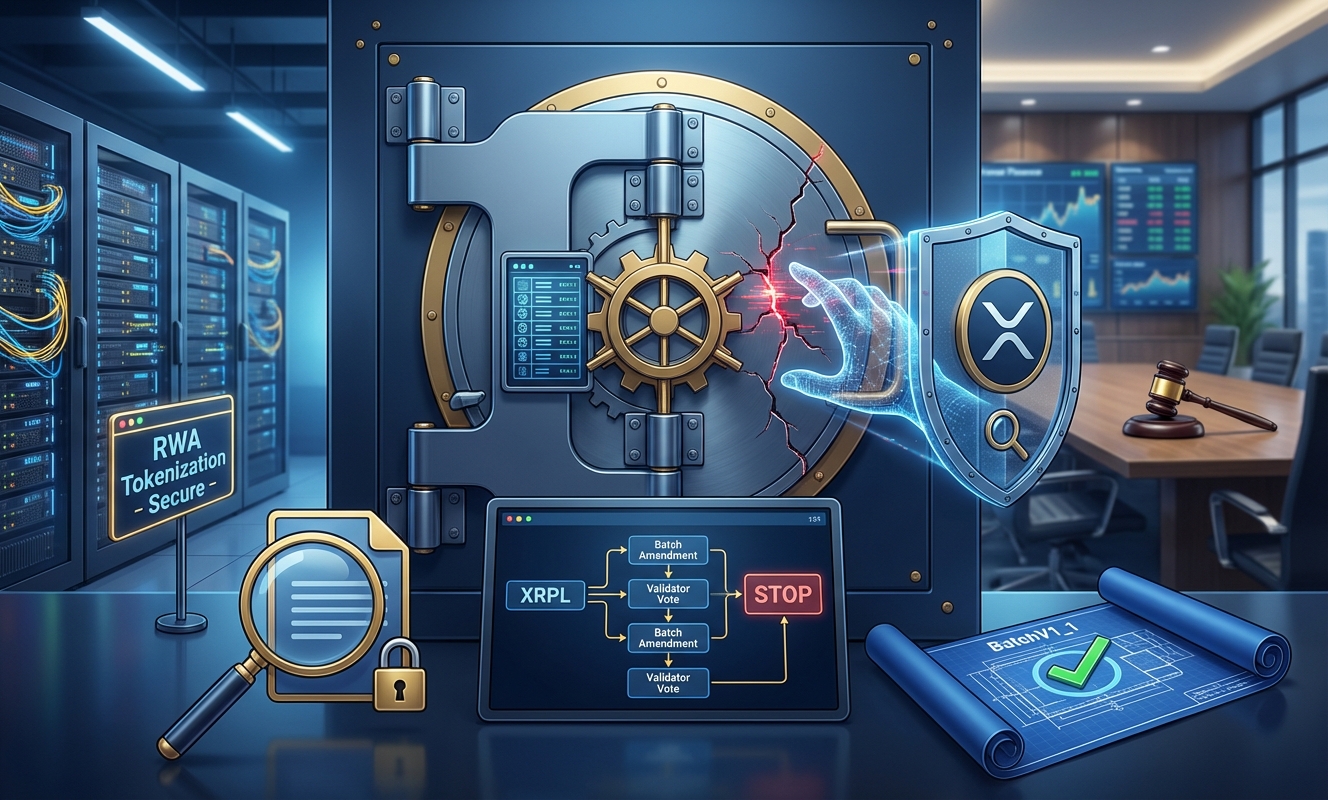
A single loop error in a proposed XRPL upgrade nearly handed attackers the ability to spend your funds without ever touching your private keys. Not a theoretical vulnerability. Not a whitepaper edge case. A real, deployable exploit that was sitting one validator vote away from going live on mainnet.
Let that sink in for a second.
Here’s the technical reality, stripped of PR spin. The proposed Batch amendment was designed to let users bundle multiple transactions into a single atomic operation. Good idea in principle. If one step fails, everything fails. Clean, developer-friendly, reduces execution risk.
But the implementation had a fatal flaw in its signer validation loop.
In the Batch design, the “inner” transactions inside a bundle are intentionally unsigned. Authorization gets delegated to a list of batch signers attached to the outer transaction wrapper. That means the code that checks those signers is the entire security perimeter. If that check breaks, everything downstream breaks with it.And it broke.
The validation function had an early-exit condition buried in its loop. When it encountered a signer whose account didn’t yet exist on the ledger, but whose signing key matched that same account (which is a completely normal state for a new account), it would return “success” immediately and stop checking the rest of the signer list.
Full stop. Done. Authorized. Move on.
Here’s why that’s catastrophic in a batching context specifically. A single Batch transaction can create accounts inside the same atomic sequence. So an attacker could construct a batch that creates a fresh account they control, trigger the premature-success condition on that entry, and then slip in a forged signer entry claiming authorization over a victim’s account. The validation loop never gets there. It already returned success.
The result? They could execute Payment transactions draining victim accounts to the reserve. They could fire AccountSet, TrustSet, even AccountDelete, all under a victim’s account signature. Zero private key access required.
This is what the industry calls a “spend without keys” scenario. It’s the kind of bug that ends projects.
Look, timing matters in crypto. And honestly, the timing here couldn’t have been more uncomfortable for the XRPL Foundation and Ripple’s broader ambitions.
XRPL is not positioning itself as a retail memecoin casino. It’s actively pitching itself as infrastructure for regulated finance. Real-world asset tokenization.
Permissioned DEXs. Compliance-sensitive institutional settlement. The network currently holds roughly $2 billion in RWA assets and about $50 million in DeFi TVL according to DeFiLlama. These are not retail degens. These are institutions with legal teams and risk committees.
XRPL recently introduced Permissioned Domains and gated DEX structures, precisely to attract participants who want blockchain settlement without open-access counterparty risk. The entire sales pitch is built on one word: trust.
Now imagine that pitch getting made the week after headlines read “XRPL upgrade lets attackers drain accounts without private keys.” That narrative doesn’t wash off quickly. Institutional memory is long. Compliance officers don’t forget. And competing chains would have used it as ammo for the next two years.
Between you and me, the reputational damage from a live exploit on a RWA-focused ledger would have been orders of magnitude worse than any actual fund loss. The perception of security is sometimes more valuable than security itself, and XRPL’s entire institutional strategy was sitting on that perception.

Credit where it’s due. The response was fast and coordinated.
The validator coordination piece is worth noting. XRPL’s governance model, love it or hate it, actually functioned here. The UNL (Unique Node List) system allowed the Foundation to rapidly align validators around a “No” vote before the amendment could accumulate support. No on-chain governance drama. No hostile fork. Clean containment.
But here’s the thing people are glossing over: rippled 3.1.1 does not contain the actual fix. It contains containment. The underlying logic error still exists in the codebase. The replacement, BatchV1_1, removes the early exit, adds extra authorization guards, and narrows the signing check scope. It’s under review with no release date confirmed yet.
So the story isn’t over. It’s in the most important chapter.
Let’s be real about market impact. In isolation, a dodged bullet that never touched mainnet shouldn’t crater XRP’s price. And it likely won’t, at least not directly. The bug was caught pre-activation. No user funds were touched. The governance response was decisive.
But context matters here.
Stacking a near-miss security disclosure on top of that backdrop isn’t great. Retail traders won’t read the technical nuances. They’ll see “XRP security flaw” in a headline and hit sell. Short-term, expect that narrative to add friction to any recovery rally. Longer-term, if BatchV1_1 ships cleanly and XRPL’s institutional pipeline stays intact, this becomes a footnote, not a thesis-breaker.
The real market question is simpler: can XRPL ship BatchV1_1 without reopening the same authorization boundary? If yes, and if the audit process they outlined (standardized AI-assisted audits, expanded loop-exit static analysis, codebase-wide pattern review) becomes the new standard, this incident actually strengthens the governance narrative long-term.
If BatchV1_1 ships with another problem, all bets are off.
Here’s what the press releases won’t tell you. The reason this bug matters beyond XRPL is what it reveals about the broader risk of atomic transaction bundling across blockchain infrastructure.
The Batch pattern, grouping multiple operations into a single all-or-nothing execution, is not unique to XRPL. Ethereum has had similar primitives discussed and implemented in various forms. Solana’s transaction model has its own authorization complexity. Every chain pushing toward more sophisticated multi-step transaction logic is introducing new authorization boundaries that need independent security boundaries too.
XRPL’s bug was a loop exit in a signer validation function. That’s almost embarrassingly simple at the code level. But it existed because the security review didn’t fully account for how account creation timing inside a batch changes the authorization state mid-execution. That’s a subtle, systemic thinking failure, not just a coding mistake.
Institutions evaluating XRPL’s competitors should be asking the exact same question about whatever atomic bundling primitive their preferred chain is building. Because the competitive pressure to ship features fast, especially in a race for institutional RWA business, creates real pressure to compress audit cycles.
Anyone holding XRP or building on XRPL with the expectation that Batch functionality is coming soon needs to understand the actual timeline reality.
The dependency risk is real. Any DeFi or RWA product roadmap that has Batch functionality baked into its architecture is currently blocked. And in crypto, “under review with no release date” has a way of stretching longer than anyone publicly admits.
Don’t adjust your XRPL thesis based on the near-miss alone. The near-miss was handled well. Adjust it based on what happens next.
Watch for these specific signals before making any institutional-grade allocation decision around XRPL’s roadmap:
Governance worked this time. The next test is whether engineering can keep pace with an increasingly ambitious feature roadmap without handing the next researcher a more dangerous version of the same bug to find.
The brakes held. Now everyone’s watching to see if the accelerator still works.