Subtotal $0.00


Magazines cover a wide array subjects, including but not limited to fashion, lifestyle, health, politics, business, Entertainment, sports, science,


Magazines cover a wide array subjects, including but not limited to fashion, lifestyle, health, politics, business, Entertainment, sports, science,
 Fact Checked by Coinsbeat Editorial Team | Expert Reviewed by Themiya
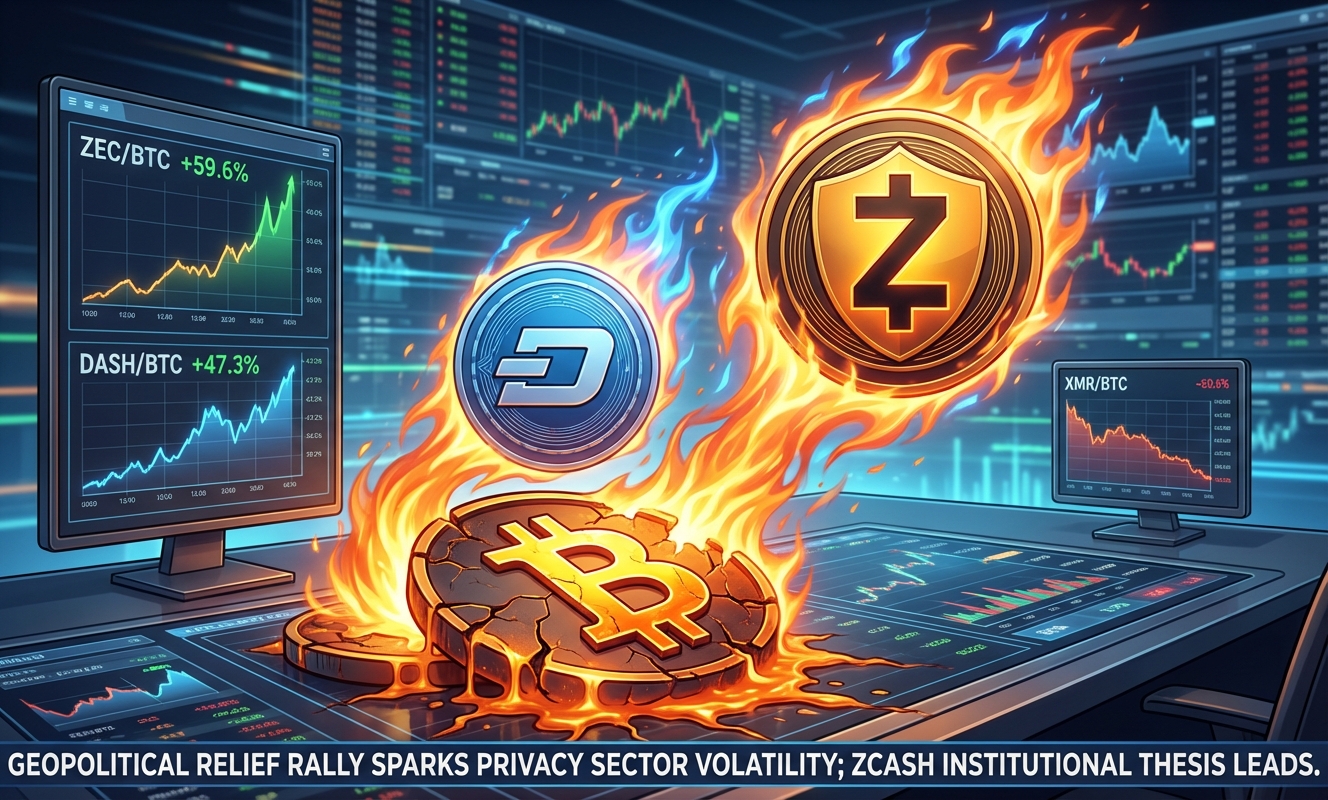
A US-Iran ceasefire sent oil sliding and European equities to their best single day in over four years. Crypto caught the relief wave. Fine. That part is simple. What isn’t simple is why Zcash posted +59.6% in seven days and Dash followed at +47.3%, while Monero, the one coin you’d actually expect to lead a genuine “people want financial privacy” trade, quietly bled against Bitcoin.
That divergence is the whole story. And if you’re trading privacy coins without understanding it, you’re probably someone else’s exit liquidity.
Let’s be real. Geopolitical relief rallies are real. When fear comes off the table, traders rotate hard into higher-beta, higher-volatility assets. Smaller caps move faster. That explains some of the move. It does not explain the shape of it.
Here’s the thing: if the thesis were “geopolitical risk = people want transactional anonymity = buy privacy coins,” Monero would have led. XMR is the most credible privacy asset by almost every technical and ideological metric. It has default privacy, genuine fungibility, and a decade-long track record of actually being used for what privacy coins are supposedly built for.
Instead, XMR/BTC fell roughly 2.3% over the same seven-day window where ZEC/BTC gained 46.6%. That number alone kills the “geopolitics narrative” as the primary driver. Dead on arrival.
What actually happened is traders treated the privacy sector as a trading cluster, not an ideology. They picked names based on squeeze potential and narrative legibility, not philosophical alignment with financial anonymity. The ceasefire was just the macro trigger that opened the door.
This is what separates ZEC from everything else in this move. The institutional stack was already accumulating, quietly, before this week’s macro relief gave traders a reason to pile in.
Look at what was already on the table:
None of that happened this week. Every single one of those catalysts predated the rally. The ceasefire didn’t create the thesis. It gave traders who were already watching the institutional buildup a convenient macro entry point to front-run the next leg.
Grayscale’s own fourth-quarter 2025 report named privacy the dominant crypto theme of the quarter. Coinbase’s January 2026 market note said privacy tokens were among 2025’s best performers and flagged the narrative as potentially remaining consequential through 2026. This wasn’t a surprise to anyone paying attention. The market just finally showed up.
Here’s a detail most people glossed over. The Grayscale Zcash Trust has historically traded at discounts as wide as 55% and premiums as high as 240%. As of March 31, it sat at a 0.3% premium to NAV. Nearly flat.
That means traders aren’t pricing current institutional demand. They’re pricing the optionality of what happens if the NYSE Arca conversion path gets approved and regulated capital suddenly has a clean, familiar vehicle to get ZEC exposure. That’s a future-access bet, not a present-demand bet. Completely different risk profile.
Dash’s 47.3% gain looks impressive sitting next to Zcash’s 59.6%. But the mechanics behind it are almost completely different, and honestly, a lot more dangerous to hold through a reversal.
Dash isn’t even in CoinGecko’s privacy coin category. The project has maintained since 2020 that its transactions are transparent by default and that it operates as a payments cryptocurrency with optional privacy. That compliance-friendly framing is actually smart long-term positioning, but it also means Dash is riding a narrative it doesn’t fully own.
What actually drove Dash was simple: Zcash broke out hard, traders looked for the nearest liquid name with any proximity to the privacy cluster, and Dash was familiar, small enough to move fast, and liquid enough to trade in size. Pure sympathy play.
The derivatives data backs this up completely. Dash showed 24-hour futures volume of roughly $669 million against a market cap of about $561 million. That’s 119% turnover relative to market cap. For context, Zcash ran at about 63.45%. Dash’s open interest sat at 15.15% of market cap versus Zcash’s 12.61%.
What those numbers tell you is that Dash’s move was derivatives-driven momentum on top of a sympathy trade. That’s not a fundamental re-rating. That’s a squeeze. Squeezes end.
Dash did have some real news in the window: AEON Pay processing 994,000 transactions across more than 50 million offline merchants, shielded transaction capabilities via Zcash’s Orchard technology, and a NEAR Intents integration. Real progress. But nothing with the same compressive institutional weight as Zcash’s stack. The fundamental ground is thinner.
The bull case requires the ceasefire to hold, equities to stay risk-on, and at least one of Zcash’s institutional catalysts to firm up concretely. In that world, ZEC holds most of its relative outperformance because the institutional-access thesis is independent of the macro trigger. Dash overshoots again because its market structure is thin enough to amplify continuation inflows.
The base case is that the relief rally cools but doesn’t fully reverse. Zcash holds better than Dash because the second narrative remains intact. Dash gives back more as momentum fades and the derivatives positioning unwinds.
The bear case is ugly. If the ceasefire proves fragile, oil rebounds, and risk appetite weakens, both coins retrace hard. Smaller and more leveraged to trader positioning than Bitcoin, they’ll fall faster. Dash goes first. Its liquidity is thinner and there’s no durable institutional narrative to slow the exit. Zcash has more cushion, but only if Foundry and Grayscale actually deliver on their stated timelines.
Then there’s the event-risk case, which gets skipped in most analysis. Grayscale’s NYSE Arca path requires regulatory approval. Foundry’s pool has a planned April 2026 launch date awaiting confirmation. If either narrative disappoints, the entire institutionalization thesis loses its near-term anchor. Coinbase’s January note specifically flagged regulatory action and exchange delistings as asymmetric risks for privacy tokens with narrower liquidity than Bitcoin. Both ZEC and Dash live in that category.
Honestly, Monero’s absence from this move deserves its own conversation. XMR is the privacy coin that actually gets used for privacy. Default shielding. Genuine fungibility. No optional privacy theater. And it bled against Bitcoin during a week where the narrative was supposedly “people want financial anonymity.”
The cold read here is that institutional capital specifically avoided Monero because it’s effectively unlisted from major regulated venues and carries the most regulatory exposure of any privacy asset. The same properties that make XMR technically superior for actual privacy use make it structurally difficult for the type of institutional access narrative that drove ZEC. It’s a real asset with a real problem, and this week’s price action confirmed that the market is currently pricing access, not ideology.
If you believe the Zcash institutional thesis has legs and you want to express a view without just taking naked long exposure in a volatile market, consider this. The ZEC/DASH spread is currently reflecting a significant fundamental premium for Zcash that is likely to widen if the Grayscale or Foundry catalysts confirm. Long ZEC, short DASH as a hedge captures the thesis without requiring the broader privacy sector to keep running. Dash’s thinner fundamental ground and over-leveraged derivatives structure make it the weaker leg of the pair. If the macro reverses hard, Dash falls faster. If it continues, ZEC likely leads. The spread trade respects both outcomes.
Both of Zcash’s most critical catalysts carry hard deadlines with soft confirmations. The Grayscale S-3/A filing describes a conversion path that is still pending regulatory approval, not guaranteed. Foundry’s institutional mining pool has an April 2026 target date, not a confirmed launch. The market is already pricing a significant probability of these catalysts delivering. If either stalls or disappoints, the premium ZEC carries over every other privacy name compresses fast. Retail traders who chased the breakout at the top of the move have very little margin of safety if the institutional narrative gets even slightly delayed. Don’t confuse a pending catalyst with a delivered one. The market has a habit of front-running good news and then selling the actual announcement, especially when the run-up is already 60% in seven days.
References & Sources:
The primary difference between Zcash and Bitcoin lies in transaction privacy. While Bitcoin’s blockchain is entirely public—meaning anyone can view wallet balances and transaction histories—Zcash offers advanced, optional privacy features. Using zero-knowledge cryptography, Zcash allows users to shield their transactions, ensuring that the sender, receiver, and transaction amount remain completely hidden from prying eyes. This fundamental difference in privacy capabilities is a key reason Zcash outperformed Bitcoin by 46% during recent geopolitical uncertainties.
Geopolitical conflicts, such as the Iran War, create significant volatility in the cryptocurrency market. Historically, chaos in the Middle East has acted as a drag on Bitcoin’s price, often causing immediate dips following escalations as investors panic-sell or move to traditional safe-haven assets. However, in a unique market shift, privacy coins have started to decouple from Bitcoin. As the conflict escalated, assets like Zcash surged over 46% against Bitcoin, as users increasingly sought financial anonymity and censorship-resistant assets amidst global turmoil.
Zcash operates as a privacy coin by utilizing a breakthrough cryptographic technique known as zk-SNARKs (Zero-Knowledge Succinct Non-Interactive Arguments of Knowledge). Unlike Bitcoin, where all transaction details are publicly visible on a transparent ledger, zk-SNARKs allow Zcash nodes to verify that a transaction is valid without revealing any sensitive data. This optional privacy layer gives users the power to choose between fully transparent transactions or shielded, completely anonymous financial transfers.
From a regulatory standpoint, privacy coins like Zcash and Monero are viewed as high risk because their core design frustrates traditional law enforcement techniques. Since these coins conceal sender and receiver metadata, they bypass the standard “follow the money” approach used to prevent fraud and financial crimes. Consequently, global regulators and cryptocurrency exchanges often categorize privacy coins as distinct regulatory risks. This tension has led to heightened scrutiny, even as retail demand for these privacy-focused assets spikes during major geopolitical crises.