Subtotal $0.00


Magazines cover a wide array subjects, including but not limited to fashion, lifestyle, health, politics, business, Entertainment, sports, science,


Magazines cover a wide array subjects, including but not limited to fashion, lifestyle, health, politics, business, Entertainment, sports, science,

The altcoin diversification pitch is dead. It just doesn’t know it yet.
For years, the “diversify your crypto” narrative was essentially a retail sales funnel. Buy ETH, SOL, ADA. Different blockchains, different risk profiles, better portfolio balance. That was the story. The data, unfortunately, never backed it up, and now the institutions that run the actual plumbing of global finance are actively building the replacement.
DTCC, Clearstream, and Euroclear, three organizations that collectively process the overwhelming bulk of global securities transactions, just published a joint white paper with Boston Consulting Group. The subject? How tokenized versions of real-world assets can achieve interoperability across blockchains and traditional finance rails. We’re talking stocks, bonds, and funds settling on distributed ledgers, with stablecoins serving as the cash leg.
Let’s be real about what this actually means. This isn’t some DeFi project shilling a new token. This is the backbone of global markets saying: we’re coming onchain, and we’re bringing $126.7 trillion in global equities and $300 billion in daily repo activity with us.
Before we get into what’s coming, let’s bury what never worked.
Coin Metrics data from early 2026 shows Bitcoin’s drawdown from peak erased nearly half its value. Painful, sure. But Ethereum and Solana each dropped roughly 34 to 35% in the same period. Think about that. These were supposed to be diversification assets, and they just tracked Bitcoin down with slightly different decimal points.
It gets worse. Pull out to a multi-year lens:
Honestly, the math is brutal. A two-asset portfolio of Bitcoin plus the S&P 500, held through a plain brokerage account and a Coinbase wallet, outperformed virtually every “diversified crypto portfolio” you could have built. No altcoin allocation required. No narrative exposure to the next Layer 1 required. Nothing.
The problem was always structural, not strategic. Crypto lived in one set of accounts. Traditional assets lived in another. Different custodians, different settlement systems, different mental buckets. That friction pushed people toward altcoins as a lazy substitute for real diversification.
Here’s the thing most people are missing about this white paper. It’s not a product announcement. It’s a territorial claim.
DTCC and its co-signatories aren’t publishing technical frameworks for fun. When institutions of this caliber put resources into a joint paper describing interoperability standards, custody models, and settlement protocols, they are announcing intent to own the infrastructure layer. Full stop.
The key insight buried in the document is about stablecoins. Circulation grew more than 75% year-to-date to approximately $290 to $300 billion at the time of the report. The paper explicitly frames stablecoins as the “cash leg” of tokenized transactions, enabling delivery-versus-payment settlement where a tokenized bond or equity transfer and its payment clear atomically on-chain.
That’s not a small thing. DvP settlement is the holy grail of clearing efficiency. Traditional markets have been chasing it for decades. If stablecoins become the accepted settlement currency for tokenized securities, the entire “crypto is separate from TradFi” narrative collapses into a single unified infrastructure question.
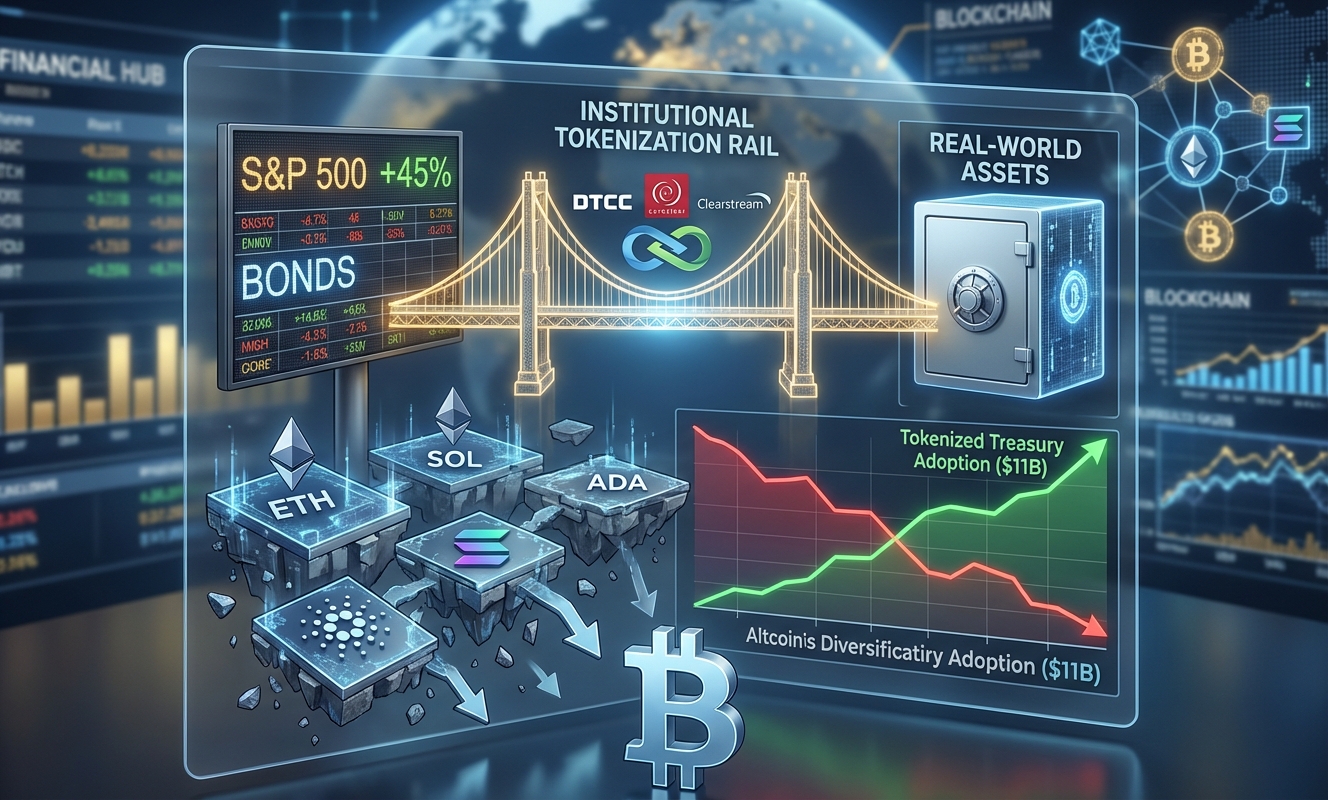
Picture the end state, even if it’s three to five years out:
In that world, the question “which Layer 1 should I buy for diversification?” simply stops making sense. You don’t need Solana to get non-correlated returns. You need a tokenized ETF and a stablecoin balance. That’s it.
Tokenized Treasuries are already at roughly $11 billion according to RWA.xyz data. That’s not a pilot. That’s product-market fit.
These instruments settle faster. They operate around the clock. They fit into DeFi as collateral. Institutions managing cash and short-duration positions love them. And critically, they represent yield-bearing, non-crypto exposure living natively on blockchain rails.
McKinsey projects $2 trillion in tokenized financial assets by 2030 in a base case, reaching $4 trillion in a bull scenario. BCG sees tokenized funds alone exceeding $600 billion. Even Amundi’s conservative estimate lands at $120 billion for tokenized funds by 2030.
The range is wide. The direction isn’t.
And none of those forecasts include crypto assets or stablecoins, which already sit above $300 billion. So we’re talking about an additional layer of tokenized real-world value being grafted onto the same infrastructure crypto built.
Look, I’m not saying altcoins go to zero tomorrow. Some won’t.
There are legitimate use cases that survive this shift. Protocols generating actual cash flows through transaction fees and staking yield remain investment candidates on their own merits. Projects building interoperability tooling, custody solutions, or on-chain compliance infrastructure actually benefit if tokenized securities adoption accelerates.
But here’s what absolutely does not survive scrutiny:
Between you and me, a huge portion of altcoin market cap is held by retail who were sold the diversification story. When tokenized equity access becomes frictionless through the same wallets they already use, that narrative collapses. Those bags become exit liquidity for whoever understood this transition earlier.
This isn’t going to happen next quarter. The DTCC paper is honest about the obstacles:
The vision is a “network-of-networks,” not a single dominant chain. Getting there requires harmonized data formats, message protocols, and legal frameworks across multiple major jurisdictions. That’s a multi-year project involving regulators who move slowly by design.
Near-term, the realistic path runs through tokenized money market funds and Treasury products first. Individual equities come later. Retail access gets mediated through regulated platforms as a final step, not a first one.

Here’s the danger most analysts won’t say clearly. We’re in a transition window. Tokenized securities aren’t ready for mainstream retail diversification yet. The infrastructure is being built, not delivered.
That means altcoin narratives still have room to run in the short term. Speculative capital doesn’t wait for DTCC to finalize interoperability standards. The next Bitcoin bull leg will almost certainly pull altcoins up with it, retail will pile in for diversification, and the cycle will repeat one more time before the tokenized securities infrastructure matures enough to redirect that flow.
The risk is getting caught holding that altcoin diversification bag when the structural argument fully dies. Rotating out into “the next Layer 1” with the assumption that it will behave differently from the last three? That’s been a losing trade across multiple cycles now.
The actionable move here isn’t to panic-sell altcoins today. It’s to be brutally honest about why each position exists.
The bottom line is uncomfortable but simple. Bitcoin for crypto exposure. Tokenized equities and fixed income for diversification. Altcoin positions treated as concentrated venture bets on specific protocol outcomes, not portfolio construction tools.
Anything else is just recycling a narrative the smart money has already moved past.
While Ethereum (ETH) is often cited as the primary alternative that could potentially challenge Bitcoin’s market dominance, beating Bitcoin remains highly unlikely in the near future. Bitcoin is firmly established as the industry’s digital gold. However, instead of searching for a cryptocurrency to “beat” Bitcoin, modern investors are increasingly looking at tokenized real-world assets (RWAs). If traditional equities and tokenized stocks move on-chain, Bitcoin holders might not even need another crypto asset to diversify, shifting the market narrative from competing with Bitcoin to complementing it with traditional financial assets on the blockchain.
Altcoins often lag behind Bitcoin because institutional capital typically flows into Bitcoin first as a safe-haven digital asset. Many altcoins struggle to connect with new market narratives or lack long-term real-world utility. As Bitcoin soars due to spot ETFs and massive institutional adoption, altcoins frequently drag their feet unless they tap into trending sectors like AI or Real-World Assets (RWAs). For Bitcoin investors, this altcoin underperformance reinforces the appeal of integrating tokenized stocks directly on-chain, allowing them to diversify their portfolios without taking on the higher volatility and risks associated with traditional altcoins.
Historically, investors have looked to established altcoins like Solana, XRP, Chainlink, TRON, and Monero for massive gains during a crypto bull run. However, skyrocketing returns often come hand-in-hand with extreme volatility and regulatory risks. As the digital asset market matures, the next explosive growth sector may not be traditional altcoins at all. Instead, the tokenization of real-world assets and traditional stocks is creating a new frontier for high-yield opportunities. If tokenized stocks gain widespread traction, Bitcoin investors may completely pivot away from speculative altcoins in favor of safer, on-chain traditional equities.
Tokenized stocks are digital representations of traditional market equities traded seamlessly on blockchain networks. Historically, Bitcoin investors used altcoins to diversify their cryptocurrency portfolios. However, altcoins are often highly correlated with Bitcoin’s price movements, failing to offer true diversification while adding significant volatility. By introducing tokenized stocks on-chain, Bitcoin holders can achieve genuine portfolio diversification by gaining exposure to traditional, stable financial markets—like S&P 500 companies—without ever leaving the crypto ecosystem. This innovation bridges the gap between traditional finance (TradFi) and decentralized finance (DeFi), effectively eliminating the need to rely on speculative altcoins.