Subtotal $0.00


Magazines cover a wide array subjects, including but not limited to fashion, lifestyle, health, politics, business, Entertainment, sports, science,


Magazines cover a wide array subjects, including but not limited to fashion, lifestyle, health, politics, business, Entertainment, sports, science,
 Fact Checked by Coinsbeat Editorial Team | Expert Reviewed by Themiya
Most retail investors hear “Bitcoin miner turns power-positive” and buy the stock. That’s exactly the kind of lazy analysis that gets people wrecked. Because here’s the thing: covering your electricity bill is not profitability. It’s just not dying yet.
A detailed cost model built around Riot Platforms’ public filings just exposed the gap between what mining company press releases imply and what the income statement actually shows. The spread is brutal. And it explains why mining stocks can look operationally fine while quietly hemorrhaging value at the accounting level.
Let’s be real about something the industry almost never explains clearly. “Cost to mine one Bitcoin” is not a single number. It’s three completely different numbers depending on which layer of the business you’re measuring.
Under current network conditions, assuming a difficulty of 145 trillion, a 3.125 BTC block reward, modern ASICs running at roughly 17 to 19 joules per terahash, and Texas industrial power at about $0.0667 per kilowatt-hour, the model spits out an electricity cost of $64,635 per BTC.
With Bitcoin sitting around $67,200, Riot’s power margin is a thin $2,565 per BTC. Positive. But barely.
Then reality hits.
Add Riot’s non-power operating costs of roughly $9,809 per BTC and that margin flips to negative $7,243. Tack on $39,687 per BTC in accounting depreciation and the accounting loss balloons to negative $46,930 per coin mined. At today’s price, Riot is clearing exactly one of three hurdles. One.
Look at what the model actually produces when you stack these costs properly:
That $49,495 gap between electricity break-even and full accounting profitability is not a rounding error. It’s the entire story of why public mining companies can sound healthy in a Twitter thread while their income statements quietly bleed.
The four-scenario stress test makes this impossible to ignore:
Honestly, that $126,000 target isn’t some moonboy fantasy number either. It’s the mathematically derived price at which a major, well-capitalized US miner actually becomes profitable by every legitimate measure. Let that sit for a second.

The model also runs Riot’s economics out to the 2028 halving, assuming the company scales from 38.5 exahash to 45 EH/s and holds there. Cumulative BTC mined across all scenarios stays roughly constant at 15,000 BTC. What changes dramatically is everything else.
The model identifies the precise accounting break-even price at $114,200 per BTC. Below that, Riot is accounting-negative on a cumulative basis through the next halving cycle. Full stop.
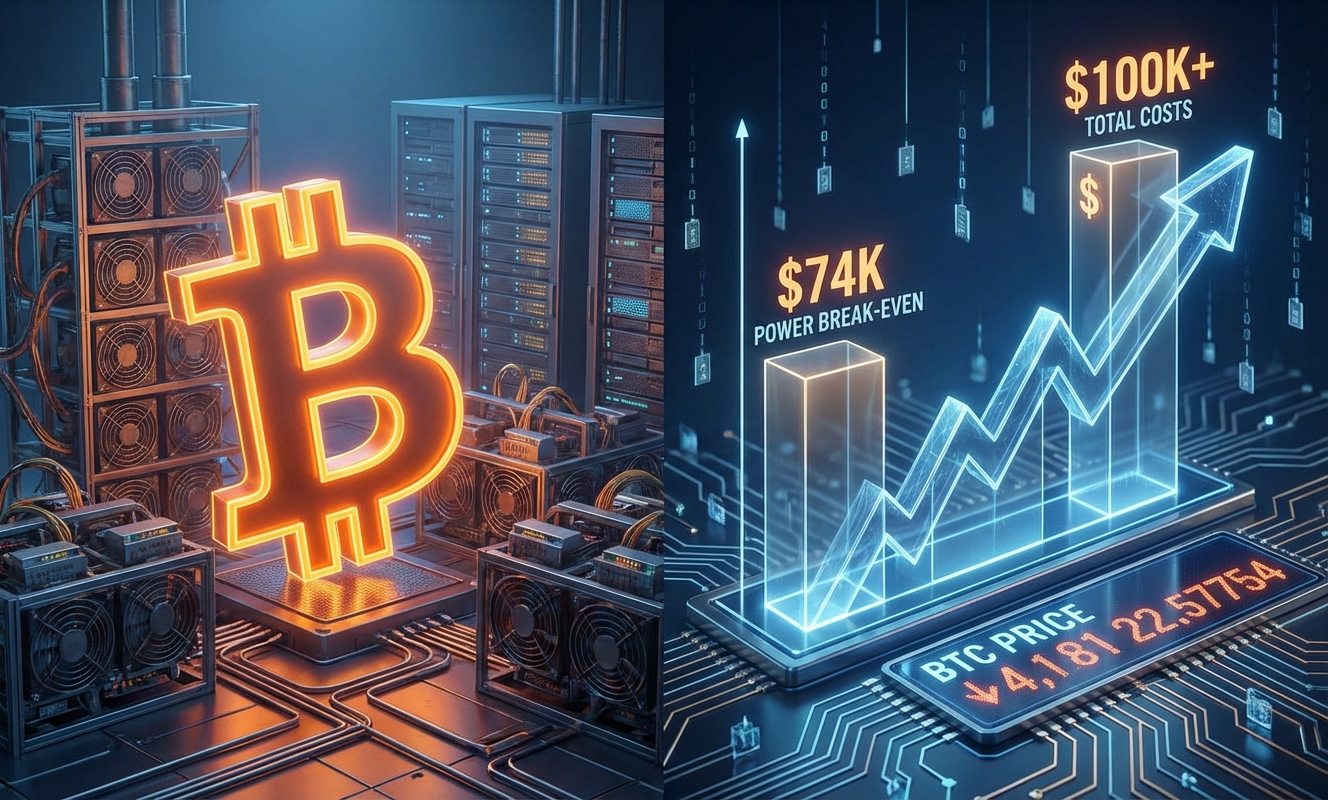
Here’s the hidden incentive structure nobody’s talking about. Miners sitting in that uncomfortable middle zone, power-positive but operating-negative, have one logical move: don’t sell the BTC you mine. Hoard it. Because selling at $67,000 to cover bills that add up to $74,000 in operating costs is just crystallizing a loss on paper that you could theoretically delay if price recovers.
This is why you’re seeing large miners increasingly frame their Bitcoin treasury as a strategic asset. It’s not some brilliant corporate innovation. It’s a rational, slightly desperate response to a margin squeeze that won’t resolve until price clears six figures.
The ASIC efficiency angle also matters here. The model compares three hardware configurations: the Bitmain S21 at 17.5 J/TH, the WhatsMiner M60S at 18.5 J/TH, and the older Antminer S19 Pro at 29.5 J/TH. The S19 Pro fleet carries a visibly higher cost line across every electricity price scenario. Miners still running older hardware aren’t just less efficient. They’re operationally vulnerable in a way that the fleet-efficiency headline numbers rarely capture.
And between you and me, a lot of smaller miners are still running that older hardware because they can’t afford to upgrade without taking on debt at rates that compress margins even further. It’s a trap.
The read-through for anyone holding mining equities is uncomfortable but important. A company that’s power-positive at $67,000 BTC is not the same as a company that’s profitable. The market has a habit of conflating these two things, especially during sentiment-driven rallies where investors stop reading income statements.
Riot specifically is a useful proxy for the wider US mining sector because its cost structure is relatively transparent. Other miners may have different overhead bases, different curtailment revenue profiles, or more aggressive depreciation schedules. But the three-layer framework applies universally. Nobody escapes it.
The companies that will actually compound value through this cycle are the ones clearing all three cost layers consistently. Right now, by this model’s math, not one scenario below $114,000 does that for Riot on a cumulative basis through 2028.
Older ASICs are not just inefficient. They’re exit liquidity for equipment manufacturers selling “upgrades” on favorable terms that add debt load. Miners chasing efficiency gains through hardware replacement cycles are sometimes trading one margin problem for another financed at 8 to 12 percent interest.

Positive power margin gets reported as “profitability.” Analysts cite it. Crypto media amplifies it. Retail buys the narrative. The actual accounting line, which is the one that determines whether equity holders are getting richer or just subsidizing machine runtime, stays buried in the 10-K.
Don’t be exit liquidity for that trade.
The model holds current per-BTC economics constant through 2028. That’s a generous assumption. Network difficulty isn’t static. It just posted its sharpest increase since 2021. If hash rate continues expanding while price stalls, the electricity cost per BTC rises, the power margin compresses further, and that $114,000 accounting break-even drifts even higher.
Add potential macro headwinds, the historical pattern of difficulty outrunning price in mid-cycle periods, and the fact that the next halving cuts the block reward again in 2028, and the window for sustained accounting profitability below a new all-time high gets very narrow very fast.
Pro-Tip: If you’re trading mining stocks, track the power margin disclosure in quarterly filings, but don’t stop there. Divide total operating expenses by self-mined BTC production to construct your own operating break-even. Then compare it to spot price. That simple ratio tells you more about where a miner actually sits than any “cost to mine one Bitcoin” figure an IR team will ever put in a press release.
References & Sources:
When the final Bitcoin is mined (expected around the year 2140), the total supply will hit its hard cap of 21 million coins, and no new Bitcoins will be generated as block rewards. However, the network will continue to operate normally. Instead of relying on new block subsidies, Bitcoin miners will earn their income entirely through transaction fees paid by users to process their transfers. This transition ensures that miners remain financially incentivized to secure the blockchain and validate transactions long into the future, even as operational costs and break-even points fluctuate.
The break-even point for Bitcoin mining is the specific price at which a miner’s generated revenue exactly covers their operational expenses. At its core, the baseline formula is straight-forward: Daily Operational Expenses divided by Daily Coin Yield equals the Break-even Price. However, a new macroeconomic model shows that miners currently need Bitcoin prices to stay above $74,000 just to break even on raw electrical power alone. When you factor in all other critical expenses, the true all-in break-even point is substantially higher.
While electricity is often the most visible expense in Bitcoin mining, it is only part of the equation. Recent models indicate that simply paying for power requires a Bitcoin price of over $74,000. The total cost to profitably mine a single Bitcoin exceeds six figures because enterprise mining operations must account for massive capital expenditures (CapEx) and operational expenditures (OpEx). These include purchasing expensive ASICs (mining hardware) that depreciate rapidly, facility leasing, advanced cooling systems, maintenance, payroll, and corporate taxes. As network difficulty increases, these cumulative overhead costs push the true profitability threshold well over $100,000 per coin.
The Bitcoin halving, an event programmed into the protocol to occur roughly every four years, cuts the block reward given to miners by 50%. This directly slashes the daily coin yield for mining operations. Because miners receive half as many Bitcoins for the exact same amount of computational effort, their break-even price essentially doubles unless offset by a corresponding surge in Bitcoin’s market value or a significant reduction in operational costs. With power break-evens already sitting around $74,000 post-halving, miners must rely on highly efficient equipment and lower-cost energy to survive the financial squeeze.