Subtotal $0.00


Magazines cover a wide array subjects, including but not limited to fashion, lifestyle, health, politics, business, Entertainment, sports, science,


Magazines cover a wide array subjects, including but not limited to fashion, lifestyle, health, politics, business, Entertainment, sports, science,

 Fact Checked by Coinsbeat Editorial Team | Expert Reviewed by Themiya
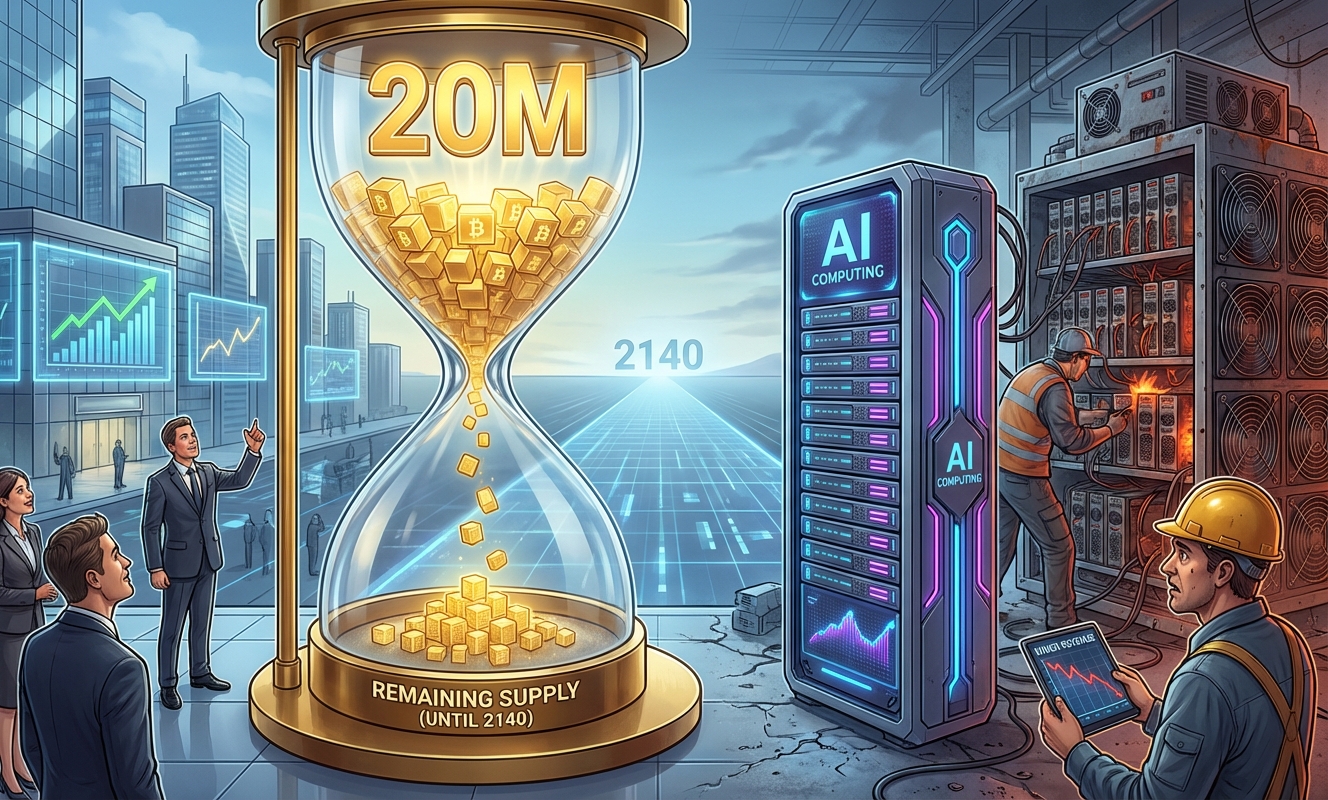
95% of all Bitcoin that will ever exist has already been mined. Let that sink in for a second. Block 940,000 crossed the wire on March 9th, mined by Foundry USA, and just like that, the circulating supply of BTC ticked past 20 million coins. The remaining 1 million? Those won’t fully enter circulation until roughly 2140. That’s not a typo. Over a century from now.
This isn’t just a feel-good milestone for Bitcoin Twitter to celebrate with laser-eye profile pictures. This is a structural inflection point that exposes a genuinely uncomfortable tension at the heart of the network. The supply story looks incredible on paper. The miner security story? Considerably less so.
Here’s the thing most of the celebratory posts conveniently skip over. Bitcoin’s issuance schedule was front-loaded by design from day one. Miners in 2009 were scooping up 50 BTC per block. By April 2024, after the fourth halving, that reward sat at 3.125 BTC. Do the math on what that trajectory means for the people actually keeping the lights on.
The dilution rate is now historically low. For holders, that’s the whole pitch. Constrained supply meeting broadening institutional demand through ETFs, corporate treasuries, and sovereign-adjacent allocators. It’s a clean thesis. But it obscures who’s being squeezed to deliver that thesis to you.
That last point is the tell. When the biggest names in Bitcoin mining are quietly rebranding their operations as AI infrastructure plays, that’s not diversification. That’s an exit strategy from a deteriorating core business, dressed up in shareholder-friendly language.
Look, the 20 million coin milestone is real. It’s verifiable on-chain. Nobody is disputing that the math works. But let’s be real about who’s amplifying it loudest.
Thomas Perfumo from Kraken called Bitcoin “one of the few truly scarce assets.” Simon Gerovich from Metaplanet called the coming era one of “true digital scarcity.” Both men are correct. Both men are also financially incentivized to say exactly that. Kraken profits from Bitcoin trading volume. Metaplanet holds BTC as a core treasury asset. Their optimism is genuine and also not free of conflict.
None of that makes the underlying argument wrong. The open-source code has run without interruption since 2009. The supply mechanics are not controlled by any government, central bank, or executive suite. That genuinely matters. Just don’t mistake a press release framing for independent analysis.

Honestly, this is the part that keeps serious Bitcoin economists up at night, even if they won’t always say it publicly.
Bitcoin’s security model works like this: miners burn electricity and computational resources to validate the chain, and in return, the network pays them. Right now, the block subsidy is doing almost all of that work. The long-term assumption baked into Bitcoin’s design is that transaction fees will eventually grow large enough to replace that subsidy as it halves away toward zero over the next hundred-plus years.
So far? The evidence supporting that assumption is thin to the point of being transparent.
Justin Drake from the Ethereum Foundation put it bluntly in 2025: “Bitcoin’s security model is broken.” He’s not exactly a neutral party, but his structural critique echoes concerns that Bitcoin-native developers and economists have raised internally for years. The fee market has not kept pace with successive halvings. The gap between subsidy income and fee income has widened, not narrowed.
The two counterarguments Bitcoin proponents offer are:
Both are plausible. Neither is proven. And both conveniently require decades of patience before we know if they’re correct. That’s a lot of faith to place in assumptions that won’t be stress-tested until the subsidy becomes truly negligible.
The bull case is straightforward and I’m not going to pretend it isn’t compelling. You have a hard-capped asset with a mathematically shrinking issuance rate, increasingly absorbed by institutional vehicles that pull coins off exchanges and into cold storage. ETF inflows, corporate treasury strategies, and sovereign-adjacent allocators have fundamentally changed the demand side of the equation over the past two years. Supply is tightening. Demand channels are multiplying. Basic economics says that combination matters.
The bear case is subtler and more structural. If the fee market doesn’t develop enough depth to compensate miners after future halvings, the network’s security budget thins out. A less-secured network is a more vulnerable one. Not vulnerable tomorrow. Not vulnerable in five years. But the trajectory is worth watching, not dismissing.
The honest position is somewhere between the laser-eye maximalism and the doomsday security warnings. The 20 million milestone is genuinely significant. The remaining supply mechanics are genuinely favorable for holders. And the miner security question is genuinely unresolved.
Here’s the catch that doesn’t fit neatly into the celebration narrative. The migration of well-capitalized miners toward AI hosting is happening right now, during a period of relatively high Bitcoin prices. Hashprice is still barely covering breakeven costs for many operators even with BTC in the range it’s been trading.
Now imagine the next major price drawdown. Say BTC revisits $61,000 levels that traders are already eyeing as support (and some are treating as a possible capitulation zone). At those prices, with current difficulty levels and the post-halving subsidy, a significant portion of the mining industry goes cash-flow negative. Some operations shut down. Hashrate drops. Difficulty adjusts, which helps, but the question of who remains to secure the network during prolonged bear markets is not an academic one.
The miners pivoting to AI aren’t going to pivot back overnight. That infrastructure is locked into multi-year contracts worth billions. Bitcoin mining becomes a secondary revenue stream for those operators, not the primary mission. The network’s security increasingly depends on a smaller, more specialized cohort of pure-play miners who can survive on compressed margins.
Pro-Tip: If you’re a long-term BTC holder, the 20 million milestone is worth understanding, not just celebrating. Use it as a trigger to review how much of your position is exposed to BTC’s price volatility versus truly cold, long-term storage. The institutional thesis is playing out. But the macro environment (oil above $115, weak jobs data, choppy risk sentiment) means the path higher is unlikely to be clean. Don’t let a milestone narrative pull you into buying a local top. Watch the $61,000 support level closely. A confirmed break below it with volume changes the short-term picture significantly, regardless of how good the supply story looks on a 10-year chart.
References & Sources:
Yes. In July 2022, Tesla quietly sold roughly 75% of its Bitcoin holdings, which was worth about $936 million at the time. This massive liquidation occurred during a period of macroeconomic uncertainty and severe market stress. While large corporate sell-offs like Tesla’s can cause short-term ripples and price volatility in the cryptocurrency market, the broader, long-term concern for Bitcoin’s network stability is increasingly focused on its core supply dynamics—specifically, how the network will remain secure now that 95% of the total supply has already been mined.
Once all 21 million Bitcoins are mined—which is projected to happen around the year 2140—miners will no longer receive “block rewards” in the form of newly minted Bitcoin. Instead, their revenue will rely entirely on transaction fees paid by users. This raises a critical security question: if the transaction fees are not high enough, or if the network volume drops, mining may become unprofitable. If a large number of miners power down their rigs, the global hash rate drops, potentially making the Bitcoin network more vulnerable to 51% attacks.
With 95% of all Bitcoin already in circulation, the remaining 5% will be distributed over the next century through a process known as “halving.” Every four years, the block reward paid to miners is cut in half. For modern miners, this means they must rely on the price of Bitcoin increasing dramatically or transaction fees rising to offset the shrinking block rewards. The heavily reduced emission rate forces the mining industry to become hyper-efficient, prioritizing cheap, renewable energy and highly advanced ASIC hardware to remain profitable.
It is highly likely that base-layer transaction fees will increase as block rewards approach zero, because miners will need those fees to cover their immense electricity and hardware costs. However, skyrocketing fees on the main blockchain don’t necessarily spell doom for everyday users. Layer-2 scaling solutions, such as the Lightning Network, are designed to process millions of smaller transactions off-chain for fractions of a cent. The main Bitcoin blockchain would then primarily serve as a highly secure, high-value settlement layer, generating enough total fee revenue to keep miners financially incentivized.