Subtotal $0.00


Magazines cover a wide array subjects, including but not limited to fashion, lifestyle, health, politics, business, Entertainment, sports, science,


Magazines cover a wide array subjects, including but not limited to fashion, lifestyle, health, politics, business, Entertainment, sports, science,

 Fact Checked by Coinsbeat Editorial Team | Expert Reviewed by Themiya
Binance already paid $4.3 billion to make the last sanctions mess go away. The ink was barely dry on that plea deal, and now the DOJ is reportedly sniffing around Iran-linked activity on the same platform. Again. Let that sink in for a second.
This isn’t just bad optics. It’s a stress test on whether the world’s largest crypto exchange actually fixed its compliance plumbing after 2023, or simply wrote a massive check and hoped regulators would lose interest.
Here’s the thing about plea deals in financial crime cases. They don’t grant immunity forever. They buy goodwill, install a monitor, and set a very clear standard: don’t do it again.
The reported probe centers on roughly $1.7 billion in suspect transfers, with more than $1 billion allegedly tied to an entity called Blessed Trust. What makes this particularly uncomfortable for Binance isn’t just the dollar figure. It’s that the Wall Street Journal reported Binance’s own investigators flagged this activity internally. That’s not a whistleblower story. That’s potentially a chain-of-custody problem inside Binance’s own compliance department.
Binance disputes everything, of course. Their official position is that the flagged entities were investigated and offboarded, no Iran-based entity transacted directly on the platform, and exposure to major Iranian crypto exchanges dropped 97.3% between early 2024 and mid-2025. They’ve also filed a defamation lawsuit against the WSJ. Bold move.
But here’s the catch prosecutors will focus on. The 2023 plea wasn’t just about what happened before the settlement. It locked Binance into a compliance framework with ongoing U.S. oversight. If sanctioned-linked activity occurred after that agreement, the legal exposure isn’t just reputational. It’s existential.
Look, this isn’t happening in a vacuum. U.S. regulators aren’t randomly picking on Binance because they’re bored. There’s a coordinated enforcement pattern building around Iran-linked crypto corridors.
The why here is pretty straightforward. The U.S. government is building a prosecutorial map of the entire Iran sanctions-evasion architecture in crypto. Binance, with 38.3% of centralized spot volume and $7.3 trillion processed in 2025 alone, sits at the center of that map whether they like it or not. Any serious probe of crypto-based Iran evasion has to examine the dominant offshore venue. It’s basic investigative logic.
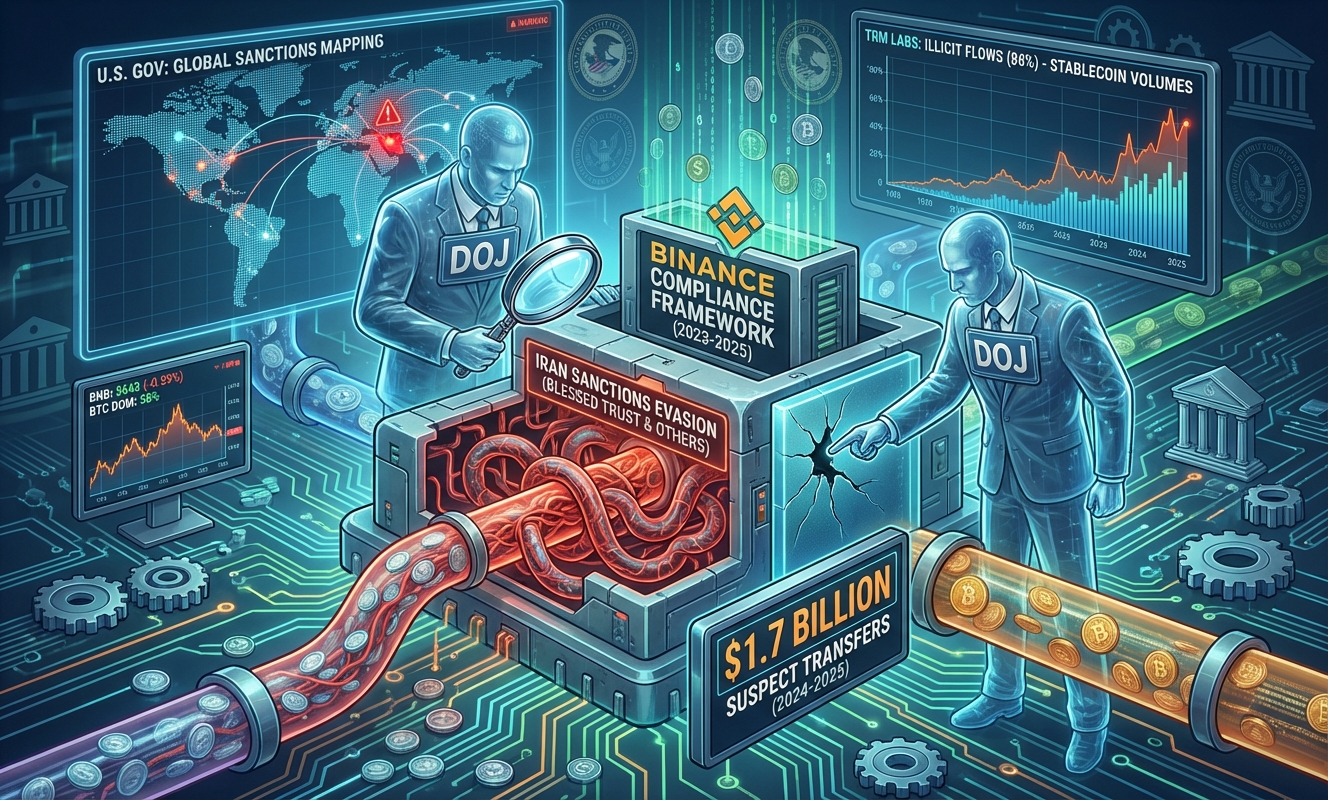
Markets haven’t panicked yet. BNB was down just 0.59% over 24 hours at $643, with a 30-day gain still sitting at 2.65%. Bitcoin dominance held at 58%. No bank run. No crater.
But don’t mistake quiet for safe.
The market is currently pricing this as a prolonged probe, not an imminent action. That’s a reasonable baseline read. The problem is that confidence reprices fast and ugly when the narrative shifts. And with $151.2 billion in reported reserve assets sitting on Binance, even small percentage moves in user behavior become massive in absolute dollar terms.
BNB is the clearest pressure valve to watch. It’s directly tied to Binance’s brand equity and exchange revenue streams. Bitcoin doesn’t care much about Binance-specific legal risk at this scale. Institutional ETF flows run on their own logic. But BNB? BNB absorbs reputational stress immediately and visibly.
If spot share starts slipping on CoinGecko’s monthly data, if reserve assets tick down two months in a row, and if BNB underperforms Bitcoin by more than 8-10% on a weekly close, that’s when this moves from background noise to a real structural market event.

Honestly, the most likely path here is slow and ugly rather than fast and catastrophic. Here’s how the scenarios actually break down from where I’m sitting.
Here’s what actually keeps me up at night about this situation. The critical legal question isn’t whether Binance is guilty of anything. It’s whether the alleged Iran-linked activity occurred after the 2023 plea agreement.
If it did, this isn’t a repeat of old sins. This is a potential violation of the settlement itself. That changes the entire enforcement calculus. Prosecutors don’t need to build a fresh case from scratch. They potentially just need to show the monitor agreement was breached. The threshold for action drops significantly.
Binance’s defamation lawsuit against the WSJ is a double-edged sword, too. Filing that suit means going into discovery. Discovery means documents, internal communications, and compliance records get examined under oath. That can be a power move when you’re genuinely innocent. It can also be catastrophic when internal records don’t perfectly match public statements.
Pro-Tip for traders: Don’t try to short BNB on this headline alone. The market has already partially digested the news, and the soft-landing scenario carries real probability. Instead, watch the monthly CoinGecko spot share figure. If Binance drops below 35% from its current 38.3% position over two consecutive months, that’s a data-confirmed signal that users are diversifying. That’s your entry point for a directional thesis on BNB weakness relative to Bitcoin. Until then, treat this as a background risk factor worth monitoring weekly, not a trade you need to make today.
References & Sources:
In 2023, Binance pleaded guilty to serious allegations involving systematic sanctions evasion. The core of the issue was that the exchange allowed individuals in heavily sanctioned nations to utilize the platform and conduct business with United States customers. Specifically regarding Iran, U.S. prosecutors discovered at least 1.1 million transactions totaling nearly $900 million that directly violated federal law. Despite a massive historical settlement, the Department of Justice is currently investigating fresh allegations that the exchange is still facilitating illicit, Iran-linked cryptocurrency flows.
The initial Department of Justice complaint centered on Binance Holdings Limited—the operator of the world’s largest cryptocurrency exchange—violating the Bank Secrecy Act (BSA) and failing to register as a money transmitting business. To resolve this extensive investigation into their failure to implement adequate anti-money laundering controls, Binance pleaded guilty and agreed to pay over $4.3 billion. However, the DOJ is now launching a renewed probe to determine if Binance has continued to allow illegal crypto transfers tied to Iranian entities despite this historic resolution.
Binance and its founder, Changpeng Zhao (CZ), were convicted of severely violating U.S. anti-money laundering (AML) laws and sanctions requirements in 2023. The company was found guilty of prioritizing growth over compliance, leading to billions in illicit transfers. While CZ stepped down and was later pardoned by President Trump—a controversial decision heavily condemned by dozens of House Democrats—the corporate conviction remains. The crypto giant is now back under federal scrutiny as authorities track potentially new illegal financial flows linked to Iran.
Yes, alongside ongoing U.S. scrutiny, French investigators opened a judicial probe against Binance in early 2025. Authorities in Paris are actively investigating the cryptocurrency platform for suspected money laundering, tax fraud, and other related charges. Although Binance has strongly denied these allegations, this French investigation significantly adds to the mounting global regulatory pressure the exchange faces in the wake of its massive $4.3 billion U.S. settlement and the new DOJ inquiries regarding Iranian crypto transactions.