Subtotal $0.00


Magazines cover a wide array subjects, including but not limited to fashion, lifestyle, health, politics, business, Entertainment, sports, science,


Magazines cover a wide array subjects, including but not limited to fashion, lifestyle, health, politics, business, Entertainment, sports, science,

 Fact Checked by Coinsbeat Editorial Team | Expert Reviewed by Themiya
Retail is buying. Institutions are leaving. And somehow XRP just hit a monthly high of $1.60. If that sentence doesn’t make you pause, you’re not paying close enough attention.
Here’s the thing. The divergence playing out in XRP right now is one of the more fascinating setups in the current cycle. On-chain metrics are screaming adoption. ETF flows are screaming panic. Both things are true simultaneously, and figuring out which signal matters more right now is the entire game.
Let’s be real. XRP’s on-chain data doesn’t usually get people excited. But what’s happened over the past few weeks is genuinely notable.
That last number is the one worth staring at. Nearly 3 million transactions per day is not noise. It’s not wash trading dressed up as activity. That’s financial assets moving on-chain at scale, and Evernorth, the largest XRP treasury company, was quick to point it out in a recent market update.
The deeper question is why. The macro trigger here is straightforward. Ripple has spent the last six months aggressively acquiring infrastructure. Hidden Road, GTreasury, Palisade. These aren’t random purchases. Ripple is building a payments and custody pipeline that routes through XRP, and it’s starting to show up in the ledger’s raw transaction volume. The adoption is real. It’s just not coming from where most XRP holders expected.
Now for the part that should make you uncomfortable.
CoinShares reported $133 million in outflows from XRP investment products in March alone. That’s the worst monthly performance for XRP among all professionally managed digital asset products this year. The four US spot XRP ETFs have been bleeding continuously since March 5, collectively hemorrhaging around $58 million.
To make this hurt a little more, that streak is the longest continuous outflow run since those ETFs launched in November. And it follows four consecutive months of positive inflows totaling approximately $1.26 billion. So institutions loaded up, got spooked, and are now quietly heading for the exit.
Honestly, the reason isn’t complicated. Geopolitical noise, Middle East tensions, a broader risk-off rotation. When macro fear kicks in, institutional money doesn’t flee to altcoins. It flees to Bitcoin. CoinShares data confirms this perfectly, with Bitcoin funds absorbing approximately $1.3 billion in fresh inflows over the same period. Institutions aren’t abandoning crypto. They’re just being very specific about which crypto they’ll hold when things get turbulent.
That’s the hidden incentive structure here. XRP ETF products were built and marketed to a TradFi audience that fundamentally views XRP as a risk-on altcoin, not a store of value. The moment macro pressure builds, those same TradFi hands are going to rotate straight into Bitcoin products. Every single time.
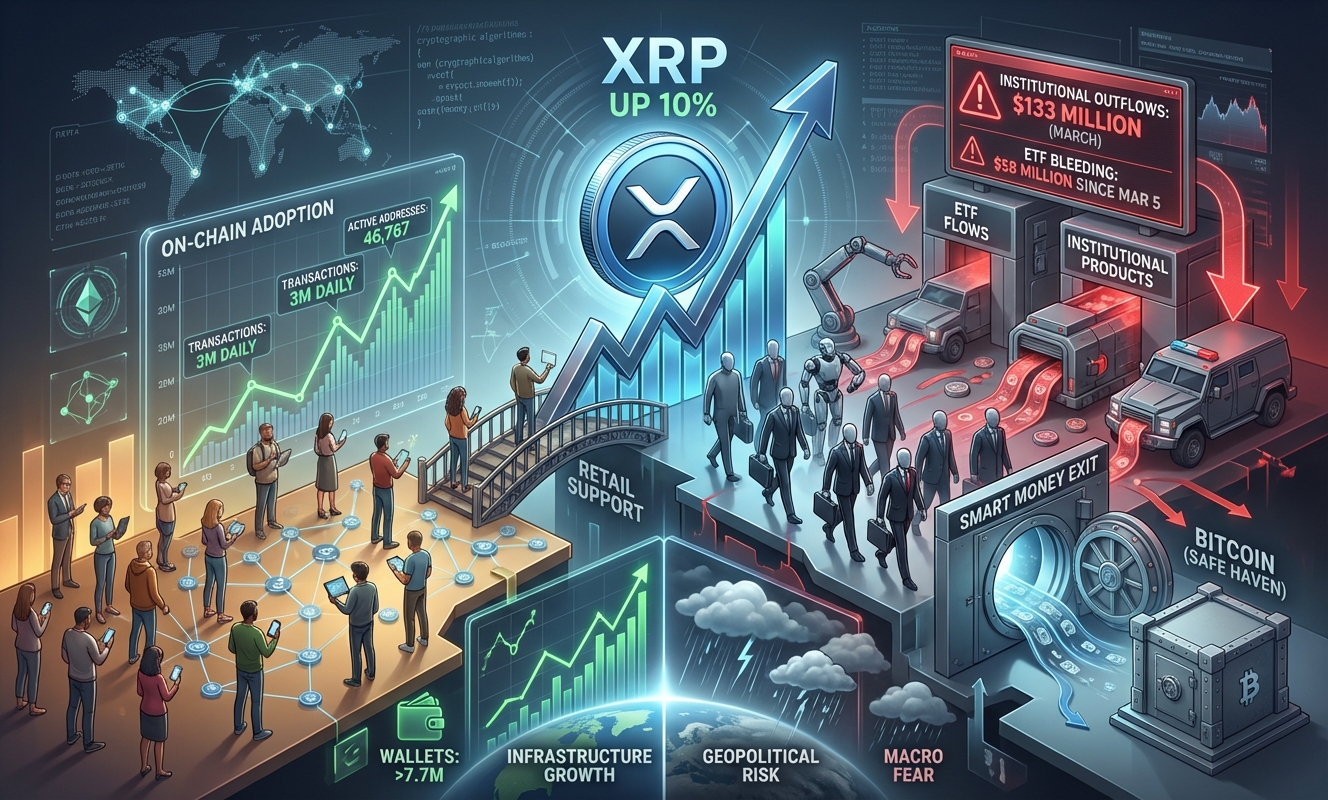
With institutional selling ongoing, retail spot buyers are the ones holding the price up. CryptoQuant confirmed this. Open interest on derivatives exchanges including Binance has been trending down since the start of the year, meaning the speculative leverage that pumped XRP in previous rallies has been flushed out. That’s not inherently bad. Leverage washouts can set up cleaner moves.
In the last 24 hours, open interest ticked up slightly to $2.84 billion while daily derivatives volume surged 71% to $7.37 billion, the highest since mid-February. Something is waking up. Whether it’s a genuine structural recovery or just exit liquidity being created for whoever is still holding leveraged longs, that’s the question nobody can answer definitively right now.
Analyst Dom added an interesting data point. The order book on Coinbase is showing the largest bid skew within a 50% range seen in nearly a year. Translation: there’s not much sell-side resistance between $1.50 and $2.00. The road up is less crowded. But a thin order book cuts both ways. It means price can move fast in either direction with relatively little volume.

Look. For XRP to sustain any meaningful move upward, two things need to happen and neither is a given.
Ripple’s corporate moves are genuinely interesting long-term. The Hidden Road acquisition alone could pull serious institutional payment flow through XRP infrastructure. But corporate strategy and token price are two very different conversations, and right now the market is confusing the two.
A thin order book between $1.50 and $2.00 sounds bullish. And it can be. But traders shilling this setup as a free ride to $2 are conveniently ignoring the fact that institutional products continue to print net negative flows every single day.
Between you and me, the most interesting version of this trade is waiting. Let the macro dust settle, watch for even one week of positive ETF inflows, and let the on-chain fundamentals do their job in the background. Chasing a 10% weekly move with $133 million in institutional outflows behind it is how you become someone else’s exit liquidity.
References & Sources:
XRP’s recent rally is primarily driven by a significant surge in on-chain activity on the XRP Ledger (XRPL). Increased active wallets, higher transaction volumes, and renewed network utility are actively overpowering the negative market sentiment typically caused by institutional sell-offs. Essentially, strong fundamental network metrics and organic demand are shielding XRP’s price from the broader impact of the $50 million in ETF outflows.
Typically, heavy ETF outflows signal a decrease in institutional interest or broader macroeconomic bearishness, which traditionally puts downward pressure on a cryptocurrency’s price. However, in the current scenario with XRP, the robust on-chain metrics and increased network activity have entirely offset this selling pressure. The recent $50 million outflow demonstrates that strong retail demand and organic network utility can sometimes decouple a digital asset from institutional market trends.
The surge in XRP Ledger (XRPL) activity is being fueled by multiple factors, including an increase in cross-border payment utility, the continuous minting of new tokens, rising decentralized exchange (DEX) volume, and expanding developer ecosystem initiatives. When active addresses and transaction counts spike, it indicates that users are actively utilizing the network for its fast, low-cost features, translating into strong bullish sentiment for the native XRP token.
Whether XRP’s price can maintain its upward trajectory amidst continuous ETF outflows depends heavily on the sustainability of its underlying ledger activity. If on-chain metrics, such as transaction volume, active addresses, and network adoption, remain historically high, XRP can continue to weather institutional sell-offs. However, persistent macroeconomic headwinds and prolonged institutional dumping could eventually test the resilience of this utility-driven rally.