Subtotal $0.00


Magazines cover a wide array subjects, including but not limited to fashion, lifestyle, health, politics, business, Entertainment, sports, science,


Magazines cover a wide array subjects, including but not limited to fashion, lifestyle, health, politics, business, Entertainment, sports, science,

 Fact Checked by Coinsbeat Editorial Team | Expert Reviewed by Themiya
Bitcoin broke below $70,000. The Fed stayed put. The ECB is now openly talking about hiking rates. And oil is sitting above $119 a barrel. If you still think this cycle plays out the same way it did in 2023 and 2024, you need to seriously reconsider your thesis.
Let’s be real. The entire bull narrative for crypto since late 2024 has rested on one assumption: major central banks were cutting. Maybe slowly, maybe reluctantly, but cutting. That assumption is now getting shredded in real time by a Middle East conflict that refuses to resolve and an energy market that is repricing everything downstream.
Here’s what actually happened on March 18 and 19. The Fed held rates at 3.50%-3.75%. Fine. Markets expected that. But the detail that matters is buried in the Summary of Economic Projections. The Fed lifted its 2026 headline and core PCE forecasts to 2.7%. Both of them. That is not a central bank that feels comfortable cutting aggressively. Chair Powell said it plainly: higher energy prices will push up overall inflation in the near term.
Then the ECB followed. Held at 2.00%, yes, but revised its 2026 inflation forecast from 1.9% all the way up to 2.6%. One official reportedly admitted the baseline is already outdated. Another floated $200 oil as a potential trigger for an April emergency move. The June meeting is now considered a live action window for a rate hike.
The Bank of England? Also held. But the market is now pricing a higher probability of a BoE hike than a cut. Think about that for a second.
Traders have repriced Fed easing expectations to roughly 14 basis points by December. That’s less than a single quarter-point cut. Not one full cut expected from the Fed this year. Meanwhile two ECB hikes are now fully priced in, with better-than-even odds of a third.
This isn’t a “cuts delayed by a quarter” story anymore. This is a regime change.
The trigger is not crypto-native. There is no exchange hack, no regulatory crackdown, no leverage wipeout driving this. It’s Brent crude briefly touching $119 on March 19 and a four-week-old Middle East conflict with no resolution in sight.
The ECB’s own scenario work makes the stakes clear. Their official baseline assumed Brent at $81.30 for 2026. Their adverse scenario peaks near $119 (where oil already was on March 19). Their severe scenario peaks near $145, which would push euro-area headline inflation to 4.4% in 2026 and 4.8% in 2027.
Those aren’t fringe numbers anymore. They’re the scenarios central banks are actively stress-testing against.
The IMF’s rule of thumb adds context. Every sustained 10% rise in energy prices for roughly a year can add about 0.4% to global inflation and trim output by 0.1% to 0.2%. That compounds fast. And it explains why central banks can’t just “look through” this shock the way they tried to in earlier cycles, especially when core inflation is still sitting above their 2% targets.
Bank of America noted that a quick resolution could pull Brent back toward $70. Honestly, that scenario is looking thinner every day given the March 19 escalation reports.
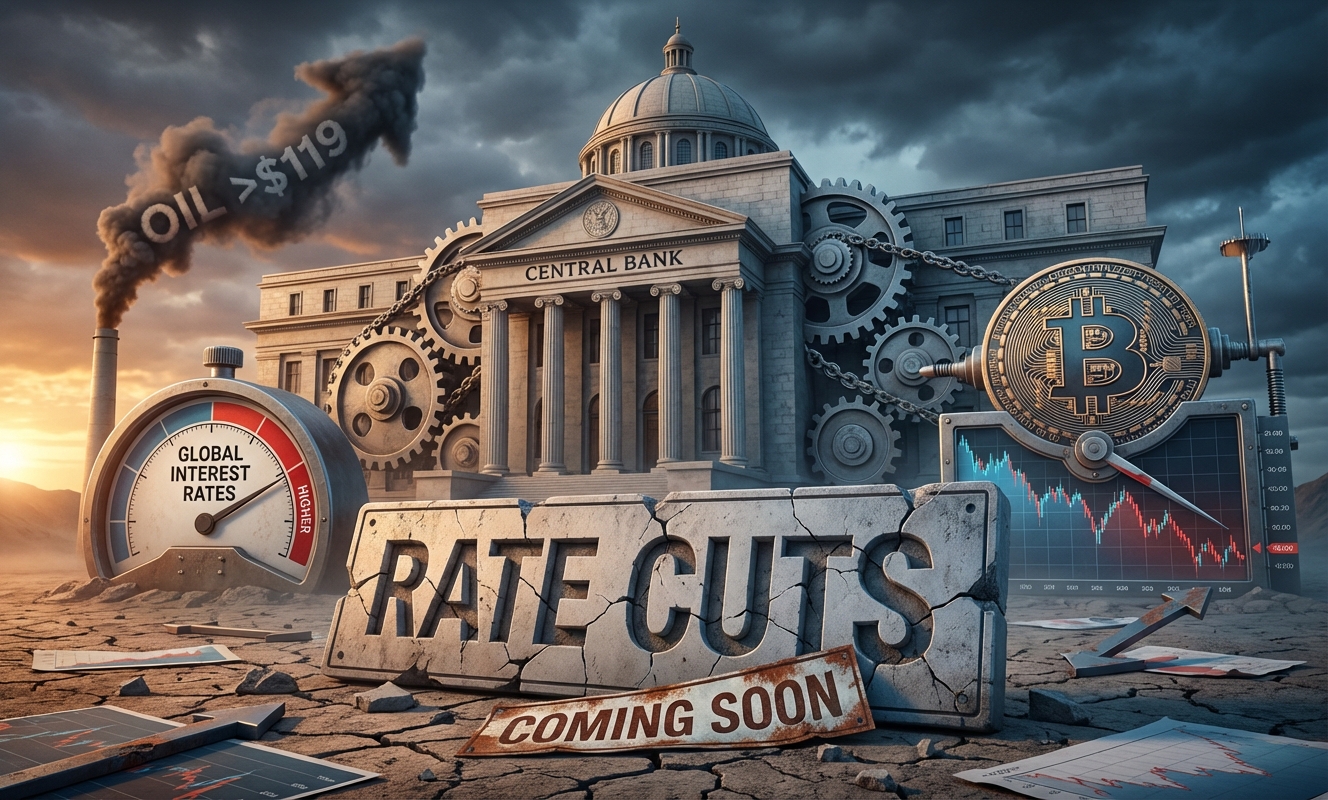
This is the uncomfortable part for a lot of retail holders. Bitcoin fell to an intraday low of $68,834 on March 19. Not because of anything happening on-chain. Not because of whale manipulation or forced liquidations from a leverage blowup. It fell because global rate expectations moved, and Bitcoin is now sensitive enough to macro liquidity that it reprices faster than equities.
Look at the sequence. Fed raises inflation projections, keeps only one cut in the median path. ECB raises inflation forecast and publishes severe scenarios. Traders dump expected rate cuts. Bitcoin breaks a key psychological level. That’s the chain of causation, and it happened inside 48 hours.
The asset is behaving less like a speculative tech-adjacent play and more like a liquidity-sensitive instrument that moves when the global cost of capital moves. That’s a double-edged reality. In a cutting cycle, it’s a massive tailwind. In a hiking cycle, or even a “higher for longer” holding pattern, it’s a headwind that doesn’t need a single crypto-specific negative catalyst to hurt you.
That bull case requires oil to cooperate. Right now, oil is not cooperating.
Honestly, the $58,000 level is not some permabear fantasy at this point. It’s a credible outside anchor from a major institutional desk.
The ECB’s own scenario analysis explicitly assumes stronger indirect and second-round effects than standard models would produce. That language is important. Central banks are not treating this as a transient supply disruption. They learned in 2022 that energy shocks, if large and persistent enough, don’t stay contained to the energy line in the CPI. They bleed into services, wages, and expectations.
The Fed’s projections now show inflation at 2.7% for both headline and core in 2026. Well above target. The BoE has publicly stated it will “do what is necessary” to keep inflation on track. These are not dovish central banks waiting for an excuse to cut. These are central banks that got caught flat-footed once before and don’t want to make the same mistake twice.
Some desks are now quietly discussing the probability of a Fed hike by year-end. That’s a tail risk. But tails matter when they’re being priced by sophisticated institutional traders, not retail speculation.

Right now, Brent crude is a leading indicator for Bitcoin’s near-term direction. Watch the weekly Brent close. If oil sustains above $115, the macro liquidity argument for Bitcoin gets worse before it gets better, and any relief rallies toward $72,000-$73,000 should be treated with caution unless you see a structural shift in energy prices. Don’t get front-run by whale positioning that already knows where the central bank decisions are heading. Set your alerts on oil, not just BTC price feeds.
Here’s the thing. Every time Bitcoin bounces off a key level like $69,000, retail FOMO kicks in. Social media lights up with “the bottom is in” shilling, and latecomers pile into leveraged longs. Be very careful. In a higher-for-longer macro environment with two potential ECB hikes priced in and the Fed barely expected to cut once, relief rallies are where smart money distributes. They aren’t confirmed bottoms. Until there is a clear, sustained reversal in energy prices and a meaningful shift in central bank forward guidance, every rally carries the risk of turning you into exit liquidity for more informed positioning.
The old narrative is dead. What replaced it is messier, more uncertain, and frankly more dangerous for anyone running high conviction long positions with leverage. Size accordingly.
References & Sources:
If Bitcoin breaks decisively below the critical $70,000 support level, it could trigger a massive liquidation cascade in the derivatives market, accelerating a downward trend. While this psychological threshold has spent weeks consolidating and is heavily defended by buyers, escalating macroeconomic pressures—such as rising oil prices forcing central banks to rethink interest rate cuts—make this support zone increasingly vulnerable to aggressive selling and amplified market dips.
Bitcoin’s recent drop toward the $70,000 mark is heavily influenced by institutional shifts, notably investors pulling capital from spot Bitcoin ETFs. Recent data shows hundreds of millions in net outflows from major funds, including BlackRock’s IBIT. When combined with renewed inflation fears sparked by surging global oil prices, cautious investors are rapidly rotating out of risk-on assets, resulting in sudden price suppression across the cryptocurrency market.
Bitcoin’s broader downward volatility is deeply tied to global macroeconomic instability and shifting monetary policies. As surging oil prices become a central-bank problem by fueling inflation, hopes for looser monetary policy fade. This geopolitical uncertainty, along with correlated sell-offs in global stock markets and fluctuating commodities like gold and silver, prompts traders to drastically reduce their exposure to volatile risk assets like Bitcoin.
Despite fierce market corrections and significant macroeconomic headwinds, it is highly unlikely that Bitcoin will ever go to zero. The cryptocurrency is fundamentally buoyed by robust, sustained demand from long-term holders, institutional investors, and corporate treasuries. Even during steep sell-offs driven by central-bank tightening or inflation fears, this deep structural support and Bitcoin’s established global role as a decentralized digital asset prevent a total collapse in value.