Subtotal $0.00


Magazines cover a wide array subjects, including but not limited to fashion, lifestyle, health, politics, business, Entertainment, sports, science,


Magazines cover a wide array subjects, including but not limited to fashion, lifestyle, health, politics, business, Entertainment, sports, science,

 Fact Checked by Coinsbeat Editorial Team | Expert Reviewed by Themiya
The March PMI data just dropped, and it’s not pretty. Stagflation isn’t some distant theoretical risk anymore. It’s showing up in the actual numbers, and Bitcoin is caught right in the middle of it.
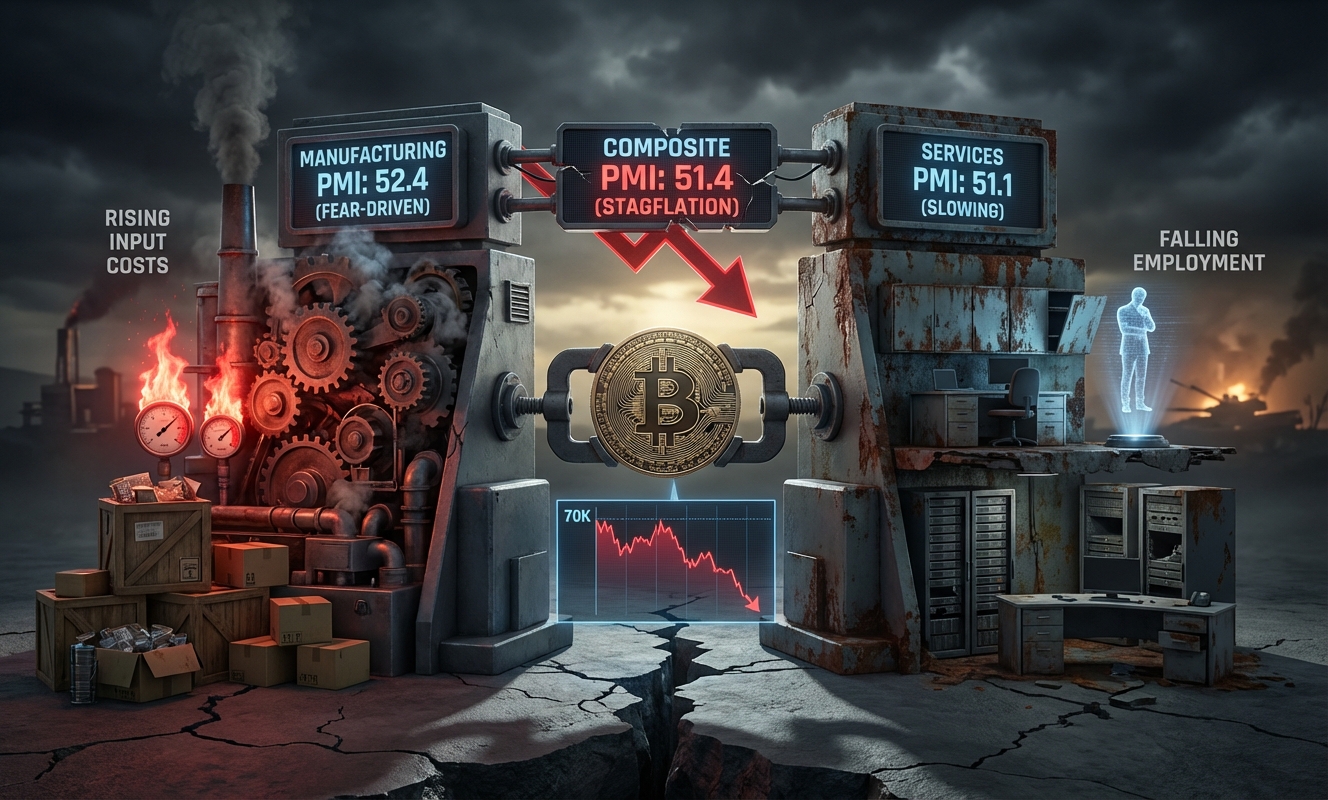
S&P Global’s flash composite PMI came in at 51.4, down from 51.9 in February. On the surface, that looks like a minor dip. But dig one layer deeper and the picture gets genuinely uncomfortable.
Here’s the thing. Manufacturing jumped to 52.4. Services slipped to 51.1. Most people see manufacturing up and think “solid.” Wrong call. That factory surge isn’t organic demand. It’s panic buying. Companies are front-running supply disruptions, stacking inventory before costs spike further, and scrambling to lock in supplier contracts while they still can. That’s not strength. That’s defensive positioning.
Services told the real story. New business slowed. Exports fell. Confidence among service providers dropped, with companies blaming higher living costs, elevated borrowing rates, and war-driven uncertainty. And then came the number that should genuinely worry crypto traders: input costs rose at their fastest pace in 10 months, while employment fell for the first time in over a year.
Let’s be real. That’s a stagflation cocktail. Slower growth, rising prices, and a labor market that just flinched. S&P Global estimated the US economy is tracking at roughly 1% annualized growth in March, while inflation looks like it could be drifting back toward 4%. Those two numbers sitting side by side? That’s the Fed’s nightmare scenario, and by extension, it’s ours too.
Bitcoin dipped after the release, losing its footing at the $70,000 level. Some bulls are shrugging it off. Don’t.
The entire rate-cut narrative that was quietly propping up risk appetite just took a serious hit. Bitcoin, like it or not, still trades like a high-beta risk asset in the short to medium term. When yields move higher and the dollar holds firm, BTC historically struggles to build momentum. That’s not a bearish opinion. That’s just what the correlation data shows over and over again.
Some crypto bulls are floating the idea that eroding confidence in fiscal policy eventually drives Bitcoin higher as a hedge. Honestly, that argument has merit in the long run. But Tuesday’s PMI gave that thesis zero near-term ammunition. The market is still laser-focused on rates staying higher for longer, and that’s the environment Bitcoin has to navigate right now.
Look, the Iran situation is making all of this harder to read. Energy prices are elevated because of it. Supply chains are getting rattled because of it. And companies are making inventory decisions based on war-driven fear rather than genuine demand signals. That distorts every data point we’re looking at.
The manufacturing PMI surge looks bullish on paper, but it’s essentially fear-driven stockpiling. When that buying cycle ends, and it always does, you could see factory activity fall off a cliff. That’s a secondary risk most macro traders aren’t modeling yet.
Bitcoin caught a brief spike above $70,000 when news broke of a pause in US Iran strikes. That move was entirely geopolitical, not fundamental. It evaporated almost as fast as it appeared. That should tell you something. Relief rallies in this environment are not conviction-driven. They’re just short-covering and noise.
The next two data prints matter enormously. Upcoming inflation and labor market reports will either confirm what the PMI is signaling or give bulls a reason to breathe again. If CPI comes in hot and jobs data shows further softening, the stagflation case firms up fast, and Bitcoin’s path of least resistance becomes a grinding, frustrating chop below key resistance levels.

Here’s where it gets genuinely nuanced. Bitcoin does have a case as a long-term stagflation hedge, particularly as confidence in central bank credibility erodes. If the Fed is perceived as being stuck between a rock and a hard place for an extended period, some capital historically flows toward scarce, non-sovereign assets. Gold has already been making that move. Bitcoin could eventually follow.
But “eventually” is doing a lot of heavy lifting in that sentence. The short-term reality is that Bitcoin is still being traded by a large chunk of the market as a risk-on asset, not a monetary hedge. That positioning doesn’t shift overnight.
Here’s the catch that most crypto media won’t spell out clearly. The current environment is a perfect breeding ground for whale manipulation and exit liquidity traps. When macro conditions are murky and retail sentiment is confused, large players have enormous incentive to pump prices on geopolitical relief headlines, shake out weak hands on negative macro prints, and repeat the cycle.
That $70,000 spike on the Iran pause headline? Classic. Retail piles in on the good news, whales who were already positioned use that liquidity to trim. Then the macro data lands and the price drifts back down. Retail is left holding bags while institutions quietly repositioned.
Until then, the honest read is this. The macro backdrop is tougher than the crypto community wants to admit, the Fed has less room to help risk assets than hoped, and the stagflation thesis is moving from fringe concern to base-case scenario faster than anyone expected. Position accordingly.
References & Sources:
Stagflation, which is characterized by stagnant economic growth paired with persistently high inflation, creates a highly challenging macroeconomic environment for Bitcoin. While Bitcoin is frequently championed by enthusiasts as a decentralized hedge against inflation, stagflation historically forces central banks to keep interest rates elevated to combat rising prices. Higher interest rates drain liquidity from the market, strengthen the US dollar, and make risk-on assets like cryptocurrencies less attractive to institutional and retail investors, potentially triggering significant price corrections.
The US Purchasing Managers’ Index (PMI) is a leading economic indicator that evaluates the health of the manufacturing and service sectors. A declining PMI indicates an economic slowdown. When a weakening PMI is coupled with stubborn inflation data, it triggers fears of stagflation. The crypto markets react aggressively to PMI reports because this data heavily influences the monetary policy decisions of the Federal Reserve. A stagflation-signaling PMI report reduces the likelihood of rate cuts, subsequently dampening investor appetite for speculative assets like Bitcoin.
Bitcoin’s status as a reliable safe haven during economic slowdowns remains highly debated. Proponents argue that its hard-capped supply of 21 million coins inherently protects purchasing power against fiat currency debasement. However, recent market cycles have demonstrated that Bitcoin largely trades as a high-beta risk asset, similar to tech stocks. When an economic slowdown occurs alongside high inflation—necessitating tight monetary policy—Bitcoin has struggled to maintain its value, challenging the narrative that it is a safe-haven asset comparable to physical gold.
During a stagflation scare, cryptocurrency investors should closely monitor a combination of inflation and growth metrics. Key indicators include upcoming US PMI readings, the Consumer Price Index (CPI), and the Producer Price Index (PPI). Furthermore, investors must pay strict attention to the Federal Reserve’s Federal Open Market Committee (FOMC) meetings. If the Fed signals a willingness to lower interest rates to spur growth despite inflation, it could provide a massive tailwind for Bitcoin. Conversely, a commitment to “higher for longer” rates will likely maintain downward pressure on the crypto market.