Subtotal $0.00


Magazines cover a wide array subjects, including but not limited to fashion, lifestyle, health, politics, business, Entertainment, sports, science,


Magazines cover a wide array subjects, including but not limited to fashion, lifestyle, health, politics, business, Entertainment, sports, science,

 Fact Checked by Coinsbeat Editorial Team | Expert Reviewed by Themiya
The “miners hold forever” narrative is dead. It just hasn’t been buried yet.
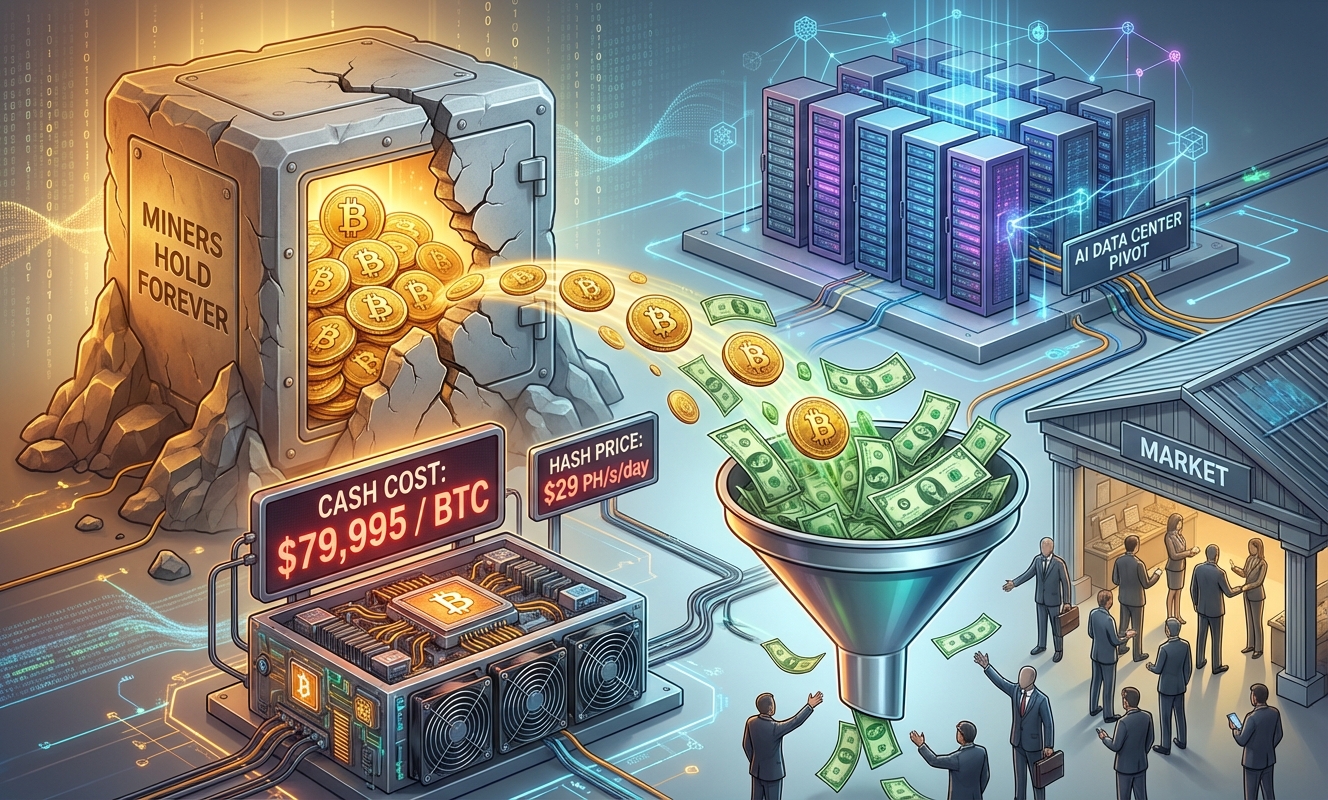
CoinShares dropped a mining report that should genuinely rattle anyone still treating public miner treasury balances as a structural floor for Bitcoin’s price. The numbers aren’t pretty. The weighted-average cash cost for public miners hit roughly $79,995 per BTC in Q4 2025. Hash price cratered from $36-$38 per PH/s/day down to approximately $29 in Q1 2026. Three consecutive negative difficulty adjustments. The first streak like that since July 2022.
Let’s be real about what that means. These aren’t abstract metrics. That’s the sound of an entire industry’s business model cracking under its own weight.
Here’s the thing most retail investors get badly wrong. They look at public miners collectively sitting on 121,516 BTC, worth roughly $8.63 billion, and assume that pile is bullish. Locked up. Safe. A signal of conviction.
It isn’t. Not anymore.
When margins collapse, miners don’t behave like Bitcoin believers. They behave exactly like any other commodity producer bleeding cash. They sell. And the brutal irony is they tend to sell the hardest precisely when BTC spot price is already weak, making treasury liquidation a pro-cyclical headwind rather than a stabilizing force.
The receipts are already in:
Honestly, that behavior should reset your entire framework for reading miner treasury data. Those 121,516 BTC aren’t a war chest. In a prolonged downturn, they’re a supply overhang that activates exactly when BTC can least absorb the selling pressure.
CoinShares believes listed miners could pull up to 70% of their revenues from AI by end of 2026. That’s up from roughly 30% today. Look at what’s already in motion:
CoinShares describes this explicitly as a bifurcation. AI and HPC-linked names earning valuation premiums over pure-play miners. And that’s a fair call. But here’s what that bifurcation actually means for anyone holding these stocks.
You are no longer buying “Bitcoin exposure with mining upside.” You’re buying a bundle. BTC price. Hyperscaler demand cycles. Lease execution timelines. Retrofit capital costs. Refinancing risk. Counterparty concentration. The ticker symbol is the same. The business underneath it has quietly shifted its center of gravity.
This part deserves its own spotlight because it’s where things get genuinely uncomfortable.
These are infrastructure-scale debt loads. Companies carrying that paper care about interest rates, refinancing windows, build-cost inflation, and whether their AI customers actually show up with the contracted workloads. That’s a completely different risk profile from a miner just riding BTC price up and down.
Network hashrate is sitting at roughly 961 EH/s. Sounds impressive. But Luxor’s February fleet data shows fleets running at 25-38 J/TH were earning about $42/MWh in implied revenue against an estimated network-average power cost of $50/MWh. That means S19-class hardware was in negative gross-margin territory throughout February.
Luxor also documented a 252 EH/s weather-driven offline episode. That much hashrate just evaporated temporarily when economics tightened. High headline hashrate coexisting with widespread unprofitability in older fleets is the real story. The network looks healthy on the surface. Beneath that, a significant chunk of it is running at a loss and one bad month away from going dark.
Bitdeer achieved a 17.9 J/TH average efficiency in Q4 2025 and is targeting 9.7 J/TH with its SEALMINER A3. That’s the direction this goes. A leaner, more machine-efficient survivor class ends up securing the network while the bloated legacy operators either pivot, sell BTC to stay alive, or die quietly.
Hash price recovers. Treasury stress lifts. The equity winners here are the hybrids that can pair recovering mining margins with credible AI and HPC execution. Core, Riot, Hut 8, TeraWulf, and IREN all have disclosed enough data center ambitions to capture both a BTC recovery and an infrastructure rerating. The AI pivot transforms from a survival mechanism into a genuine valuation catalyst. Debt-heavy operators with strong contract pipelines could earn multiples that pure-play miners simply cannot match.

Hash price stays in the high-$20s to low-$30s. Treasury drawdowns normalize across the sector. Legacy fleets, many already underwater before any further price decline, accelerate forced shutdowns. That 121,516 BTC in combined miner treasuries becomes an activated supply overhang hitting spot markets when they’re already soft. The most debt-loaded hybrids absorb pressure from two directions simultaneously: BTC price weakness and AI contract execution scrutiny. Refinancing windows matter enormously here. A capital markets tightening cycle at the wrong moment could turn several of these stories from “ambitious pivot” into “distressed asset sale.”
Between you and me, the market hasn’t fully repriced what these companies are becoming. Most retail positioning in names like MARA, Riot, Core Scientific, and IREN still carries the mental model of “leveraged BTC bet.” That model is increasingly wrong for most of them.
The actual risk factors worth tracking right now:
The miners that survive this cycle in a position of strength will be the ones with sub-20 J/TH fleets, power costs well below $50/MWh, and AI revenue that’s actually contracted and flowing, not just announced. Everything else is speculative infrastructure storytelling layered on top of a commodity squeeze. Position accordingly.
References & Sources:
Bitcoin miners are pivoting to artificial intelligence (AI) to capitalize on high-margin, consistent revenue streams. By reallocating their massive power infrastructure to host AI workloads and data centers, miners can easily cover their high fixed costs. This strategic shift not only drives shareholder value by providing guaranteed income but also allows them to maintain their core Bitcoin operations. Essentially, they use AI revenue to stabilize their business while treating their mined Bitcoin—often kept secure in cold storage—as a pure, high-upside asset.
Yes, Bitcoin mining is completely legal in the United States, as well as in the majority of other countries worldwide. However, it is highly recommended to research your specific state and local regulations. While the federal government permits cryptocurrency mining, individual states and municipalities may enforce zoning laws, noise ordinances, energy consumption limits, and environmental regulations that directly impact commercial or large-scale mining operations.
Bitcoin miners are primarily funding their transition to AI infrastructure by taking on new corporate debt and liquidating portions of their Bitcoin reserves. Upgrading traditional mining facilities into AI-ready data centers requires massive upfront capital for high-performance GPUs, advanced cooling systems, and specialized networking. To raise these funds while remaining operational, miners are strategically issuing debt offerings and regularly selling their mined BTC to ensure they have the necessary fiat liquidity to cover construction and hardware costs.
Miners are selling their Bitcoin (BTC) holdings primarily to stay liquid and cover immediate operational and expansion expenses. The pivot to AI hosting is incredibly capital-intensive, requiring billions in infrastructure upgrades across the industry. Instead of solely relying on high-interest debt, miners liquidate their BTC reserves to manage cash flow, pay for daily energy consumption, and fund the acquisition of expensive AI computing hardware without over-leveraging their corporate balance sheets.