Subtotal $0.00


Magazines cover a wide array subjects, including but not limited to fashion, lifestyle, health, politics, business, Entertainment, sports, science,


Magazines cover a wide array subjects, including but not limited to fashion, lifestyle, health, politics, business, Entertainment, sports, science,

 Fact Checked by Coinsbeat Editorial Team | Expert Reviewed by Themiya
Let’s be real. Ripple has spent years telling institutions that XRP and the XRPL are the future of global finance. Now they’re finally putting serious engineering muscle behind that claim, and the pitch has gotten a lot more sophisticated. Privacy upgrades. AI-driven security. A full institutional stack. On paper, it sounds like exactly what regulated money managers want to hear.
The uncomfortable question nobody at Ripple’s press events is going to ask out loud: does any of this actually pump value into the XRP token, or is Ripple just building a beautiful piece of financial plumbing that big banks will happily use without ever touching XRP itself?
Here’s the thing about Confidential MPTs. The concept is genuinely clever. Using zero-knowledge proofs to encrypt balances and transfer amounts while keeping issuer controls like freeze and clawback intact is a technically elegant solution to a real problem. Institutions on public blockchains hate having competitors see every treasury move they make. That’s not paranoia. It’s basic competitive logic.
The XLS-33 token standard extension would allow a bank or asset manager to run tokenized fund operations or collateral movements on XRPL without broadcasting their position sizes to the entire market. Sender and receiver identities stay visible, so compliance and AML obligations aren’t thrown out the window. But sensitive balance data gets shielded. Honestly, that’s the kind of design that a compliance officer at a tier-one bank can actually bring to their legal team without getting laughed out of the room.
That gap is significant. A portfolio manager considering XRPL for tokenized fund administration isn’t going to wait two years for a privacy feature to ship into production. Ripple is essentially selling blueprints while other networks are selling finished buildings.
Look, most crypto projects slapping “AI” onto their roadmap are pure theater. Ripple’s approach here is actually different, and I’ll give credit where it’s due.
Framing AI as a continuous security discipline rather than a product feature is the right institutional message. Automated code scanning on pull requests, adversarial testing guided by threat models, a dedicated red team running stress tests on feature interactions. That’s not shilling. That’s the kind of operational rigor that a treasury department head at a major financial institution genuinely cares about.
The fact that the AI-assisted red team has already surfaced more than 10 bugs, and that the next XRPL release is being devoted entirely to fixes rather than new features, sends a very specific signal. Ripple is telling institutional clients: we are prioritizing stability over hype cycles. For a ledger that’s been running since 2012 and has processed over 100 million ledger closes, that accumulated technical debt is a real concern. Older code carries older assumptions. Complex feature interactions create attack surfaces that periodic audits simply won’t catch fast enough.
Continuous AI-assisted hardening is a credible answer to that problem. Whether Ripple’s execution actually delivers on it consistently is another question entirely, but the strategic framing is sound.

Ripple’s product surface has expanded dramatically. RLUSD. Custody. Treasury software via the GTreasury acquisition. Institutional prime brokerage through Hidden Road. Permissioned domains and a permissioned DEX on XRPL itself. Payments processing north of $100 billion globally.
Between you and me, this is a company that has quietly assembled something that looks less like a crypto startup and more like a regulated financial infrastructure provider with a blockchain core. That repositioning is deliberate.
That last point is where it gets complicated. Ripple Prime, custody, RLUSD, GTreasury. These products can all function and generate revenue for Ripple without XRP ever being the primary liquidity asset. The ecosystem gets richer. Ripple the company gets bigger. And XRP? It sits there hoping some of that institutional activity spills over into token demand.
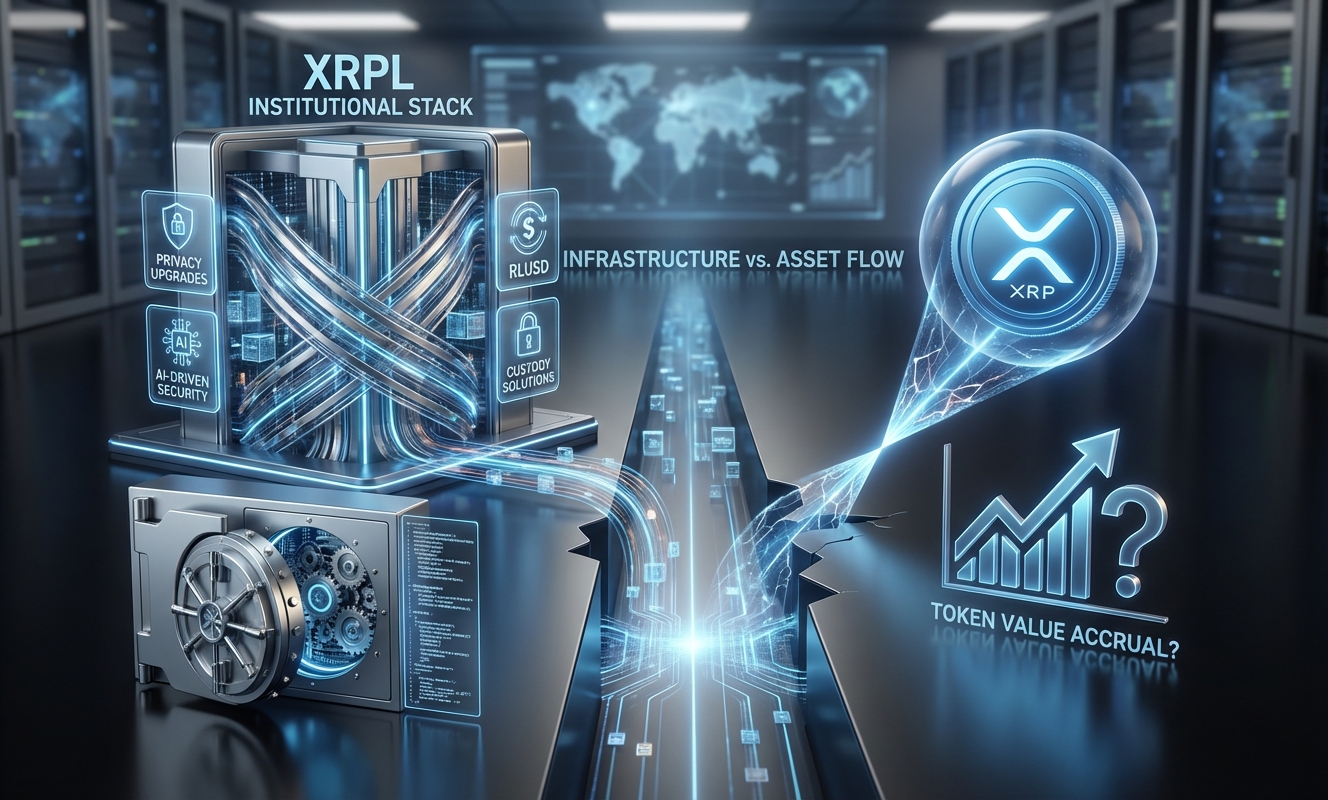
This is the crux of it. Bitrue Research put out a March 27 report laying out the core tension clearly, and it deserves attention. The central issue for 2026 isn’t whether XRPL adoption grows. It almost certainly will. The issue is whether that adoption actually flows through XRP as a liquidity asset or routes around it entirely.
Think about how this plays out in practice. An institution settles tokenized treasuries using RLUSD on XRPL. Value flows. Activity grows. XRPL gets stronger network validation for its institutional positioning. And XRP sits on the sideline because RLUSD was the settlement currency, not XRP. The ledger wins. The token doesn’t necessarily follow.
Bitrue’s base case has XRP moving from around $1.40 to $1.80 to $2.00 by September 2026. Their bull case gets to $2.25 to $2.50 if RLUSD expands faster, XRPFi matures, and regulatory conditions improve. Those are reasonable projections. But 82% of RLUSD’s supply currently sits on Ethereum, not XRPL. That’s not a minor footnote. That’s a structural leak in the thesis that XRP captures value from Ripple’s institutional success.
This is where retail XRP holders need to be especially careful. The narrative Ripple is building is genuinely compelling at the infrastructure level. Privacy upgrades, AI security hardening, institutional compliance tooling. That is the kind of story that attracts enterprise adoption.
But ecosystem sophistication and token price appreciation are not the same thing. They can diverge for extended periods, and they are diverging right now. XRP ETFs just flipped from inflows to outflows after a $1.2 billion run. Over 60% of XRP holders are currently underwater. Leverage has collapsed 78% from recent highs.
Pro-Tip: If you’re holding XRP as a speculation on Ripple’s institutional success, watch two specific metrics closely. First, the growth of on-chain XRP volume specifically in XRPFi liquidity pools, not just RLUSD stablecoin flows. That’s where you’ll see actual XRP demand emerging from DeFi activity. Second, watch whether RLUSD’s supply balance shifts back toward XRPL from Ethereum. If that ratio starts moving in XRPL’s favor, that’s your early signal that institutional settlement is actually flowing through the ledger Ripple is building out. Until those two things move, the infrastructure story and the token story are running on different tracks.
References & Sources:
Ripple is developing private ledgers to meet the strict regulatory, compliance, and data privacy requirements of traditional financial institutions. Banks require controlled, permissioned environments to handle sensitive transaction data securely, which public decentralized blockchains like the public XRP Ledger cannot always guarantee. By offering a more private infrastructure, Ripple aims to accelerate enterprise adoption of its blockchain technology for institutional cross-border payments, Central Bank Digital Currencies (CBDCs), and asset tokenization.
Ripple is incorporating artificial intelligence (AI) to automate and enhance the auditing of smart contracts and blockchain code. These AI code checks help developers instantly identify security vulnerabilities, optimize network performance, and ensure strict compliance before applications are deployed. This proactive security measure drastically reduces the risk of hacks or exploits, making the ecosystem significantly safer and more appealing to institutional players who demand bank-grade security for decentralized finance (DeFi) applications.
There are growing concerns among crypto investors that Ripple’s pivot toward private, enterprise-grade blockchains might isolate or reduce the direct utility of the public XRP Ledger, potentially leaving the XRP price behind. If banks solely operate on private ledgers without utilizing XRP as a bridge currency, it could theoretically limit the token’s market demand. However, Ripple maintains that these private networks are built to be interoperable with the public mainnet, ultimately relying on XRP for On-Demand Liquidity (ODL) and seamless cross-chain settlements.
Yes. While the enterprise blockchains themselves are private to ensure institutional data confidentiality, they are purposefully designed to be highly interoperable with the public XRP Ledger. Ripple’s long-term strategy involves using XRP as a neutral bridge asset to facilitate instant, low-cost liquidity between different fiat currencies and these segregated private ledgers. The ultimate goal is to create an interconnected “network of networks” where private bank ledgers communicate seamlessly, utilizing the XRP token as the underlying utility asset to settle global transactions efficiently.