Subtotal $0.00


Magazines cover a wide array subjects, including but not limited to fashion, lifestyle, health, politics, business, Entertainment, sports, science,


Magazines cover a wide array subjects, including but not limited to fashion, lifestyle, health, politics, business, Entertainment, sports, science,

 Fact Checked by Coinsbeat Editorial Team | Expert Reviewed by Themiya
Six straight months of red candles. A 55% drawdown from peak. Trading at $1.33 while Ripple’s press release machine runs hot. If you’re an XRP holder right now, you’re watching the company win while the token bleeds, and you deserve an honest explanation for why that’s happening, not a hopium-laced recap of partnership announcements.
Let’s be real about what we’re looking at here.
The numbers are ugly. Six consecutive months of losses since October 2025, averaging roughly 10% down each month. The last time XRP strung together a comparable run of monthly declines was December 2013 through June 2014, when the market was so early that most people buying it were doing so from a forum thread. That’s not a minor footnote. That’s a decade-plus of context telling you this isn’t just a bad week.
The macro backdrop is making it worse, obviously. Bitcoin dropped from above $126,000 to around $66,000, and when BTC catches a cold, altcoins get pneumonia. Sentiment across the board is risk-off. Traders aren’t chasing anything without a clear, immediate catalyst. XRP doesn’t have one right now.
Then there’s the liquidity problem. CryptoQuant data showed XRP’s 30-day liquidity index on Binance sitting at roughly 0.062, one of the lowest readings in recent memory. The 30-day turnover index is around $4.46 billion. Translation: thin order books, light participation, and a setup where a single large sell order can gap the price down hard. That’s not a market in recovery mode. That’s a market in avoidance mode.
Here’s the thing that should genuinely bother every XRP investor. Ripple is having what looks like a legitimately productive business period, and the token is completely ignoring it.
Look at what’s actually happened recently:
That’s a serious amount of institutional surface area being covered in a very short window. So why is XRP still getting obliterated?
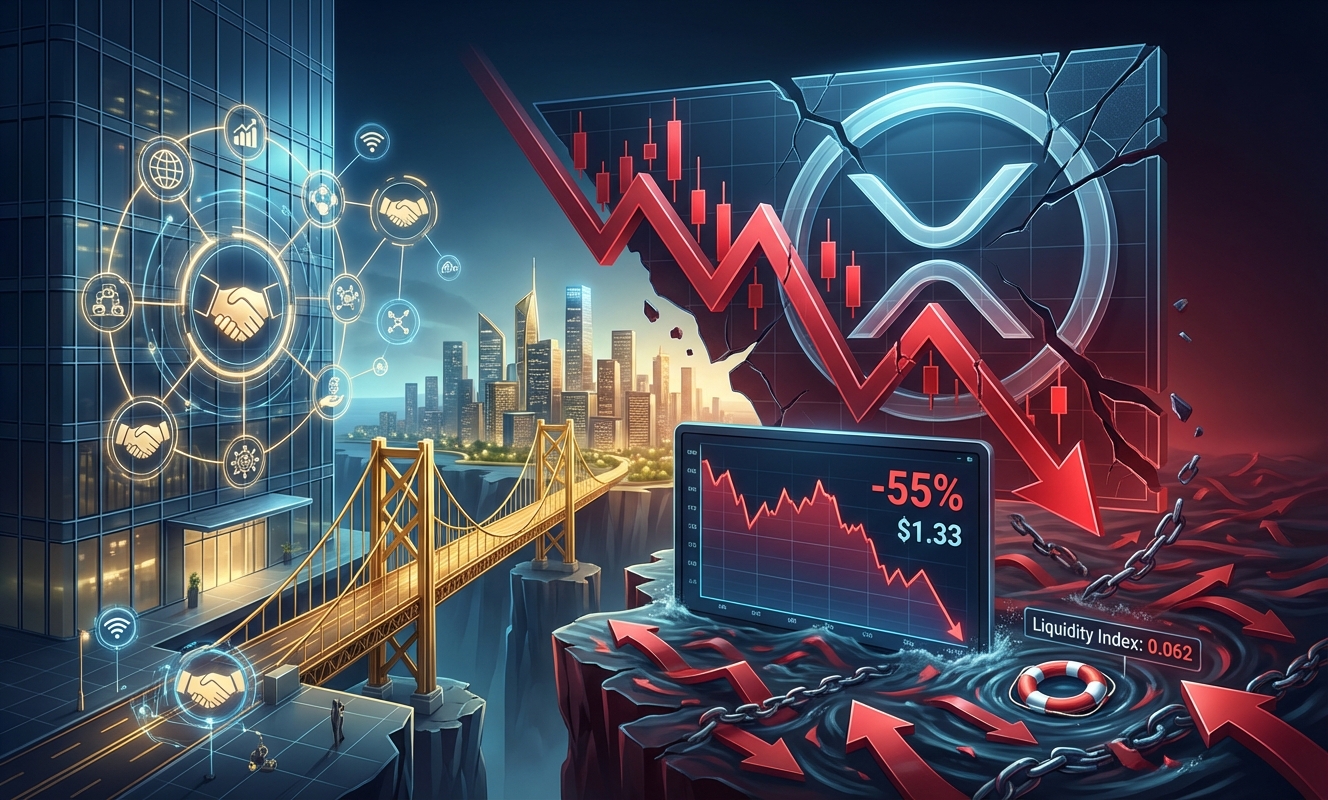
Ripple the company and XRP the token have structurally misaligned interests, and most retail holders are too deep in the narrative to see it clearly.
Ripple’s revenue model doesn’t require XRP to pump. GTreasury generates fees from enterprise clients. Ripple Prime generates fees from institutional trading access. The Convera partnership generates fees from payment flow. RLUSD, their stablecoin, is the actual workhorse in the “stablecoin sandwich” model, not XRP.
Honestly, the more Ripple builds RLUSD into the center of its payment infrastructure, the more you have to ask: in a world where the stablecoin handles the actual value transfer, what specific function is XRP performing that couldn’t be replaced? The company says XRP is the bridge asset. But bridges get replaced when better roads get built. That’s not FUD. That’s a legitimate structural question the market is quietly pricing in.
Ripple’s own 2026 survey found that 72% of finance leaders said they need a digital asset solution to stay competitive. Great. But “digital asset solution” can mean a lot of things. It doesn’t automatically mean XRP. And sophisticated institutional money knows the difference.
Markets are forward-looking machines. When a token drops 55% while its parent company announces deal after deal, the market is sending a specific message: we don’t believe the deals directly create token demand.
And historically, it has a point. Consider the pattern. Ripple has been signing partnerships and expanding its payments network for years. The SEC lawsuit dragged sentiment down, fine. But now that legal overhang is largely resolved, the partnerships are accelerating, and the token is still underperforming. That’s not a legal problem anymore. That’s a fundamental demand problem.
The Bitrue Research base case of $2.00 by September with a bull case of $2.50 if RLUSD adoption accelerates sounds reasonable on paper. But it’s contingent on multiple things breaking right simultaneously. RLUSD adoption accelerating, XRPFi expanding meaningfully, and regulation becoming more supportive. That’s a lot of “ifs” stacked on top of each other while the price is trending in exactly the wrong direction.
The Ripple Prime and Hyperliquid story is worth paying closer attention to, and not for the reasons Ripple’s PR team would prefer.
Hyperliquid’s HIP-3 daily volume has crossed $2 billion with $2 billion in open interest, and only 7 of its top 30 markets are even crypto pairs. Ripple is positioning itself as the sole institutional counterparty for clients wanting access to that venue’s liquidity. That’s smart business. It builds Ripple Prime’s brokerage stickiness with institutional accounts.
But here’s where it gets interesting from a market structure perspective. More institutional access to derivatives on decentralized venues means more sophisticated participants who know exactly how to short XRP with precision if the fundamentals don’t support the price. Better institutional infrastructure cuts both ways. It doesn’t guarantee buying pressure. It guarantees more efficient price discovery, which right now means more efficient selling.
Look, Ripple is clearly playing a long game, and some of it is genuinely impressive. Embedding XRP into the CFO’s software stack through GTreasury is a smarter distribution move than anything most crypto projects have managed. Getting RLUSD into a Convera-scale payment network is real. The MAS BLOOM initiative is the kind of regulated, state-level validation that most blockchain projects can only dream about.
The problem is timing and translation. None of this infrastructure creates immediate, measurable spot demand for XRP in the current quarter. Treasury teams that can now hold XRP alongside fiat balances aren’t obligated to buy it. Institutional clients using Ripple Prime to trade HIP-3 perpetuals aren’t buying XRP spot. These are long-duration catalysts in a market that’s operating on short-duration fear.
Ripple is building the pipes. XRP still needs to become the water.
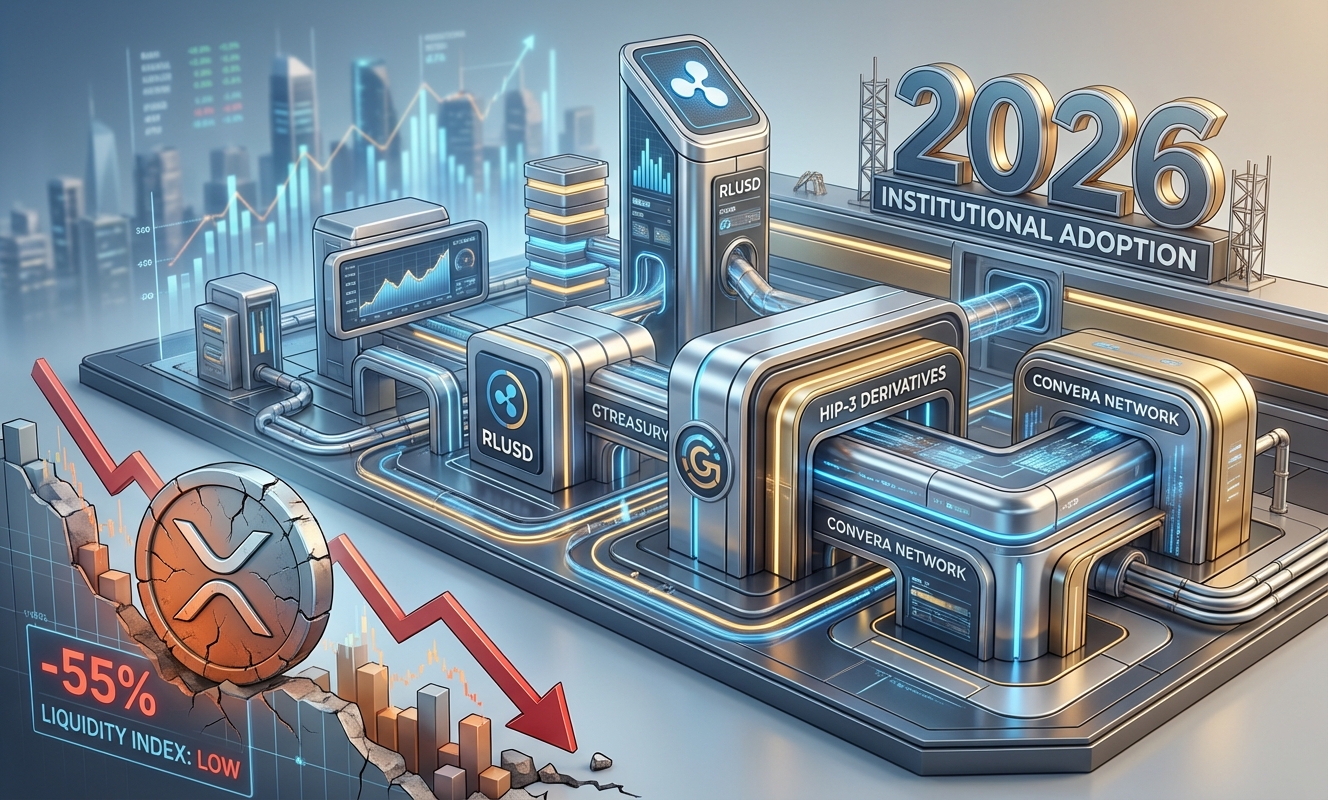
This is the risk nobody in the XRP community is comfortable discussing openly. Every time Ripple deepens RLUSD’s role in a payment or settlement workflow, there’s a scenario where RLUSD becomes the default and XRP becomes optional. The “stablecoin sandwich” with Convera uses stablecoins at the core of the transaction. If that model scales globally at the pace Ripple wants, the $33 trillion stablecoin volume figure (up 72% last year) flows primarily to RLUSD, not to XRP.
That scenario isn’t guaranteed. But it’s not zero probability either. And at $1.33 with a 55% drawdown and the weakest liquidity conditions in years, the market seems to be quietly assigning it meaningful weight.
If you’re positioning in XRP right now based on the partnership momentum, you need a clear thesis for why those partnerships translate into spot demand, not just strategic value for Ripple the company.
Ripple is executing well as a company. XRP is still waiting for proof that execution becomes demand. Until those two things connect in a measurable way, the price action is the honest signal. Everything else is a press release.
References & Sources:
Unlike cryptocurrencies like Bitcoin (BTC) and Ethereum (ETH) which are continuously created through mining, all 100 billion XRP tokens that will ever exist were pre-mined in 2012. Upon creation, the founders retained 20% of the total supply, while the remaining 80% was gifted to Ripple Inc. To ensure market stability and predictable supply, Ripple later placed the majority of these holdings into an escrow system, which releases a maximum of up to 1 billion XRP per month (12 billion annually) to fund operations and their ongoing institutional initiatives.
Despite Ripple’s aggressive $13 trillion institutional push, a $100 price tag for XRP within the next five years is highly unlikely. Ripple’s CTO Emeritus, David Schwartz, has pointed out the realities of market psychology: if investors truly believed there was even a 10% chance of XRP reaching $100 in the near future, the token would not be trading at its current depressed levels. Furthermore, an XRP price of $100 would require an astronomical market capitalization that far exceeds the current valuations of the entire cryptocurrency market.
Even though XRP has recently faced its longest slump in a decade, long-term holders have still seen significant gains. Over the last five years, XRP’s price has increased by approximately 228%. If you had invested $1,000 in XRP five years ago, your investment would be worth roughly $3,282 today. To put this in perspective, the S&P 500 index grew by 83% over the same period, meaning a $1,000 traditional stock market investment would have grown to around $1,831.
Ripple’s $13 trillion institutional push refers to the company’s massive strategic pivot toward dominating the global cross-border payments and financial messaging sector. While the retail price of XRP has suffered a prolonged slump, Ripple is actively working to integrate its blockchain technology—such as RippleNet and On-Demand Liquidity (ODL)—with central banks, major financial institutions, and global payment providers. The goal is to capture a significant slice of the trillions of dollars moved daily by institutions, proving XRP’s real-world utility over purely speculative trading.