Subtotal $0.00


Magazines cover a wide array subjects, including but not limited to fashion, lifestyle, health, politics, business, Entertainment, sports, science,


Magazines cover a wide array subjects, including but not limited to fashion, lifestyle, health, politics, business, Entertainment, sports, science,
 Fact Checked by Coinsbeat Editorial Team | Expert Reviewed by Themiya
An AI just tested smarter than 99.96% of every human alive. Let that sit for a second.
OpenAI’s GPT-5.4 Pro posted a 150 on TrackingAI’s public Mensa-style leaderboard. That’s not a rounding error from the 136 that o3 hit last year. That’s a 14-point vertical leap in roughly 12 months. For context, 150 is the IQ territory historically associated with Einstein and Feynman. We’re not talking about incremental. We’re talking about acceleration that’s starting to look almost uncomfortable.
And yet the crypto market is staring at CPI data and Iran ceasefire noise. Look, both things can matter at once. But here’s the thing most traders are missing: this AI benchmark isn’t just a tech headline. It’s a macro signal wearing a lab coat.
Let’s be real about what a public IQ benchmark actually measures. It’s noisy. It’s sensitive to prompt engineering, training-set contamination, and test format familiarity. TrackingAI uses rolling averages across recent completions, and the methodology was already getting side-eyes when o3 hit 136. Those questions haven’t gone away.
But here’s the thing about skepticism: it cuts both ways. You can’t dismiss every benchmark result as a quirk when the pattern keeps pointing in the same direction across multiple systems. IQ tests, coding benchmarks, GDPval, OSWorld-Verified, browser use, desktop navigation. They’re all climbing. That’s not noise. That’s a trend.
The score’s real value isn’t its precision. It’s its portability. A number like 150 doesn’t require a PhD to process. Enterprise buyers don’t need to audit the methodology to understand that a system capable of stronger tool use, 1 million token context handling, and improved computer navigation is starting to eat into white-collar workflows. That compression of complexity into a single legible signal? That’s how capital allocation decisions actually get made.
GPT-5.4 Pro wasn’t positioned as a research curiosity. OpenAI framed it explicitly around professional work: coding, tool search, computer use, and enterprise productivity. The 1 million token context window isn’t a flex. It’s a direct play for document-heavy, long-horizon knowledge work across legal, finance, and operations teams.
Honestly, that’s the part that should make labor economists nervous and AI infrastructure investors excited. When a model can navigate a browser, verify its own outputs, plan multi-step tasks, and handle a million tokens of context, you’re not talking about a chatbot anymore. You’re talking about a system that can functionally replace a junior analyst, a customer support tier, a research workflow, and a chunk of internal operations, all at once.
Jack Dorsey basically said this out loud when Block announced it was moving from hierarchy to intelligence, using AI to strip out management coordination layers entirely. That’s not a startup experiment. That’s a publicly visible signal of where enterprise adoption is actually heading.
This is where it gets interesting for us specifically.
The standard playbook says AI narrative = buy AI tokens. NEAR, FET, RNDR, TAO. The usual suspects. And yes, some of that reflexive money will flow into AI-adjacent coins whenever OpenAI drops a headline. That’s predictable exit liquidity for whoever was already holding bags.
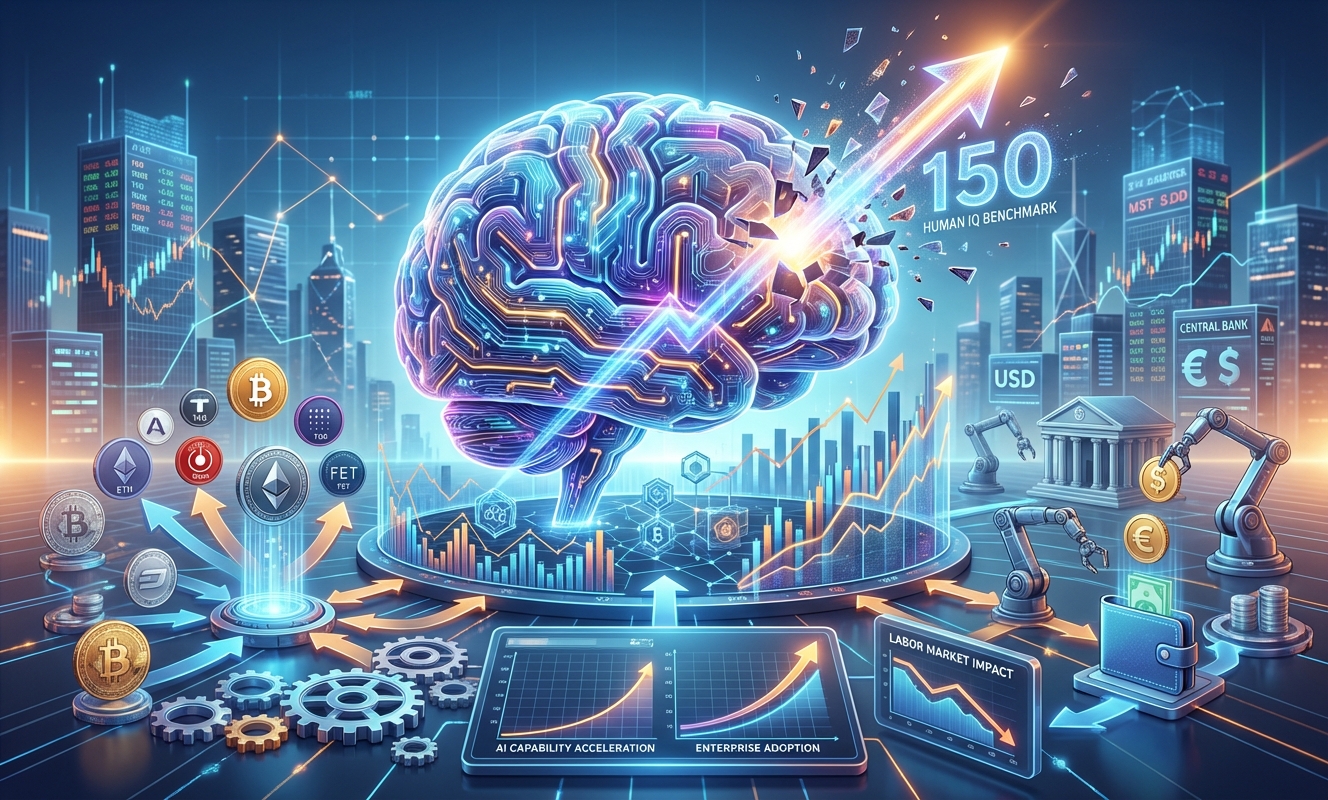
But the smarter trade is further upstream. Here’s the actual chain of consequences:
The last point is the one most people are sleeping on. Autonomous AI agents need programmable, permissionless payment rails. They can’t open a bank account. They can’t use OAuth to a corporate credit card. The infrastructure that wins that use case isn’t a speculative AI token. It’s likely stablecoins, layer-2 settlement networks, and whatever protocol ends up being the default payment layer for machine-to-machine transactions.
This week’s calendar is stacked. FOMC minutes on April 8. CPI on April 10. PPI on April 14. Traders are rightly focused on those prints because rate expectations are still driving the bulk of risk-on and risk-off positioning in crypto.
But consider the secondary effect. If AI capability is genuinely accelerating at the pace that GPT-5.4 Pro’s benchmark suggests, then the labor market data that feeds into those inflation prints is going to start looking structurally weird. Soft labor numbers that would normally signal recession could increasingly reflect automation displacement rather than demand weakness. The Fed’s models weren’t built for that distinction.
That’s not a Q3 problem. But it’s closer than markets are pricing. And in crypto, being early to a macro shift is usually where the real money is made before everyone figures it out and the trade gets crowded.
Don’t underestimate the business function of OpenAI sitting at the top of a public benchmark. With Claude, Gemini, Grok, and Qwen all fighting for enterprise contracts, benchmark leadership compresses a technically complex differentiation argument into a single hierarchy. GPT-5.4 Pro is number one. Full stop.
That narrative handle matters to sales cycles. It matters to developer adoption. It matters to the venture capital and institutional money that’s still trying to figure out which AI infrastructure plays survive the next consolidation round. OpenAI being able to point to a public IQ board where they’re clearly ahead is worth more in commercial positioning than three whitepapers about transformer architecture improvements.
And for crypto markets specifically, OpenAI’s continued dominance in that race feeds directly into valuation assumptions for the companies supplying the infrastructure underneath it. Nvidia. TSMC. The hyperscalers. The power companies. Those valuation assumptions ripple through macro sentiment, which ripples through Bitcoin’s correlation to tech equities, which is still uncomfortably high whenever risk-off hits.

Here’s the catch, and it’s a real one.
If you want to position around this theme, ignore the obvious AI shilling. The narrative trade is already priced into most AI-branded tokens. The real opportunity is in identifying which crypto infrastructure layers become essential for autonomous AI agent payments and settlement.
Look at protocols with actual machine-to-machine payment use cases. Look at stablecoin issuers with programmable payment rails. Look at layer-2 networks with the throughput and cost structure to handle high-frequency, low-value automated transactions. That’s where the structural demand ends up if AI capability keeps compounding at this pace.
Don’t chase the IQ headline. Follow the capital flows it’s going to redirect.
References & Sources:
The GPT-5 Pro model previously scored a highly impressive 148 IQ on the Mensa test, which initially sparked widespread debate regarding AI surpassing human reasoning skills. However, OpenAI has since broken its own record with the release of GPT-5.4 Pro. In recent assessments, GPT-5.4 Pro jumped to a staggering 150 IQ on the rigorous Mensa Norway test, firmly cementing its capabilities in the profound “genius” and highly gifted territory.
OpenAI’s o3 model scored a 135 on the Mensa IQ test, officially hitting the “genius” level of intelligence. To put that score into perspective, the average human scores between 90 and 110, and anything above 130 is considered genius territory. While o3 was a massive breakthrough, OpenAI’s continuous rapid development led to the newer GPT-5.4 Pro model completely shattering that benchmark with an unprecedented score of 150.
GPT-5.4 Pro’s 150 IQ score represents an astronomical leap over average human intelligence, which typically falls between the 90 to 110 range. Scoring 150 means the AI operates at a cognitive tier achieved by less than 0.1% of the human population. This exceptional rating demonstrates that the model possesses advanced problem-solving, pattern recognition, and abstract logic capabilities that vastly outperform standard human cognitive metrics.
The Mensa Norway test is globally recognized as one of the most reliable standardized metrics for measuring fluid intelligence. It primarily features culture-fair, matrix-style visual puzzles that require intense abstract reasoning rather than learned knowledge. When a model like GPT-5.4 Pro scores 150 on this specific test, it proves that the AI is not just regurgitating memorized training data, but is genuinely capable of complex logical deduction and zero-shot problem-solving at an elite human level.