Subtotal $0.00


Magazines cover a wide array subjects, including but not limited to fashion, lifestyle, health, politics, business, Entertainment, sports, science,


Magazines cover a wide array subjects, including but not limited to fashion, lifestyle, health, politics, business, Entertainment, sports, science,

 Fact Checked by Coinsbeat Editorial Team | Expert Reviewed by Themiya
Three teams gone. Not three random Discord moderators. The people who actually ran Aave’s risk models, wrote the governance proposals, and reviewed the security of every upgrade quietly walked out the door within weeks of each other. And the market barely flinched. That’s the part that should make you nervous.
BGD Labs, ACI, and Chaos Labs didn’t all happen to decide to move on at the same time for unrelated reasons. BGD cited an environment that “no longer aligns.” ACI chose not to renew. Chaos Labs walked specifically because it looked at the V3-to-V4 transition, did the math, and said the risk surface area requires at minimum an $8 million budget while Aave was historically paying roughly $3 million for that exact function.
Let’s be real. When your risk manager leaves and writes down on the way out that the protocol is expanding into a more complex architecture while simultaneously underpaying for the people managing existential risk, that’s not a resignation letter. That’s a warning.
Aave’s own governance documents described these three teams as an interlocking operating chain. ACI drove growth and governance coordination. Chaos Labs handled risk parameter management. BGD owned technical and security verification. Every major initiative, by ACI’s own account, required the full chain functioning simultaneously. Now Aave Labs is absorbing all of it. That’s the actual situation.
This isn’t theoretical. On March 10, a CAPO oracle misconfiguration pushed the effective wstETH exchange rate roughly 2.85% below market. That deviation triggered approximately $10.938 million in wstETH liquidations across 34 accounts, generating about $26.6 million in total liquidation volume.
No bad debt, technically. But a reimbursement proposal of 512.19 ETH landed on the DAO’s desk, costing it 358.56 ETH net. And this happened while Chaos Labs, BGD, and ACI were all still active. That’s the key point most people are glossing over.
Honest question: if a configuration-layer error caused eight-figure harm to users with the full contributor operating chain in place, what does the error surface look like when Aave Labs is handling governance tooling, CAPO pricing management, risk agent coordination, bridge adapter maintenance, GitHub upkeep, and proposal lifecycle management simultaneously?
Chaos Labs isn’t being dramatic. It’s being precise.
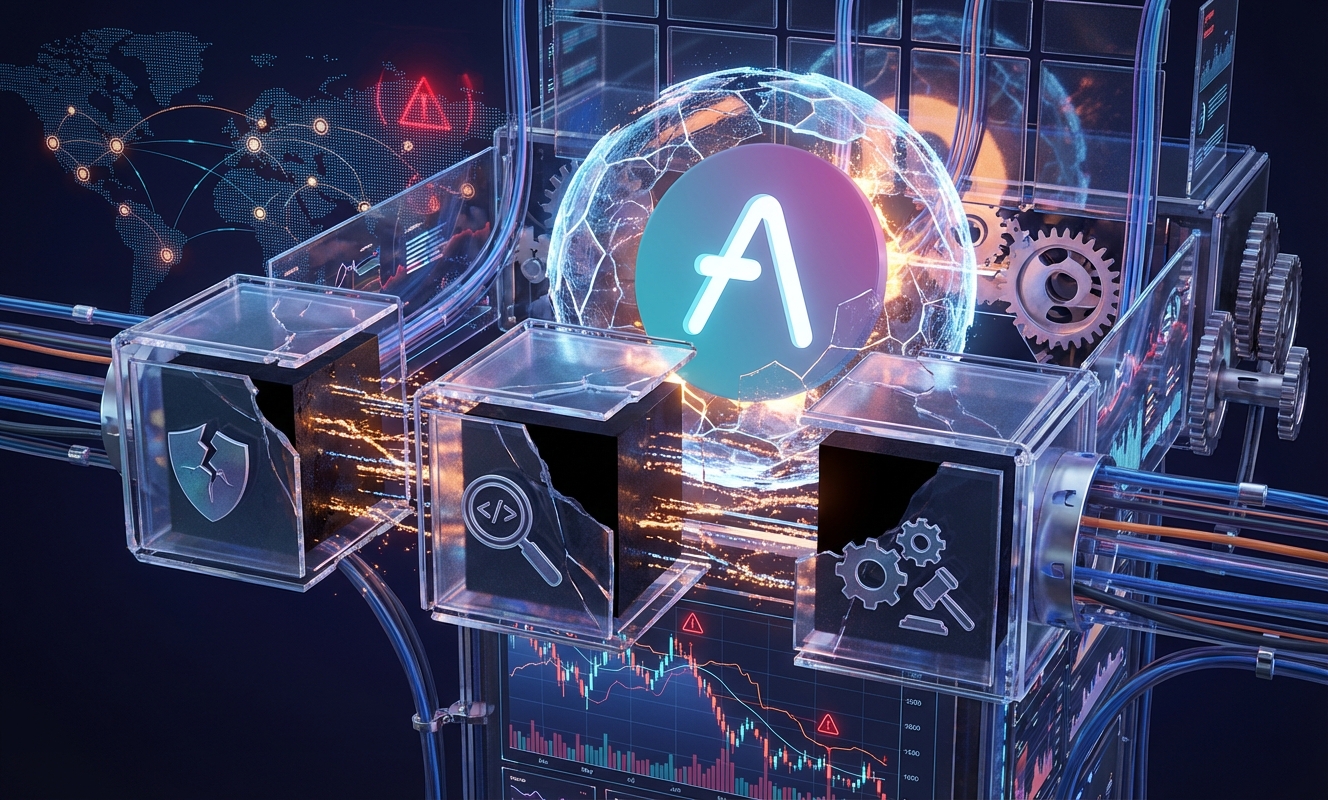
The “Aave Will Win” ARFC is essentially Aave Labs making the case that centralized accountability beats a federated contributor model. Fewer cooks, cleaner kitchen. Faster execution because there’s only one table making decisions.
The argument has some merit. Federated governance creates coordination lag, misaligned incentives between external shops, and accountability diffusion when things go wrong. Nobody wants to own an incident that ran through three different teams’ review processes.
But here’s the thing. The pro-consolidation thesis only works if Labs can replicate the operational density of what it’s replacing. BGD handled technical verification at a depth that took years to build. Chaos Labs managed risk parameters across Aave V2 and V3 since November 2022 with zero material bad debt. That track record wasn’t an accident. It was accumulated institutional knowledge about exactly how Aave’s position management behaves under stress.
You can’t copy-paste that into a new organizational structure in a quarter and expect continuity. Especially not during a live overlap between a battle-tested V3 and a new hub-and-spoke V4 architecture that just went live on Ethereum mainnet with deliberately conservative caps.
$17.53 billion in borrowed funds against Morpho’s $4.29 billion and Spark’s $968 million. That’s a 4:1 gap over the nearest competitor. Protocol switching costs are real for large borrowers. Aave holds more than 80% of USDT and USDC deposits and borrows on Ethereum. At roughly $20 billion in stablecoin deposits and $13 billion in borrowed stablecoins, it’s functioning more like credit infrastructure for on-chain dollar markets than a lending app in the traditional sense.
And the February stress test was genuinely impressive. Approximately $429 million in liquidations across 12,500 transactions, $1.7 billion in stablecoin outflows, and the protocol didn’t break. That operational record doesn’t disappear because contributor teams rotate out.
But capital allocation is a slow compounding process. New capital doesn’t need to move all at once. It just needs to consistently choose Morpho’s modular architecture or Spark’s cleaner governance optics over a protocol that’s visibly managing a transition. The 4:1 gap can compress quietly over 12 to 18 months if Aave fumbles a V4 incident or two before Labs has proven it can run the full operating chain.
Morpho at $7.337 billion in TVL is not a joke competitor anymore. Its market-specific modular structure is a genuine architectural alternative, not just a smaller version of the same product.

If a V4 incident occurs before Labs has demonstrated credible operational control, the narrative stops being “Aave is going through a governance transition.” It becomes “the people who knew how to run this thing left, and then something broke.” That’s a confidence-pricing event for AAVE token holders, not a governance footnote.
GHO, Horizon, Aave Pro, and the MiCA-authorized fiat ramp via Push are all expanding the protocol’s surface area right now. That’s the ambitious version of Aave. More products, broader reach, more attack vectors. And the team managing the risk layer of all of it is in the middle of a restructuring that involves absorbing functions built by three separate specialist organizations over multiple years.
Look, the bulls aren’t wrong that Aave is the dominant DeFi lending protocol by a wide margin. V4 underwent approximately 345 cumulative days of security review across four audit firms with no critical or high findings. The protocol carries over $250 million in Umbrella first-loss coverage. BGD has a two-month advisory retainer through May 31. LlamaRisk stays engaged. These are real safety nets.
But safety nets are different from the core operating layer. And the core operating layer just got substantially thinner.
The immediate risk window is the V3/V4 overlap period, roughly the next two to three quarters. This is when Labs is most exposed operationally, when it’s absorbing the most new functions, and when V4 caps are still conservative enough that a single misconfiguration catching a large position could be genuinely expensive.
The protocol is still the category leader. Nobody serious is arguing otherwise. But the margin for operational error just got a lot thinner at the exact moment the architecture got more complex. Keep your eyes open.
References & Sources:
Aave is a leading decentralized finance (DeFi) protocol that allows users to lend and borrow cryptocurrency without centralized intermediaries like banks. It earned the title of a “$25 billion lending empire” by accumulating massive Total Value Locked (TVL) during peak market cycles, cementing its position as the largest and most trusted decentralized lending market across multiple blockchain networks.
Key contributors and core developers occasionally exit decentralized projects due to protocol maturity, a desire to shift to new ventures, or internal governance fatigue. For Aave, the departure of seasoned builders poses a significant stress test for its decentralized governance model (the Aave DAO). It challenges the community to maintain top-tier security, drive ongoing innovation, and manage complex financial risks without relying on its original founding team.
Directly, the exit of core contributors does not jeopardize deposited funds because Aave operates on immutable, heavily audited smart contracts running autonomously on the blockchain. However, long-term protocol security and the ability to rapidly respond to future software vulnerabilities or severe market volatility will depend on the technical capabilities of new development teams and the effectiveness of the Aave DAO’s governance.
The Aave DAO is navigating this crucial transition by heavily leveraging its decentralized governance framework. This system allows AAVE token holders to publicly vote on key proposals, adjust critical risk parameters, and allocate treasury funding to hire new independent development teams. This decentralized approach is designed to ensure the protocol remains resilient and proves that a massive DeFi ecosystem can sustain itself indefinitely beyond its initial creators.