Subtotal $0.00


Magazines cover a wide array subjects, including but not limited to fashion, lifestyle, health, politics, business, Entertainment, sports, science,


Magazines cover a wide array subjects, including but not limited to fashion, lifestyle, health, politics, business, Entertainment, sports, science,

 Fact Checked by Coinsbeat Editorial Team | Expert Reviewed by Themiya
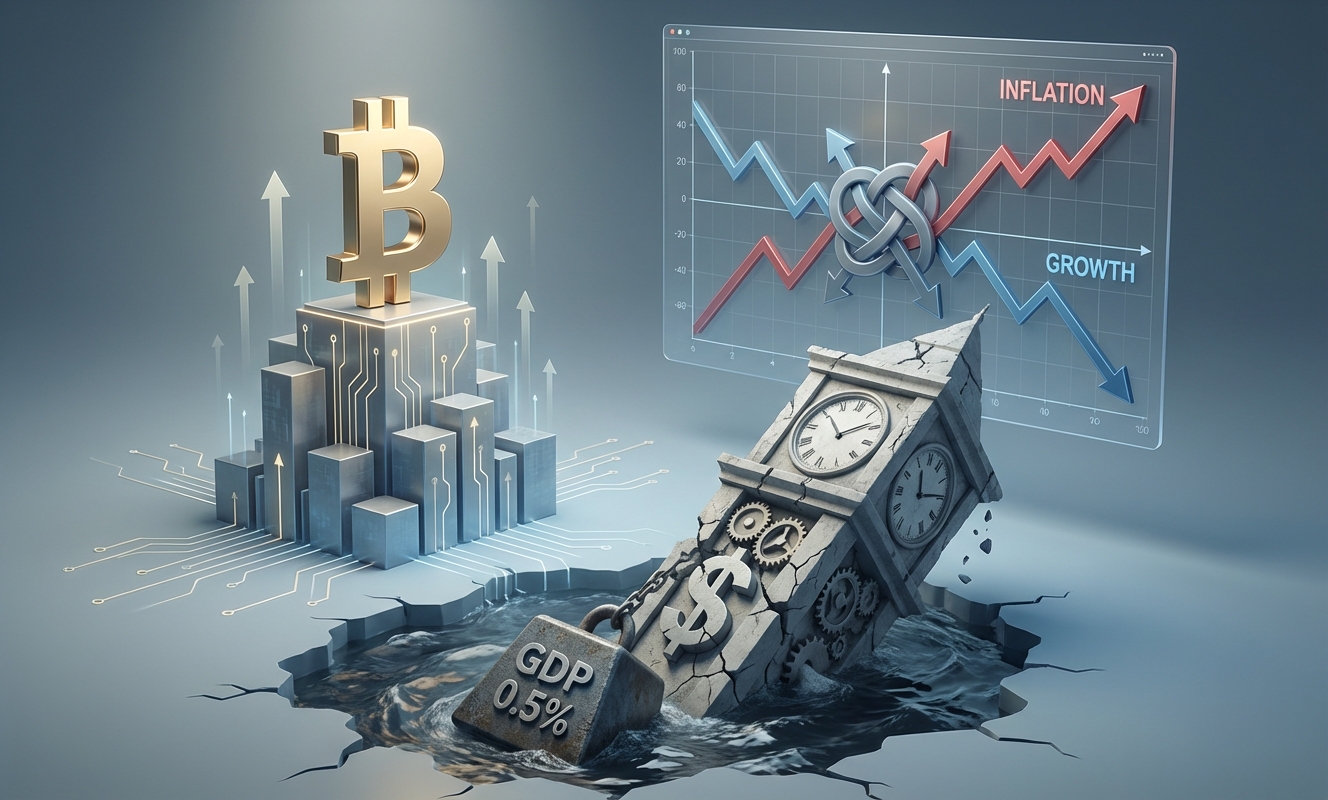
The U.S. economy just printed a 0.5% GDP growth rate for Q4 2025. That’s not a soft landing. That’s a belly flop. And the truly uncomfortable part? Inflation didn’t get the memo to calm down.
This is the macro trap nobody on crypto Twitter wants to talk about right now. Everyone’s busy celebrating Bitcoin’s 7.84% weekly gain, and sure, that move is real. But the backdrop it’s happening against? Genuinely dangerous.
Let’s be real about what just happened. Q3 2025 GDP came in at 4.4%. Solid. Comfortable. The kind of number that lets policymakers sleep at night. Then Q4 comes along and hands us 0.5%. That’s not a modest deceleration. That’s a near-complete stall.
And here’s the thing about how this number was delivered. It didn’t arrive all at once. The Bureau of Economic Analysis walked markets down slowly, from the advance estimate to the second estimate, and finally to the third. Each revision chipped away at confidence. By the time the final print landed, the soft-landing story had developed serious cracks that the headline optimists were still papering over.
In a normal rate cycle, a GDP print that weak would have traders front-running Fed rate cuts before the press release even finished loading. Markets would price in three cuts minimum and risk assets would rip. Simple story.
This is not a normal rate cycle.
Honestly, the word “stagflation” was borderline taboo six months ago. Analysts would hedge it with seventeen qualifiers before even suggesting the concept. Now? It’s sitting right there in the data, unblinking.
Growth is slowing hard. Inflation is staying warm. The Fed is boxed in. That’s the definition. Not a prediction. A description of what the numbers are already showing.
February’s PCE report landed roughly where forecasts expected on the headline, 2.8% year-over-year. Core came in at 3.0%, marginally cooler than the 3.1% consensus. Fine. Except the monthly readings for both headline and core came in at 0.4%. That monthly pace, if it persists, keeps annual inflation running well above the Fed’s 2% target for the foreseeable future.
So here’s the actual problem. The growth slowdown points the Fed toward easing. The inflation data points the Fed toward patience. Those two signals are pointing in opposite directions simultaneously. The Fed doesn’t get to follow both. And markets are discovering that “wait and see” has a real cost when you’re holding risk assets.
Look at the 10-year Treasury yield. It was hovering around 4.3% after the GDP and PCE releases dropped. Real yields, adjusted for inflation, have stayed elevated enough that traditional fixed income is still competing meaningfully with Bitcoin for institutional capital.
This matters more than most retail crypto participants appreciate. When an insurance fund or a pension allocation committee can earn a real, inflation-adjusted return sitting in Treasuries, the bar for rotating into a non-yielding asset like Bitcoin gets higher. Not insurmountable. But genuinely higher.
The labor market is adding its own layer of complexity. March payrolls came in at 178,000 with unemployment near 4.3%. Weekly jobless claims ticked up to 219,000, which is worth watching. But it’s not the kind of sharp deterioration that forces the Fed’s hand. A labor market that softens slowly gives the Fed a convenient excuse to stay put, and right now, they’re clearly using it.
Here’s where it gets interesting. Bitcoin isn’t holding these levels despite the macro. It’s holding them because of a specific structural factor that’s relatively new to this cycle: spot ETF demand.
On April 6, spot Bitcoin ETFs pulled in roughly $470 million in a single day. That’s not speculative leverage from a degenerate with a BitMEX account. That’s institutional allocation flowing through regulated products. BlackRock’s IBIT, Fidelity’s FBTC, and now Morgan Stanley’s freshly launched ETF buying 430 BTC on its debut day. This is a fundamentally different demand base than what Bitcoin has historically relied on.
ETF flows create something previous Bitcoin rallies didn’t have: a persistent, non-panic-selling buyer base. Retail traders chase momentum and exit at the first red candle. Institutional ETF allocations move on quarterly rebalancing cycles. That difference in holding behavior creates a meaningful floor under price during macro turbulence.
That said, let’s not get carried away shilling the ETF narrative as a permanent override of macro conditions. It isn’t.
The way I see it, Bitcoin’s price trajectory right now runs through four distinct variables, and they’re not all pointing the same direction:
Two out of four are working against Bitcoin right now. One is strongly supportive. One is ambiguous. That’s why price action feels like it’s grinding sideways with occasional bursts rather than launching into a clean breakout. The math on the macro just doesn’t fully support a sustained vertical move yet.
Between now and the end of Q2 2026, a few things have to happen that will break this stalemate one way or the other.
The April Fed meeting will signal how seriously Powell and the committee are treating the GDP deterioration. The first estimate of Q1 2026 GDP will tell markets whether the Q4 stall was a one-quarter anomaly or the beginning of a genuine contraction. The Atlanta Fed’s GDPNow model is already tracking Q1, and the Cleveland Fed’s inflation nowcast is providing live read-through on PCE trajectory.
The constructive scenario for Bitcoin looks like this: monthly CPI and PCE prints start sliding back toward 0.2% or below, energy prices stabilize, and the Fed starts telegraphing cuts for late 2026. In that environment, real yields fall, duration-sensitive assets catch a bid, and Bitcoin’s structural demand combines with macro tailwind. That’s when the next clean leg higher becomes plausible.
The ugly scenario looks like this: oil stays elevated, monthly PCE readings stay at 0.3% to 0.4%, the Fed explicitly delays cuts into 2027, and the GDP weakness deepens without inflation giving ground. In that world, high real yields continue competing with Bitcoin, institutional risk appetite contracts, and even ETF inflows may not be enough to carry price higher against that kind of headwind.
Between you and me, the middle path is probably the most realistic outcome over the next few weeks. Growth stays soft but doesn’t collapse into full recession. Inflation cools slowly but not fast enough to trigger Fed action. Bitcoin grinds in a range. Directional traders get frustrated. Accumulators keep adding quietly.
There’s one more variable sitting outside the standard macro framework that’s increasingly relevant. Energy prices. The situation around oil supply and geopolitical risk hasn’t fully resolved, and if crude stays elevated or spikes, that feeds directly into PCE inflation data two to three months down the line. Which keeps the Fed stuck. Which keeps real yields high. Which keeps the pressure on Bitcoin’s macro support layer.
This isn’t a theoretical risk. It’s already in the conversation. And it’s the kind of supply-side inflation shock the Fed genuinely cannot fight with rate hikes without crushing an economy that’s already at 0.5% growth. That’s the real stagflation trap: the tool to fight inflation is the same tool that kills growth, and both problems are active simultaneously.

The institutional ETF narrative is real and supportive. I’m not disputing that. But here’s the catch that’s not getting enough airtime.
ETF demand can and does slow down when macro conditions deteriorate sharply. The $470 million inflow day on April 6 was exceptional. Average daily ETF flows have been inconsistent. If Q1 GDP prints negative, if Core PCE jumps back above 3.2%, or if the Fed delivers genuinely hawkish language at the April meeting, institutional allocators don’t disappear overnight but they do pause. Quarterly rebalancing that previously tilted toward Bitcoin tilts back toward Treasuries or cash when the risk-adjusted comparison shifts.
That’s the scenario where Bitcoin’s structural support and macro headwinds collide in the same moment, and price discovers how much of the current level is genuine demand versus positioning ahead of a macro catalyst that hasn’t arrived yet. A sharp correction from $72K back toward $60K to $63K in that scenario would not be surprising. It would actually be orderly.
The exit liquidity risk is real. The people getting loud about Bitcoin’s resilience right now are often the same people who need buyers above their entry price. Don’t be that buyer without understanding the macro setup you’re walking into.
Stop trying to pick the exact bottom of a range trade in a macro-confused market. That’s a retail mistake.
Instead, build a simple trigger framework based on the two variables that matter most right now. First, watch monthly PCE. If February’s 0.4% monthly gain drops to 0.2% or below in the next two prints, the rate-cut timeline compresses and Bitcoin’s setup improves materially. That’s your signal to add exposure, not the price action itself.
Second, watch the 10-year real yield. If it drops below 2.0% on a sustained basis, the opportunity cost argument against Bitcoin weakens. ETF structural demand plus falling real yields is the combination that historically drives Bitcoin’s most sustained moves.
Until both of those conditions show up in the data, treat any Bitcoin allocation above your core position as a trade, not an investment. Set your size accordingly. And absolutely do not let the weekly gain narrative convince you that macro risk has been resolved. It hasn’t. The GDP and PCE data are both still in the room.
References & Sources:
The Federal Reserve typically rescues a stalling economy by lowering interest rates to stimulate borrowing, business investment, and consumer spending. However, if inflation is “too hot” or remaining above its 2% target, cutting interest rates can fuel further price increases. The Fed is caught in a dilemma: it must maintain high rates to cool off inflation, even if that risks stalling economic growth further, making an easy rescue impossible.
When economic growth stalls while inflation remains high, the economy faces a risk of “stagflation.” In this scenario, everyday consumers are squeezed by rising prices for essential goods and services, despite stagnant wages and slowing business expansion. It creates a painful financial environment where purchasing power drops, job creation slows down, and standard monetary policy tools become less effective.
Inflation can remain stubbornly high due to several sticky structural factors. These include robust consumer spending in the services sector, a tight labor market that keeps wage growth elevated, and persistent high costs for necessities like housing, healthcare, and auto insurance. Even as broader economic demand cools, these underlying pressures prevent consumer prices from quickly falling back to the Fed’s target level.
The Federal Reserve aims for a “soft landing”—cooling inflation without triggering widespread job losses. However, keeping interest rates high for an extended period increases the risk of an economic downturn. High borrowing costs heavily restrict business expansions, home purchases, and consumer credit spending. If the economy stalls significantly and the Fed cannot lower rates due to hot inflation, this sustained pressure could eventually tip the U.S. into a recession.