Subtotal $0.00


Magazines cover a wide array subjects, including but not limited to fashion, lifestyle, health, politics, business, Entertainment, sports, science,


Magazines cover a wide array subjects, including but not limited to fashion, lifestyle, health, politics, business, Entertainment, sports, science,

 Fact Checked by Coinsbeat Editorial Team | Expert Reviewed by Themiya
Let’s be real. When a project under serious fire suddenly announces a sweeping governance overhaul, your first instinct shouldn’t be applause. It should be suspicion. World Liberty Financial just dropped a proposal covering 62.28 billion locked WLFI tokens, complete with extended vesting cliffs, insider lockups, and a token burn. Sounds responsible. Sounds like accountability. It’s not.
It’s a pressure valve. Nothing more.
Here’s the breakdown. Early supporters would move into a two-year cliff followed by a two-year linear vest. Founders, team members, advisors, and partners get the tougher end: a two-year cliff and a three-year linear vest. On top of that, up to 4.52 billion WLFI (roughly 10% of the insider allocation) gets burned immediately.
On paper, that looks like insiders are paying a real price. And honestly, the burn is a big number. You can’t dismiss it entirely.
But here’s the thing. The opt-in structure creates a massive loophole. If you don’t participate, your tokens stay locked under the old terms, but you keep your voting rights. So WLFI gets cleaner supply optics for participating holders, while a massive, uncaptured pool of voting power still floats outside the new system. You solve one problem. You quietly preserve the other.
That’s not reform. That’s a controlled narrative release.
You can’t evaluate this proposal in a vacuum. Context matters. A lot of it is ugly.
Each of those events chipped away at credibility. This proposal didn’t arrive in a calm environment. It arrived after weeks of community outrage, a high-profile public falling out, and growing scrutiny of a project that mixes token governance with Trump-connected political capital. That combination is uniquely toxic when trust breaks down.
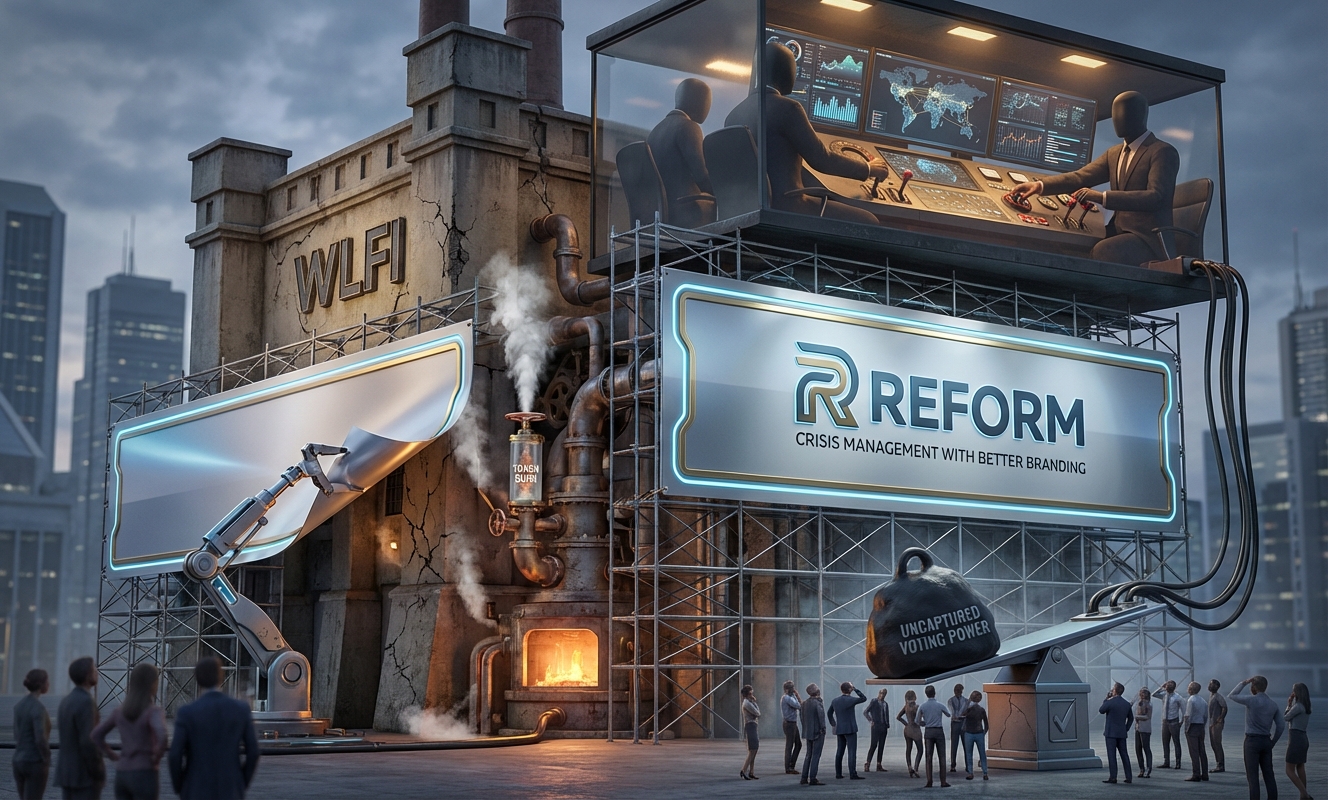
Look, WLFI isn’t wrong that participation has been weak. Six prior governance votes drew between 2.7 billion and 11.1 billion WLFI at peak. Out of a 62.28 billion locked supply. That’s roughly 23% participation at best. The rest is sitting on the sidelines, and a good chunk of that silent power still remains uncaptured under the new plan.
The deeper issue is structural. Power at WLFI concentrates with capital. Bigger wallets get Super Node access. Insiders set the collateral rules. Admin teams hold wallet restriction powers that haven’t been transparently explained. In that environment, a new vesting schedule is window dressing on a house that hasn’t been structurally inspected.
Here’s what a genuine reset would actually require:
None of that is in this proposal. Not one line of it.
Institutionally, WLFI’s stated ambitions include stablecoin infrastructure, trust bank partnerships, and regulatory legitimacy. Those goals require the exact opposite of what’s currently on display. Opacity doesn’t survive due diligence. Concentrated admin power doesn’t survive an institutional legal review. The political adjacency to Trump-world was initially a marketing asset. It’s now a liability every time a governance scandal breaks.
For retail holders, the calculus is grim.
Honestly, if you’re holding WLFI expecting decentralized governance to protect you, you’re not holding what you think you’re holding.
Words are cheap in this space. What matters is what happens on-chain and in governance behavior over the next few months. Watch these four things:
If those four things get addressed clearly and publicly, this proposal graduates from crisis management to something worth respecting. If they don’t, you have your answer.
Here’s the uncomfortable read that nobody in WLFI’s governance forum is going to say out loud. Extended vesting schedules and token burns are standard tools for suppressing near-term sell pressure while keeping the project alive long enough for insiders to exit at better prices later. That’s not a conspiracy theory. That’s how vesting mechanics have worked in this industry across dozens of projects.
The burn reduces supply, which creates a price floor narrative. The longer cliff delays unlock pressure, which buys time. The governance proposal gives the community something to debate, which creates engagement metrics. All of it serves the same short-term goal: make the token look structurally sound while the harder questions about power and process stay unanswered.
The real risk isn’t that WLFI fails loudly. It’s that it slowly normalizes concentrated control, wraps it in better-looking governance documents, and retail holders don’t notice the difference until the insiders have already managed their positions.
Pro-Tip: If you’re evaluating WLFI as a long position, don’t anchor on the burn numbers or the vesting language. Watch the on-chain governance participation data after this proposal passes or fails. If the non-opt-in bloc of locked tokens starts voting in coordinated patterns that consistently align with team-friendly outcomes, that’s your signal. The governance is captured. Act accordingly.
References & Sources:
The new plan for World Liberty Financial (WLFI) is a damage control measure aimed at restructuring the crypto project after a series of initial hurdles. It is highly controversial because it forces current token holders to agree to updated, potentially less favorable terms. If investors refuse to accept these new conditions, their tokens are frozen indefinitely, effectively stripping them of liquidity and control over their digital assets.
WLFI holders who choose not to accept the newly proposed terms will face an indefinite lock-up of their tokens. This means they will be entirely unable to trade, sell, or transfer their assets for the foreseeable future. While the development team has positioned this strategy as a necessary step for project stability and compliance, it leaves dissenting investors stranded without a viable exit strategy.
World Liberty Financial is conducting damage control following a rocky initial launch characterized by website crashes, lower-than-expected token sales, and heavy scrutiny from the broader cryptocurrency community. To regain trust and stabilize the platform’s economics, the Trump-backed project introduced a massive restructuring plan. However, the aggressive tactic of locking the funds of uncooperative holders has sparked massive backlash instead of soothing investor concerns.
As of the current damage control plan, there is no official timeline or mechanism for unlocking funds if an investor explicitly refuses the new terms. The tokens remain locked indefinitely. Unless the WLFI governance team amends the policy, or faces regulatory intervention that forces a refund or unlock, dissenting holders are left in a state of financial limbo with no immediate way to access their capital.