Subtotal $0.00


Magazines cover a wide array subjects, including but not limited to fashion, lifestyle, health, politics, business, Entertainment, sports, science,


Magazines cover a wide array subjects, including but not limited to fashion, lifestyle, health, politics, business, Entertainment, sports, science,

 Fact Checked by Coinsbeat Editorial Team | Expert Reviewed by Themiya
The companies that built the Bitcoin mining industry are quietly walking away from it. Not all at once, not with any dramatic announcement, but the numbers don’t lie. Public miners offloaded over 32,000 BTC in the first three months of 2026 alone. That’s more than they dumped during the entire chaos of Terra-Luna’s implosion. Let that sink in for a second.
Let’s be real about the scale here. CryptoQuant data shows miners have recorded a net sell of 61,000 BTC since the start of this cycle. That’s not profit-taking. That’s structural liquidation.
Marathon Digital alone unloaded over 13,000 BTC, dropping itself out of the top three Bitcoin holders in the process. Riot sold 4,026 BTC. Core Scientific raised $175 million by dumping 1,900 BTC in January. Cango sold 2,000 Bitcoin to wipe out Bitcoin-backed debt. These aren’t trades. These are distress signals dressed up in investor relations language.
These firms used to position their BTC treasuries as a long-term strategic asset. Now those same treasuries are functioning as emergency ATMs.
Here’s the thing about the April 2024 halving that nobody wanted to say out loud. Cutting block rewards from 6.25 BTC to 3.125 BTC didn’t just reduce income. It repriced the entire viability of industrial Bitcoin mining at scale.
CoinShares head of research James Butterfill put a number on the damage. The weighted average cash cost to produce a single Bitcoin for public operators hit nearly $80,000 in Q4 2025. Meanwhile, Bitcoin is sitting around $77,000. Do the math on that margin.
Hashprice collapsed to between $28 and $30 per petahash per second per day in Q1 2026. That’s near the lowest profitability levels ever recorded. Transaction fees? Structurally weak at less than 1% of total block rewards. So miners are almost entirely dependent on spot price appreciation just to stay above water.
This isn’t a bad quarter. This is a business model caught in a vice with no obvious escape route on the mining side.
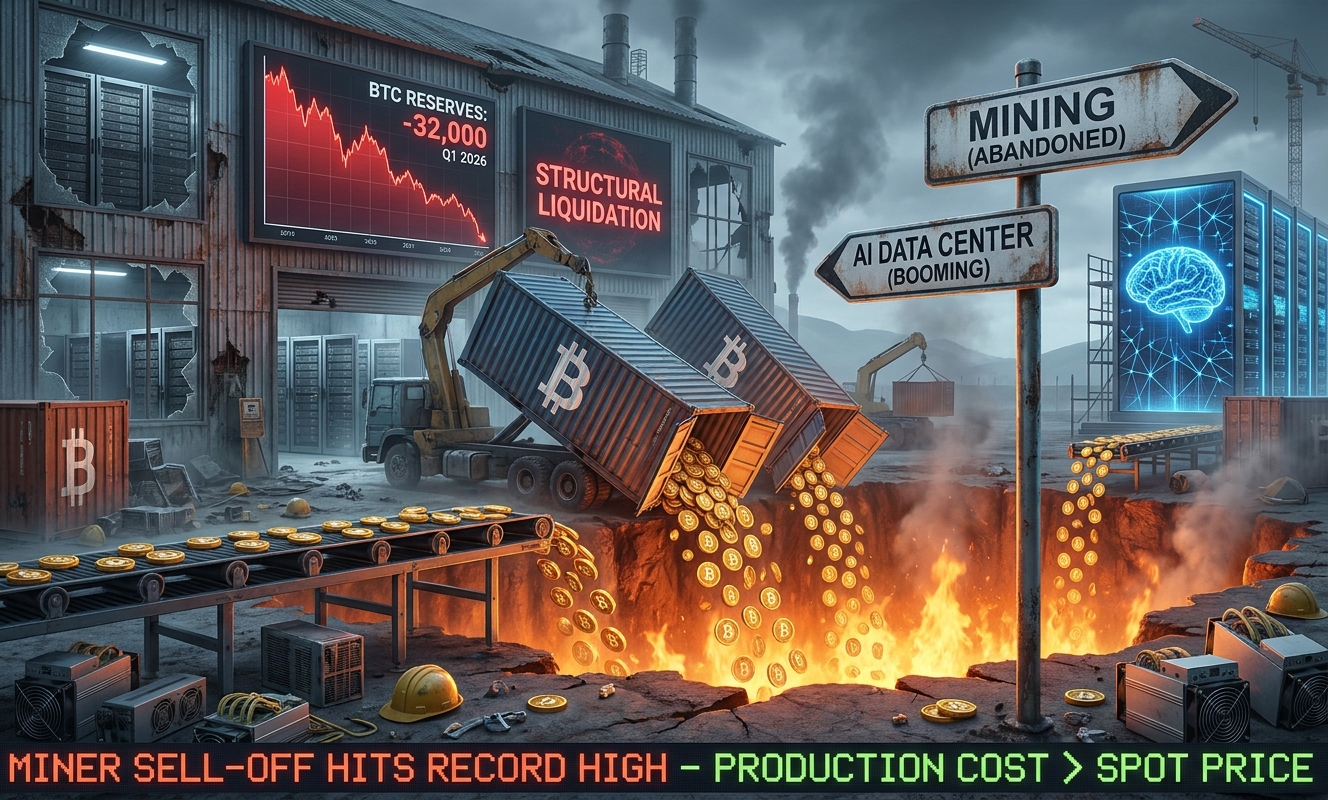
Honestly, this is the part that deserves the most scrutiny. The AI pivot isn’t just a survival strategy. It’s being aggressively incentivized by institutional capital, and the equity markets are making the math impossible to ignore.
Mining companies that set AI revenue targets of 80% or higher have seen stock prices surge by an average of 500% over the past two years. Five hundred percent. Compared to pure-play mining peers who are fighting to stay solvent, that gap in market multiples tells you everything about where the money wants to go.
The underlying unit economics explain the enthusiasm. Electricity costs account for roughly 40% of Bitcoin mining revenue. For AI cloud operators leasing out high-powered chips, energy costs sit in the low single digits as a percentage of revenue. Throw in the fact that AI data centers come with stable, multi-year contracts from Google, Microsoft, and Anthropic, and the pitch practically writes itself to any board of directors.
Butterfill estimates public miners could pull up to 70% of their revenues from AI by the end of 2026. Right now that number is around 30%. The acceleration is happening faster than most people are tracking.
Look, there are two camps on this and both have legitimate points. Neither side is shilling you a simple answer here.
Capriole Investments founder Charles Edwards is watching this closely and he’s not hiding his concern. His projections show the average Bitcoin revenue share among top public miners collapsing to just 30% within three years. His take is blunt: “If these numbers are even half accurate, the energy and commitment to Bitcoin is under significant threat.”
The cultural shift is real too. Dedicated mining publications are rebranding toward broader energy themes. Industry conferences are quietly swapping mining stages for energy-focused content. The industry is actively distancing itself from its original identity. That’s not nothing.
Blockstream CEO Adam Back pushed back on the alarmism by pointing directly at Bitcoin’s difficulty adjustment mechanism. If hashrate drops, difficulty drops. Margins improve. Surviving miners become more profitable and sell less BTC to cover costs. Back called it “an arbitrage, with equilibrium when mining margin is the same as AI workloads.”
On-chain analyst James Check framed it even more bluntly, calling the transition “literally the intended design of the difficulty adjustment.” His point is that infrastructure firms buying power and compute are simply being rational. AI provides stable baseload revenue. Bitcoin mining flexes as a grid-balancing tool. Both coexist.
Between you and me, both arguments are right simultaneously. The protocol survives. Individual companies stop being Bitcoin companies. Those are two very different outcomes that can happen at the same time.
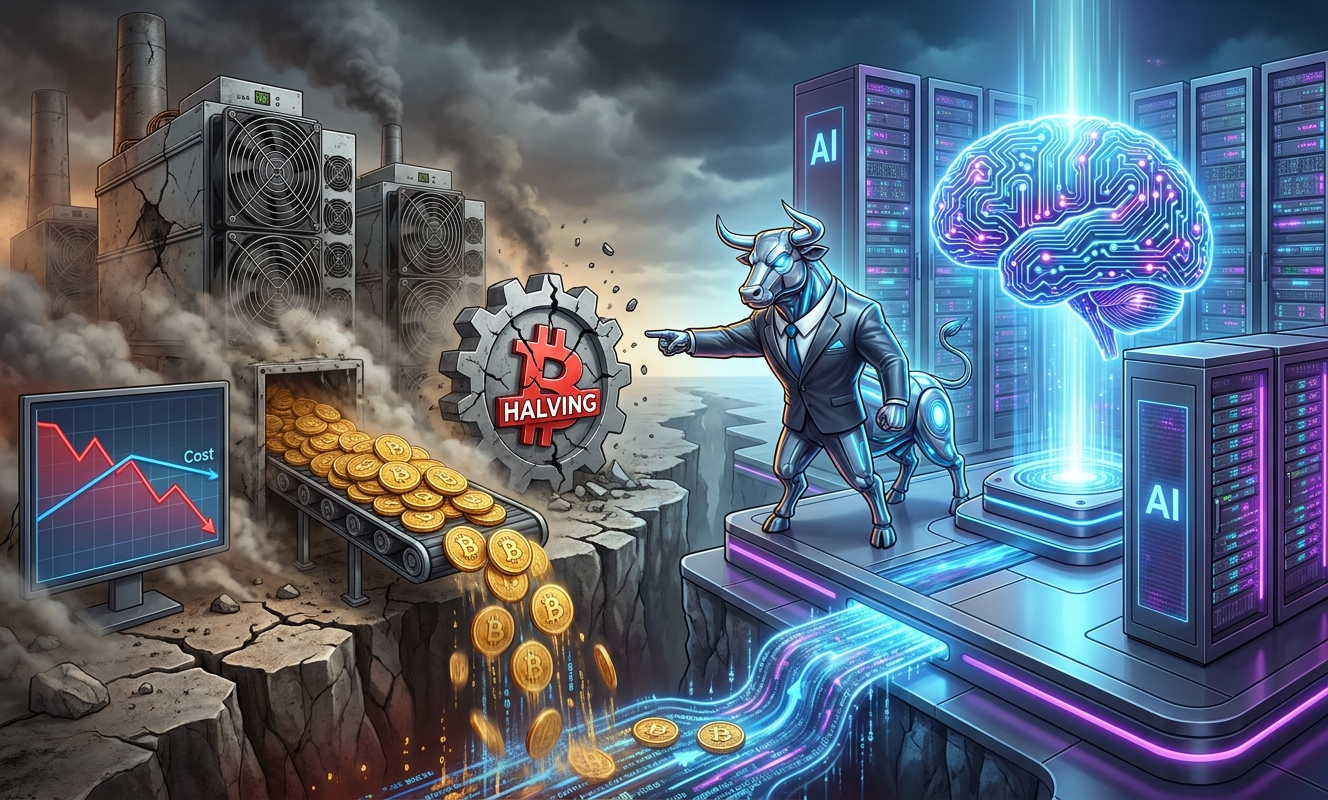
The immediate market impact is more important than the long-term security debate for most traders. Here’s the actual problem for BTC price in the near term.
Miners have historically been one of the most predictable sources of natural selling pressure in the market. When their treasuries become emergency liquidity engines instead of strategic holdings, that selling pressure becomes persistent, not cyclical. It doesn’t stop at a target price. It continues until balance sheets are clean.
With over $70 billion in cumulative AI and high-performance computing contracts announced across the public mining sector, capital that used to flow into next-generation ASICs is now flowing into data center infrastructure. That means less organic demand for BTC to fund operations, but also an ongoing need to liquidate BTC reserves to fund the buildout transition period.
Bitcoin needs to sustainably clear $80,000 to even approach production cost parity for most major operators. Until that happens, treasury liquidations won’t stop. And persistent miner selling into any rally is one of the cleaner explanations for why price discovery has been so sluggish coming off the October 2025 peak of $126,000.
The deeper structural risk here isn’t network security in 2026. The difficulty adjustment handles that. The real risk is what happens to Bitcoin’s price narrative when the companies that industrialized its validation stop being Bitcoin companies.
Right now, public miners collectively hold significant BTC reserves. As they complete their AI pivots and reduce their need to hold Bitcoin operationally, there is no structural reason for them to maintain those positions. The 61,000 BTC sold this cycle could easily look like a warm-up.
Pro-Tip: Watch the hashprice metric weekly. A sustained recovery above $50 per PH/s/day would signal that miner economics are improving enough to reduce treasury liquidation pressure. Until you see that number move, treat any Bitcoin rally into the $82,000-$85,000 range as a zone where miner sell pressure historically picks back up. Use those levels to take partial profits on long positions rather than chasing momentum, at least until the next difficulty adjustment cycle confirms reduced selling from distressed operators.
References & Sources:
Bitcoin miners are pivoting to artificial intelligence (AI) primarily due to the economics of structurally higher and more stable returns. While setting up AI infrastructure is significantly more expensive—costing around $8 million to $15 million per megawatt compared to $700,000 to $1 million per megawatt for Bitcoin mining—the potential revenue streams from AI computing power are much more lucrative. AI offers predictable contract-based revenue, making operations much less susceptible to the wild volatility of cryptocurrency markets and post-halving reward drops.
Currently, Bitcoin’s security backbone remains incredibly robust, but a mass exodus of institutional miners has raised long-term concerns. The network’s security relies on its total hash rate; if major public miners rapidly transition their massive power resources to AI computing instead of hashing blocks, the overall hash rate could theoretically dip. However, a complete hollowing out is highly unlikely. Bitcoin’s built-in difficulty adjustment ensures that as competition decreases, mining becomes easier and more profitable for the remaining participants, which continually incentivizes new miners to step in and secure the network.
Public Bitcoin miners are dumping record amounts of their BTC holdings primarily to fund their capital-intensive transitions into the artificial intelligence sector. Upgrading existing crypto mining data centers to handle high-performance computing (HPC) for AI requires massive upfront investments in advanced GPUs, sophisticated liquid cooling systems, and upgraded fiber optics. Selling their mined Bitcoin provides the immediate liquidity necessary to build out this expensive infrastructure and capitalize on the booming AI market before competitors do.
Bitcoin miners are uniquely positioned to dominate the AI infrastructure space because they already possess the most critical and scarce resource for AI computing: access to massive, cheap, and scalable energy. Miners typically operate vast data centers equipped with secured power purchase agreements, industrial-scale electrical grids, and robust cooling infrastructure. Repurposing or expanding these existing high-capacity energy sites to accommodate dense AI server racks is significantly faster and more cost-efficient than navigating the years-long process of building a new data center and securing grid connections from scratch.