Subtotal $0.00


Magazines cover a wide array subjects, including but not limited to fashion, lifestyle, health, politics, business, Entertainment, sports, science,


Magazines cover a wide array subjects, including but not limited to fashion, lifestyle, health, politics, business, Entertainment, sports, science,

 Fact Checked by Coinsbeat Editorial Team | Expert Reviewed by Themiya
$500 million. Gone. In less than three weeks. And the entity responsible isn’t a lone wolf coder in a basement. It’s a nuclear-armed nation-state using crypto theft to literally fund its weapons program. Let that sink in before you go ape on the next yield farm.
Here’s the thing most people aren’t saying out loud: this isn’t a story about a clever hack. This is a story about a sovereign government treating decentralized finance as its personal ATM, and the industry repeatedly letting it happen.
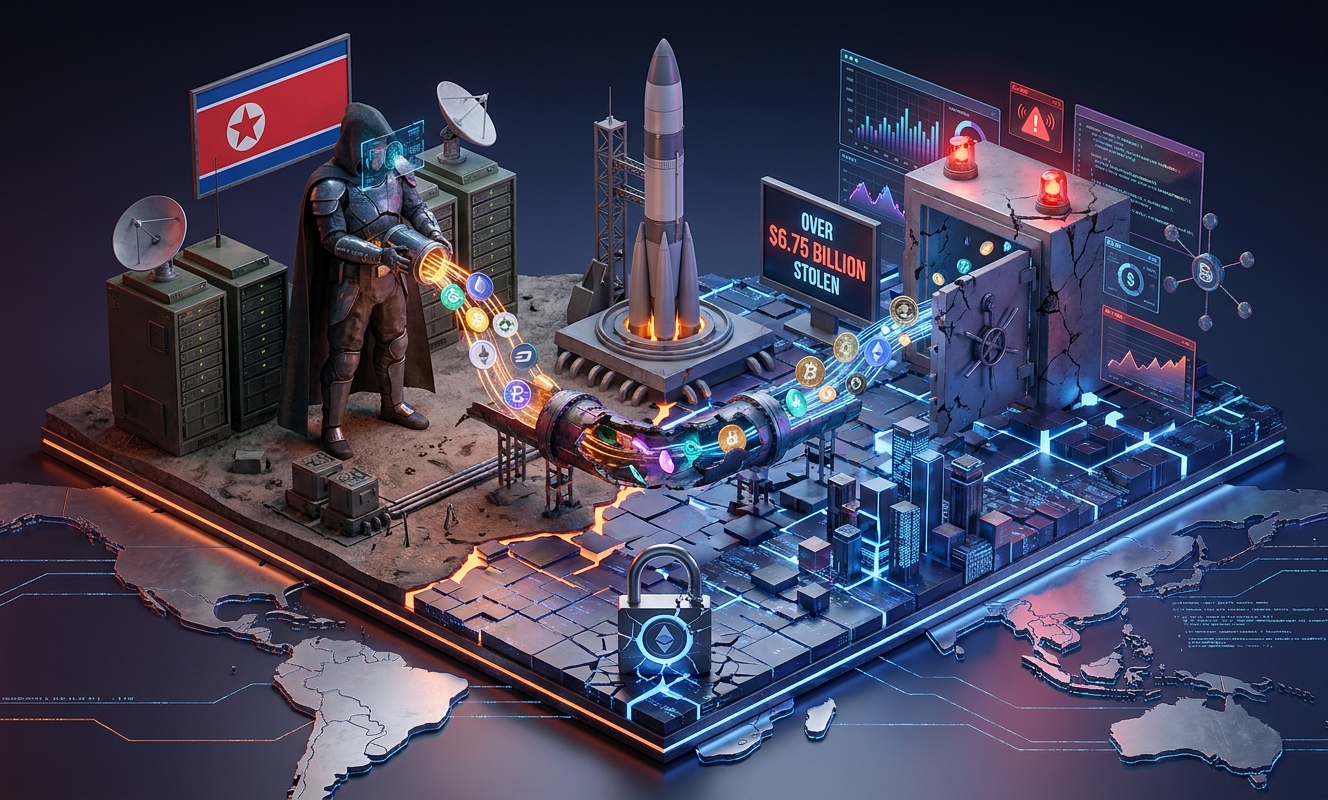
Between the Drift Protocol drain on April 1 (roughly $286 million, Solana-based perps exchange, gone) and the KelpDAO exploit on April 18 ($290 million, now the single largest crypto hack of 2026), North Korea’s Lazarus Group and its affiliated cell TraderTraitor have pushed their 2026 haul past $700 million. Their all-time total? A genuinely horrifying $6.75 billion.
Elliptic flagged the Drift attack as the 18th confirmed DPRK-linked incident they’ve tracked this year alone. Eighteen. The industry keeps treating each one like a surprise.
This is where it gets technically nasty, and honestly, way more frightening than a smart contract bug.
For the KelpDAO breach, the attackers didn’t touch the core protocol cryptography. They didn’t need to. Instead, they compromised the RPC infrastructure feeding into LayerZero’s Decentralized Verifier Network. By corrupting those data pathways upstream, they manipulated what the protocol “saw” and acted on, without ever triggering the alarms protecting the core contracts.
Think of it this way. You build a vault with an unbreakable lock. They bribe the person who reads the combination to you every morning. The lock is fine. You’re still cleaned out.
Blockchain security firm Cyvers put it bluntly when they told us:
“We also observe how they consistently find the weakest link. In this case, it was a third party rather than the protocol’s core infrastructure.”
This mirrors the supply-chain compromise of the widely-used Axios npm package, which Google researchers tied to a separate DPRK actor, UNC1069. They’re poisoning software libraries before the code even touches a blockchain. The attack surface isn’t just DeFi anymore. It’s the entire software stack feeding into DeFi.
Look, the on-chain exploits get the headlines. But the insider threat operation? That’s the one keeping serious security people up at night.
The Ketman Project, operating under Ethereum Foundation’s ETH Rangers program, just wrapped a six-month investigation. Their finding: roughly 100 North Korean cyber operatives are currently sitting inside blockchain companies on legitimate payrolls. Using fabricated identities. Passing HR screenings. Quietly reading your internal code repositories.
ZachXBT separately exposed a specific DPRK network generating around $1 million per month through fraudulent remote work, funneling crypto-to-fiat transfers through sanctioned financial channels, with over $3.5 million processed since late 2025.
This is intelligence-agency-level patience. They’re not smashing and grabbing. They’re sitting in your Slack channels for months, waiting for the right moment to pull the pin. That’s a completely different category of threat than a flash loan attack.
Let’s be real about the macro incentive here, because it matters for how you think about this risk.
North Korea is one of the most heavily sanctioned economies on earth. Traditional financial rails are essentially closed to them. Crypto, particularly DeFi with its permissionless nature and pseudonymous transactions, is one of the very few mechanisms they have to generate hard currency for the regime and, critically, for weapons development.
Chainalysis confirmed DPRK hackers stole a record $2 billion in 2025, representing 60% of all global crypto theft that year. The Bybit raid alone accounted for $1.5 billion of that. This isn’t opportunistic crime. It’s a state budget line item.
Once the funds move, Lazarus Group laundering patterns are distinct. They actively avoid DEXs and peer-to-peer protocols (too traceable, too many honeypots). Instead, on-chain forensics point to Chinese-language guarantee services, deep OTC broker networks, and cross-chain mixers. The geographic concentration points to structural constraints, not choice. Their off-ramps are limited, but they’re clearly working.
Terence Kwok, founder of Humanity, was refreshingly direct with us. The recurring theme across these losses isn’t some exotic new exploit technique. It’s the same old failures.
“What’s striking is how often the damage still comes down to the same weak points around access control and single points of failure. That tells you the industry still has some basic security discipline issues it has not solved.”
Honestly, that’s a brutal indictment. We’re in 2026. Projects are still getting rinsed over access control failures and weak vendor dependencies. The checklist isn’t complicated:
The last point is the hardest. How do you vet a remote developer whose entire professional identity was fabricated by a state-level intelligence operation? There’s no easy answer there.
Short answer? Be worried, but be specific about what you’re worried about.
The broad crypto market has shown a frustrating tendency to shrug off individual hacks after the initial panic dump. Bitcoin barely flinches at this point. But the cumulative weight of this campaign is doing something more corrosive than a single-day price drop. It’s eroding institutional confidence in DeFi infrastructure at exactly the moment that tokenized real-world assets and institutional capital were supposed to be flooding in.
Protocols running on complex cross-chain messaging infrastructure (LayerZero ecosystem projects, multi-chain bridges, anything with a large third-party dependency surface) are carrying materially higher tail risk than the market is pricing in right now. That’s not FUD. That’s just reading the pattern of where Lazarus Group is hunting.
Drift’s token took an obvious hit. KelpDAO’s restaking positions triggered what looked like bank-run dynamics with $10 billion in DeFi outflows following the exploit. These aren’t isolated events anymore. They’re a persistent structural drain.

Here’s the catch that nobody wants to talk about. Every security tool in crypto is built around on-chain anomaly detection. Unusual transaction patterns. Abnormal contract calls. Suspicious wallet clustering. These tools are genuinely getting better.
But an embedded DPRK operative sitting on your engineering team for eight months? Reading your internal documentation? Understanding exactly which dependency is weakest before ever touching a single blockchain transaction? There’s no on-chain signal for that. By the time anything appears on a block explorer, the damage is already locked in. The sophisticated move by Lazarus isn’t the exploit itself. It’s the months of preparation that precede it.
If you’re investing in or building on any protocol with a large remote development team and limited internal security auditing, that risk is not being adequately priced. Period.
Don’t just audit the smart contract. Audit the infrastructure stack around it. Before you park serious capital in any DeFi protocol right now, ask:
Protocols that can’t answer those questions clearly aren’t being paranoid enough for the threat environment we’re actually in. Your yield means nothing if the underlying vault gets drained by someone who’s been on the Discord server for six months pretending to be a community moderator from Singapore.
The DPRK isn’t going to stop. The financial incentive is too strong and the consequences for them are essentially zero. The only rational response is to make their job significantly harder. Right now, the industry is making it way too easy.
References & Sources:
According to recent data, the United States is considered the number one country in cryptocurrency. It boasts one of the largest markets by both investment size and user base, with over 50 million Americans holding crypto. The U.S. ecosystem supports casual investors and institutional hedge funds alike, offering strong infrastructure and steady innovation despite complex regulations. However, this immense concentration of digital wealth also makes platforms operating within the U.S. and its allies prime targets for sophisticated cyber heists by state-sponsored actors, such as those from North Korea.
North Korean hackers have looted staggering amounts of digital assets, recently hitting the crypto industry for over $500 million in a single month alone. Overall, cybersecurity and blockchain intelligence firms estimate that North Korean state-sponsored threat groups, such as the Lazarus Group, represent a $6.75 billion threat to the global ecosystem. These massive stolen funds are routinely laundered through decentralized mixers and exchanges to bypass international sanctions and finance state-level initiatives.
North Korean cybercriminals employ highly sophisticated, multi-layered methods to steal cryptocurrency. They primarily rely on elaborate social engineering, targeted phishing campaigns, exploiting vulnerabilities in smart contracts, and attacking cross-chain bridges. Often, these groups will pose as recruiters or colleagues to trick employees at crypto exchanges or blockchain firms into downloading disguised malware. Once installed, the malware grants hackers access to private keys, centralized exchange servers, and multi-signature wallets, allowing them to rapidly drain funds.
No, the $6.75 billion threat from North Korean crypto hackers is far from over. Cybersecurity experts warn that as long as cryptocurrency remains a viable, high-yield target to bypass global financial sanctions, state-sponsored groups will continue to evolve their tactics. As the industry patches old vulnerabilities, threat actors are already pivoting to new exploits involving decentralized finance (DeFi) platforms and advanced social engineering schemes. Crypto exchanges and users must maintain vigilant, continuously upgraded security protocols to defend against future attacks.