Subtotal $0.00


Magazines cover a wide array subjects, including but not limited to fashion, lifestyle, health, politics, business, Entertainment, sports, science,


Magazines cover a wide array subjects, including but not limited to fashion, lifestyle, health, politics, business, Entertainment, sports, science,
 Fact Checked by Coinsbeat Editorial Team | Expert Reviewed by Themiya
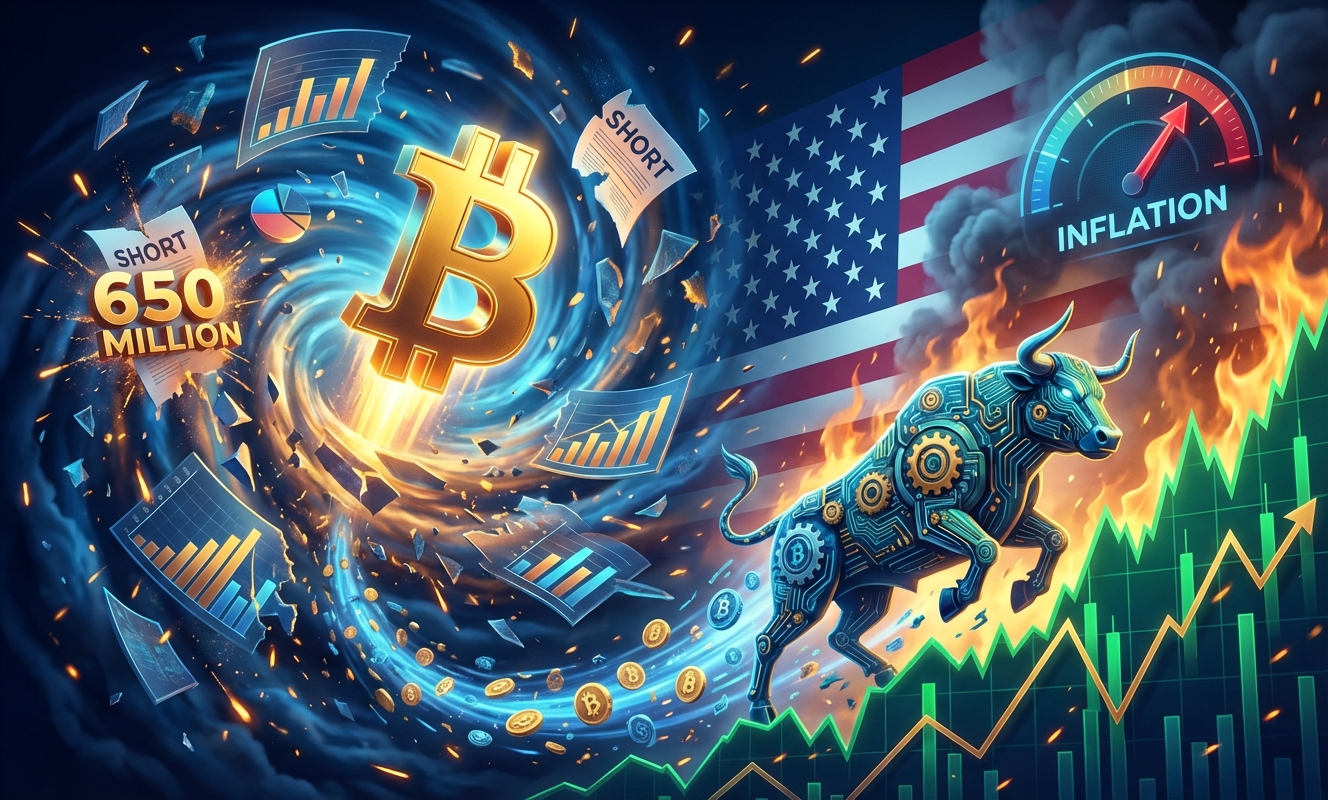
Over $514 million in short positions just got vaporized in a single session. Let that sink in. Bears who were confidently betting against Bitcoin got handed the most painful short squeeze since February, and the macro cocktail that triggered it is messier and more contradictory than most analysts want to admit.
Here’s the thing about Tuesday’s rally. It wasn’t driven by good news. It was driven by less bad news, which in this market apparently qualifies as euphoria-inducing.
The March Producer Price Index came in at 4% year-over-year. Still hot. Still well above the Fed’s comfort zone. But Wall Street had priced in 4.7%, so the market collectively exhaled and started buying everything in sight.
Look, this is classic trader psychology. Nobody actually celebrates 4% wholesale inflation. What they’re celebrating is that it wasn’t 5%. That distinction matters, because the underlying inflation trajectory is still pointing in the wrong direction.
That last bullet point is the one everybody is quietly ignoring while they’re busy celebrating. Annual producer prices are running at their hottest pace in three years, and a chunk of that pressure is being directly tied to the US-Iran war driving energy costs higher. This isn’t a clean inflation story. Not even close.
Bitcoin surged past $76,000 during early US trading. The crypto market added approximately $110 billion in total market cap within 24 hours. And for traders who were short? It was a bloodbath.
CoinGlass data shows that in a single one-hour window, over $100 million in leveraged positions were liquidated. Total market liquidations blew past the $650 million mark. Short sellers absorbed $514.94 million of that damage. Those are staggering numbers for a single session.
Alphractal CEO Joao Wedson pointed out that April 14th historically registers as a “fractal day” for Bitcoin price action. Interesting observation, though between you and me, the more relevant explanation is simpler: too many people were positioned too aggressively on the short side, and the market hunted them down with surgical precision. That’s how cascading liquidations work. Whales know where the stop clusters are. They almost always do.
Traditional markets didn’t sit this one out. The Nasdaq jumped 2.85%, adding $960 billion in value. The Russell 2000 surged 3%. The S&P 500 gained 2.12%, coming within 100 points of a new historical benchmark. US equities absorbed nearly $1.4 trillion in market cap across two sessions.
Simultaneously, optimism around Middle East conflict stabilization sent WTI crude oil tumbling 6% to settle around $93 per barrel. Lower oil prices reduce near-term inflation pressure, which gives the Fed slightly more room to breathe. Slightly. Don’t get too comfortable with that narrative.
Bitwise CIO Matt Hougan raised a genuinely interesting point. Since US and Israeli airstrikes began on February 28th, Bitcoin is up 12%. The S&P 500 is down 1% over that same stretch. Gold has fallen 10%.
Honestly, those numbers do complicate the standard “Bitcoin is pure risk-on trash” thesis that traditional finance types love to trot out every time volatility spikes.
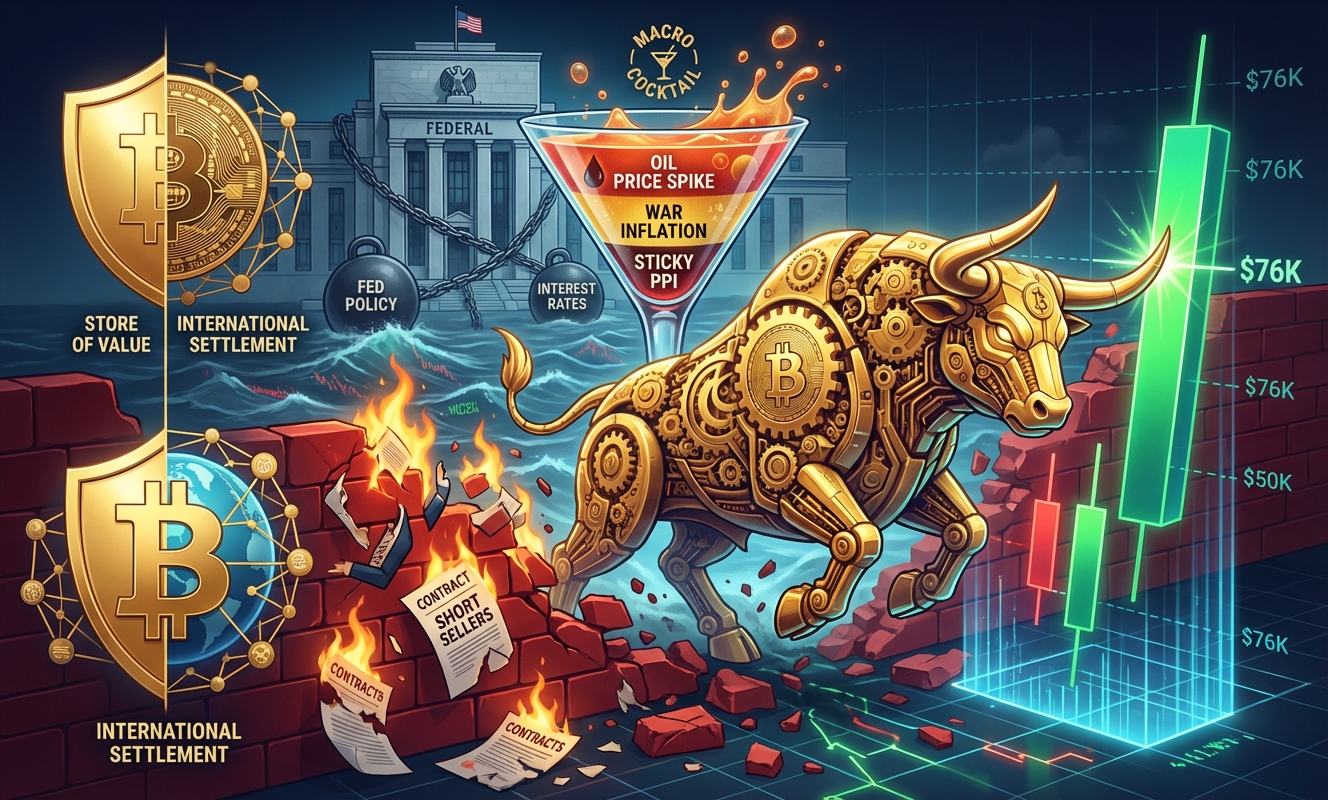
The argument being constructed in certain corners of the market is that Bitcoin now carries two distinct roles simultaneously. One is the scarce digital asset narrative that competes with gold as a store of value. The other is more structural, tied to Bitcoin’s potential utility in international settlement as global payment rails fragment further.
That second argument isn’t new, but it keeps gaining traction every time a geopolitical rupture puts dollar-based financial infrastructure under pressure. The West cutting Russian banks off from SWIFT accelerated this conversation. The US-Iran conflict is extending it.
But here’s what the bulls shilling this narrative won’t tell you. Bitcoin’s correlation to rate expectations and equity market liquidity hasn’t disappeared. It hasn’t even weakened that much. The second the Fed signals a genuine hawkish pivot, or the second equity markets roll over seriously, Bitcoin will feel it. The “geopolitical safe haven” story is a compelling overlay, not a structural replacement for the macro sensitivity that has defined BTC price action for years.
This is where the rally gets uncomfortably fragile. The same PPI report that triggered the celebration also confirmed that producer inflation is running at a three-year high. Treasury Secretary Bessent is publicly telling the Fed to “wait and see” on cuts. The central bank faces a war-driven inflation environment that makes aggressive easing politically and economically difficult to justify.
Higher-for-longer rates drain liquidity from the system. They’re structurally bad for Bitcoin and high-growth tech equities. Capital rotates toward yielding safe havens when real rates are elevated. This isn’t theory. We’ve watched it play out repeatedly since 2022.
So what we got on Tuesday was essentially a relief rally built on a soft beat of a bad number, amplified by a monster short squeeze and a temporary oil price collapse. That’s a cocktail that tastes great going down and often leaves a brutal hangover.
Worth noting that BTC dominance is sitting at 59.25% with the total crypto market at $2.53 trillion. That level of Bitcoin dominance, while altcoins lag, tells you that this isn’t broad speculative euphoria yet. Capital is parking in Bitcoin specifically. Altcoins haven’t caught the same bid. That’s actually a slightly more mature and less reckless signal than what you’d see at the peak of a full-on mania cycle, for whatever that’s worth.

Don’t mistake a short squeeze for a structural trend reversal. Here’s what’s working against a sustained move higher from current levels.
If you’re trying to trade around this, the short squeeze is already done. You were exit liquidity if you chased BTC above $76,000 without a position already on. That’s just the reality.
The smarter play is to watch the $72,000 to $73,000 range as a potential accumulation zone if we get a retest. That level represents former resistance that should act as support if the bullish structure holds. Set your alerts. Don’t FOMO into a squeeze already in progress.
And if you’re holding spot Bitcoin through this period, the macro picture argues for keeping position sizing disciplined. A genuine dovish pivot from the Fed, or a ceasefire in the Middle East, could send BTC on a legitimate run toward the mid-$80,000s. But neither of those is guaranteed or even particularly likely in the near term. Manage your size accordingly. Don’t let one good day make you forget the macro backdrop hasn’t actually changed.
References & Sources:
Yes, Bitcoin has historically demonstrated the ability to appreciate against inflation expectations and economic shocks, confirming its status as an inflation hedge for many investors. As seen in its recent surge past $76,000, favorable US inflation numbers can trigger significant market rallies. However, it is important to note that while Bitcoin effectively beats inflation in highly liquid risk-on environments, it does not behave exactly like a traditional safe haven. Unlike gold, Bitcoin can still experience sharp price declines during periods of intense, broader financial uncertainty.
A short squeeze happens when traders who bet against an asset’s price (short sellers) are forced to buy it back to cover their losses as the price unexpectedly rises. In this recent event, US inflation data signaled favorable macroeconomic conditions, sparking a sudden, aggressive rally across risk assets. This unexpected upward spike forced the mass liquidation of roughly $650 million in over-leveraged short positions. The mandatory buying from these liquidations created a cascading loop, rapidly catapulting Bitcoin’s price over the $76,000 threshold.
US inflation numbers directly influence the monetary policy of the Federal Reserve, which heavily dictates global market liquidity. When inflation cools or aligns with market expectations, the likelihood of aggressive interest rate hikes decreases. A lower-rate environment means cheaper borrowing and an increase in capital circulating within the economy. This excess liquidity drives investors away from low-yield bonds and toward higher-return risk assets like Bitcoin, pushing its price up significantly.
Bitcoin trades as a risk asset because its price movements are closely tied to global liquidity, investor risk appetite, and macroeconomic sentiment—much like high-growth tech stocks. During times of economic optimism fueled by positive data (like stabilizing US inflation), investors aggressively buy Bitcoin, driving massive surges. Conversely, during sudden financial shocks or genuine panic, investors typically sell off Bitcoin for cash or traditional safe-haven assets like government bonds and gold. This characteristic volatility prevents it from functioning as a pure safe haven during absolute financial uncertainty.