Subtotal $0.00


Magazines cover a wide array subjects, including but not limited to fashion, lifestyle, health, politics, business, Entertainment, sports, science,


Magazines cover a wide array subjects, including but not limited to fashion, lifestyle, health, politics, business, Entertainment, sports, science,
 Fact Checked by Coinsbeat Editorial Team | Expert Reviewed by Themiya
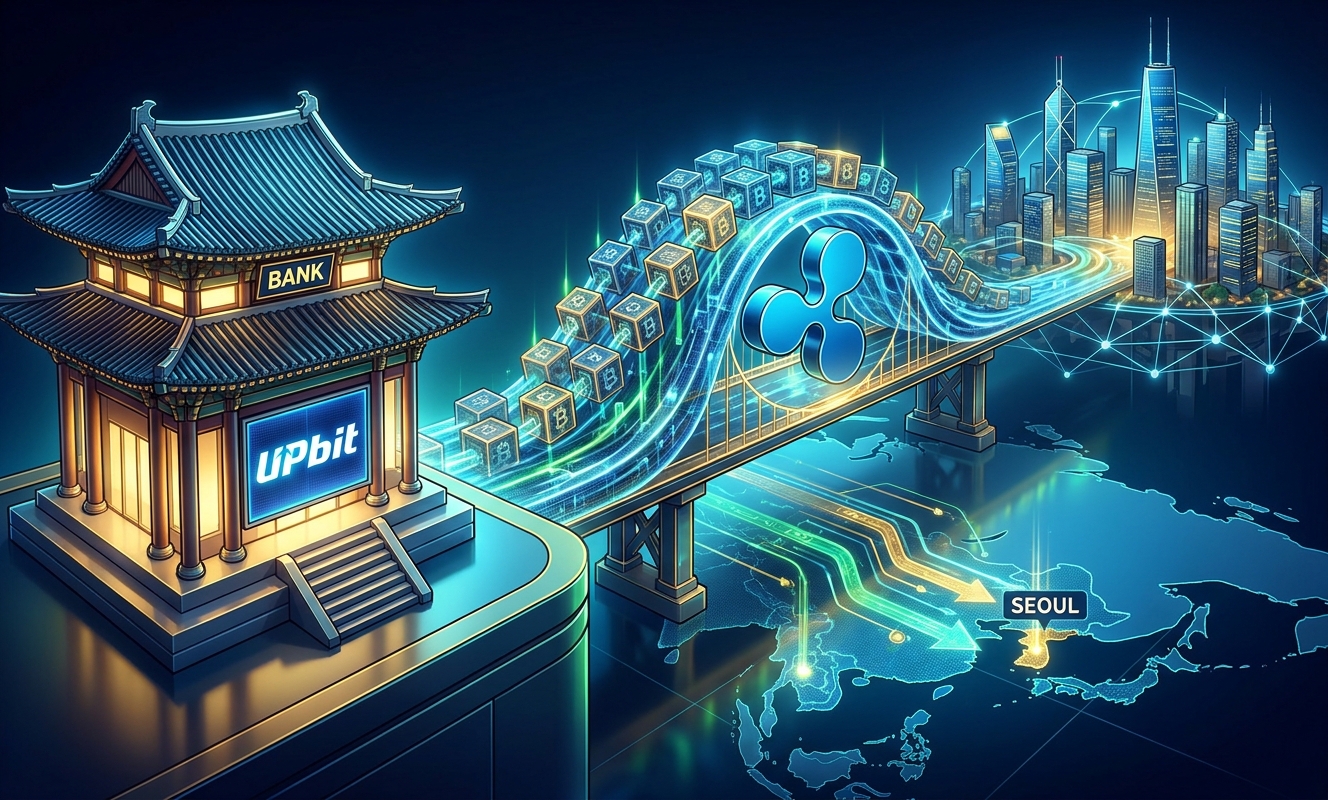
Let’s be real about what’s happening here. South Korea’s Kbank didn’t sign a partnership with Ripple because it suddenly got excited about blockchain technology. It did it because 24% of its entire deposit base sits inside a single crypto exchange relationship, and that’s the kind of concentration that keeps bank executives awake at night.
This is a survival story disguised as a payments pilot.
Here’s the thing most coverage glosses over. As of Q3 2025, Upbit-linked funds accounted for roughly 24% of Kbank’s 30.4 trillion won deposit balance. That number is extraordinary for a regulated bank. Imagine a traditional lender with nearly a quarter of its deposits tied to the trading activity of a single crypto platform. One regulatory crackdown, one Upbit license suspension, one market crash that triggers a mass withdrawal event. Gone.
Kbank’s own CEO Choi Woo-hyung has already said publicly that the bank needs to reduce its reliance on Upbit. That admission alone tells you everything. The Ripple proof-of-concept isn’t a tech experiment. It’s Kbank building a second runway before the first one gets shut down by regulators or market conditions.
The Ripple partnership is essentially Kbank asking: can we use what we know about crypto-adjacent banking infrastructure to run cross-border payment rails, instead of just sitting here as Upbit’s KRW gateway?
Strip away the press release language and the ceremony photo with Ripple’s APAC head Fiona Murray, and you get a fairly specific scope.
Honestly, the Palisade angle is the most interesting technical detail here. This isn’t just a “send money faster” test. It’s a full custody stack evaluation. Kbank is poking around the entire institutional plumbing: wallet architecture, account linkage, compliance controls, key management, settlement flows. That’s a serious technical undertaking, not a PR stunt.
What remains completely undefined: the settlement asset, the fee model, the launch date, live customer access, and actual transaction volume targets. So yes, it’s a readiness test. A very expensive, very strategic readiness test.

Look, the XRP community is already celebrating this as confirmation that XRP will be used to settle Kbank’s remittances. Pump the brakes. The announcement does not confirm XRP as the settlement asset. Full stop.
Ripple’s infrastructure does not automatically mean XRP settlement. Ripple offers solutions that use XRP for liquidity bridging, but institutions can also use Ripple’s technology stack with fiat-to-fiat models or their own stablecoin rails. South Korea is actively debating its own won-backed stablecoin framework. The idea that Kbank, a regulated Korean bank in the middle of a domestic stablecoin policy debate, automatically reaches for XRP as its settlement layer is a leap that the current evidence doesn’t support.
Between you and me, the more likely near-term outcome involves a hybrid model with stablecoin optionality baked in, depending on which way Seoul’s regulatory wind blows.
Here’s where this whole story hits a wall. South Korea’s digital asset legislation has been delayed. Seoul Economic Daily has already reported that this legislative drag is keeping Korean blockchain and remittance infrastructure from moving into live operations. Banks can test mechanics. They can run simulations. They can evaluate Palisade and corridor flows and account-linkage stability. What they cannot do is launch a commercial remittance product into a regulatory vacuum.
The stablecoin rulemaking debate is directly relevant because any bank-led remittance product that uses on-chain settlement will need clarity on what assets can be used, how they’re custodied, and what the reporting obligations look like. None of that is settled yet.
So the timeline from “PoC signed” to “customer sending money to Dubai via Kbank’s Ripple rails” is not months. It’s potentially years, contingent on political timelines that crypto markets are notoriously bad at pricing accurately.
For XRP specifically, this is sentiment fuel, not a fundamental catalyst. Yet. The distinction matters enormously for how you trade around it.
The broader structural point is actually more interesting than the XRP price angle. Kbank is sitting at the intersection of South Korea’s two most important crypto-adjacent rails: exchange fiat access and now potentially cross-border payments. If those two lanes converge under one banking roof, the infrastructure concentration in South Korea’s crypto market gets even tighter.

The partnership signing is already priced into sentiment. What the market hasn’t priced is the regulatory trigger. Watch for South Korea’s digital asset payment legislation to advance. That’s the actual binary event. When Seoul moves toward a defined framework for bank-led on-chain remittances, that’s when Kbank’s Ripple PoC goes from “interesting test” to “live commercial product in a defined regulatory lane.”
Proof-of-concepts in regulated banking have a graveyard. The history of blockchain remittance pilots that never made it to production is longer than most people in this space want to acknowledge. Santander, SWIFT’s own GPI blockchain experiments, various central bank CBDC proofs-of-concept. The technical validation often works. The commercial and regulatory assembly is where things stall for years.
Kbank’s regulatory environment is not permissive right now. South Korea’s financial regulators have shown they’re capable of moving aggressively against crypto-adjacent activity when they decide the risk profile is too high. The same bank-account rails that make Kbank strategically valuable in this story also make it a target if regulators decide crypto-linked banking concentration is a systemic risk.
Add to that the fact that the settlement asset is unresolved, the fee model is unresolved, and the full regulatory framework is unresolved. That’s not three open questions. That’s the entire commercial model being open.
Kbank is smart to be building this optionality now. Whether it ever becomes a real product depends on factors that are genuinely outside Ripple’s control and mostly outside Kbank’s control too.
References & Sources:
K Bank, one of South Korea’s leading internet-only banks, is the primary fiat banking partner for the prominent cryptocurrency exchange Upbit. K Bank is currently exploring and testing Ripple’s enterprise blockchain technology to facilitate faster, more efficient, and highly cost-effective cross-border payments.
Ripple integration allows financial institutions to process international transactions with near-instant settlement times and significantly lower fees compared to the traditional SWIFT network. By leveraging Ripple’s decentralized blockchain infrastructure, banks can eliminate the need for multiple intermediaries, resulting in highly transparent, secure, and streamlined global remittances.
Although K Bank is testing Ripple primarily for its own cross-border fiat banking operations, a successful integration could yield massive downstream benefits for Upbit users. It establishes a more robust technological bridge between traditional finance and the crypto ecosystem, potentially enabling faster fiat deposits and withdrawals, seamless off-ramping, and cheaper global transfers for digital asset investors in South Korea.
While exact technical details of the testing phase are often proprietary, Ripple’s flagship cross-border payment solution—Ripple Payments (formerly known as On-Demand Liquidity)—typically utilizes the XRP cryptocurrency as a bridge asset. If K Bank tests or adopts this specific liquidity feature, XRP would be leveraged to instantly source liquidity and settle fiat transactions globally, bypassing the costly need for pre-funded correspondent destination accounts.