Subtotal $0.00


Magazines cover a wide array subjects, including but not limited to fashion, lifestyle, health, politics, business, Entertainment, sports, science,


Magazines cover a wide array subjects, including but not limited to fashion, lifestyle, health, politics, business, Entertainment, sports, science,
 Fact Checked by Coinsbeat Editorial Team | Expert Reviewed by Themiya
Twenty sanctions packages. Count them. Twenty. And Russia’s crypto flows kept moving, kept mutating, kept finding new pipes to run through. So why should anyone believe the EU’s latest swing actually lands differently? Honestly, there are a few real reasons this time, and they’re worth paying attention to.
Every previous round of EU sanctions took roughly the same approach: find a named exchange, a flagged wallet, a specific operator, and add it to the list. Clean. Simple. Completely ineffective at stopping anything beyond that one entity.
What happened every single time? The network just spawned a successor. Garantex gets disrupted, and Grinex materializes. A7A5 becomes the financial bridge connecting the two. The money doesn’t stop moving. It just changes its shirt and walks through a different door.
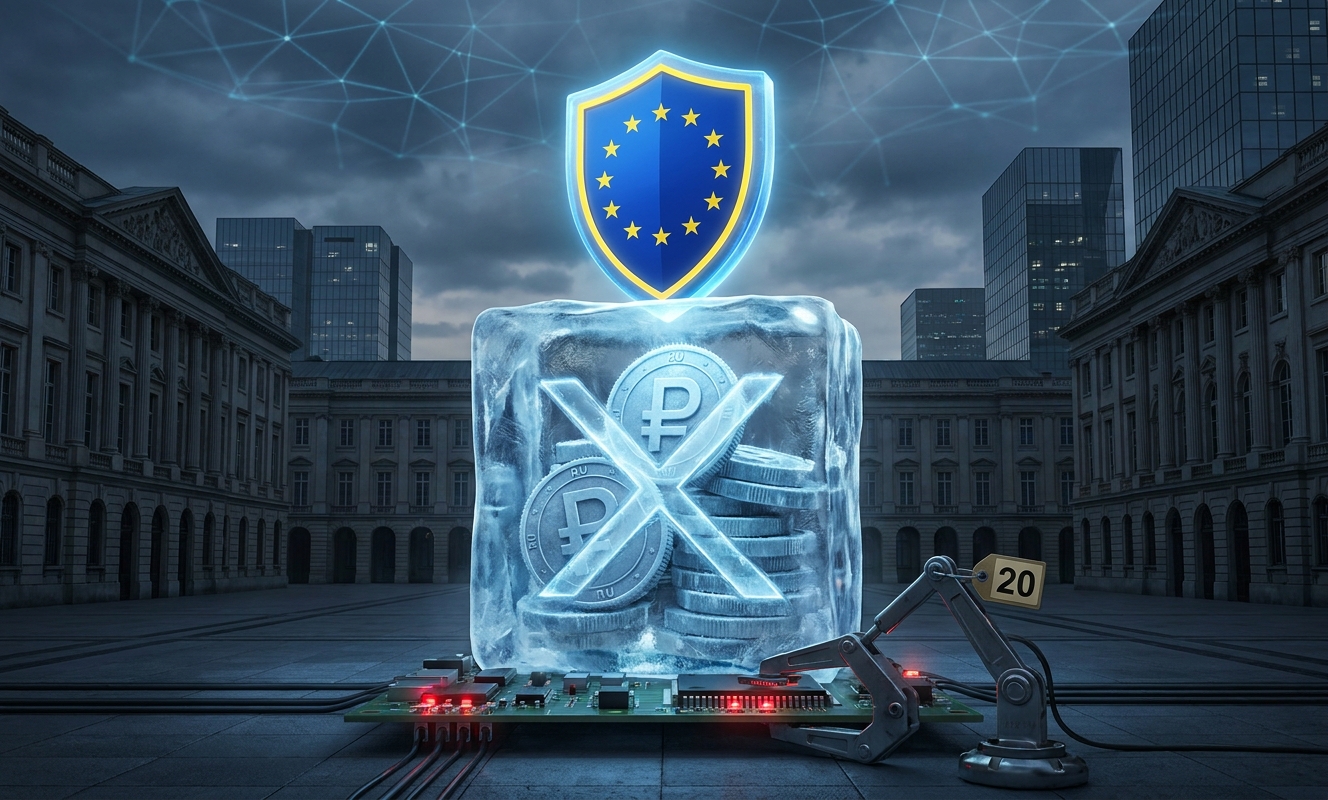
The 20th package, adopted April 23, tries something structurally different. Brussels is no longer just naming names. It’s targeting the entire service layer that keeps Russia-linked crypto settlement operational. That includes decentralized trading platforms being used for evasion, third-country intermediaries, ruble-backed stablecoins, payment netting agents, and yes, even the digital rouble project itself.
Let’s be real about what this means. If you’re a platform operating anywhere in the world and you’re processing settlements that touch Russian crypto infrastructure, you are now inside the EU’s enforcement perimeter, even if nobody has spelled your name out on a list yet. That’s a meaningful shift.
TRM Labs laid this out clearly. When Garantex got shut down, the network didn’t collapse. It migrated. Grinex stepped in as the successor venue, and A7A5, a ruble-backed stablecoin, acted as the connective tissue keeping liquidity flowing between the old infrastructure and the new one.
Chainalysis confirms the same conclusion from a different angle, describing A7A5 as a “Russia-linked stablecoin rail for sanctioned businesses seeking access to the global financial system.” The Kyrgyz exchange TengriCoin, operating as Meer.kg, is explicitly identified as the venue where significant A7A5 volumes were trading.
Here’s the thing about that. A stablecoin issued in a third country, traded on a Central Asian exchange, became a critical node in Russian sanctions evasion. The EU package is now explicitly targeting that entire route. Not just the stablecoin. Not just the exchange. The architecture that connects them.
And then there’s RUBx. Rostec, the Russian state-owned conglomerate, had plans for a ruble-pegged token on Tron paired with a payment platform called RT-Pay. The EU has now prohibited use of and support for RUBx outright, alongside restrictions on supporting the digital rouble CBDC project from the Bank of Russia.
Think about what that signals. The EU is explicitly treating state-backed crypto as sanctions-relevant payment infrastructure. That’s not a minor compliance footnote. That’s a geopolitical statement about how governments are now thinking about CBDCs and stablecoins in the context of sanctions regimes.

Most coverage of this package focused on the high-profile items. The A7A5 designation. The RUBx prohibition. Fair enough, those are significant. But the netting ban deserves more attention than it’s getting.
The Commission explicitly prohibited transactions with agents, whether in Russia or in third countries, that facilitate international transactions from Russia to bypass EU sanctions. It also bars netting transactions with Russian agents.
Chainalysis flagged this as particularly significant for crypto compliance. Netting is exactly how you obscure gross flows. You match offsetting transactions, and suddenly the underlying counterparties become invisible to standard screening. It’s a classic obfuscation mechanic, and the EU just specifically targeted it.
For crypto firms, the compliance implications are genuinely uncomfortable. You now have to look at:
Screening for known wallet addresses and blacklisted exchange names isn’t going to cut it anymore. The route itself is now the compliance object.

Look, let’s be skeptical here, because the history of crypto sanctions enforcement demands it.
The honest read is that this package creates real friction without creating a real wall. If major stablecoin issuers, exchanges, custodians, and infrastructure providers actually enforce these rules aggressively, the cost of moving Russia-linked settlement through crypto goes up significantly. Redemption access gets tighter. Platform relationships become harder to maintain. Liquidity on evasion routes dries up.
But the migration risk is equally real. Successor platforms keep appearing. Nested services buried inside legitimate-looking intermediaries can push activity into less transparent venues. The EU’s answer to this, pairing crypto restrictions with measures against third-country financial institutions and anti-circumvention channels, is the right instinct. Whether enforcement infrastructure can actually keep pace with how fast these networks adapt is a completely different question.
For Bitcoin specifically, the macro signal here is nuanced. Tighter Russia-linked stablecoin rails don’t immediately translate into Bitcoin demand. But there’s a longer-term dynamic worth watching. As the EU, the US, and other jurisdictions treat stablecoins and CBDCs as enforcement infrastructure, Bitcoin’s censorship-resistance narrative gets a quiet, structural tailwind. Not because anyone is rushing to buy BTC for sanctions evasion. But because reserve managers and institutional allocators are increasingly asking which assets remain usable when geopolitics breaks the normal financial rails.
That conversation was already happening before this package. It’s going to get louder.
Here’s the ugly part that doesn’t get discussed enough. Enforcement measures this complex, this layered, this dependent on route-level due diligence rather than simple name-matching, are brutally expensive to implement properly.
Large exchanges and established stablecoin issuers can absorb those costs. They have compliance teams, blockchain analytics contracts, legal resources, and the institutional relationships to navigate ambiguous guidance. Smaller platforms, regional exchanges, and newer infrastructure providers often don’t.
The EU has drawn a more sophisticated enforcement map. Whether it has the tools to actually navigate that map in real time is the question that decides whether this is a genuine chokepoint or just an expensive compliance exercise for the firms that play by the rules while the evasion routes quietly relocate.
Watch the stablecoin issuers. Watch whether Tether and Circle start issuing freezes and redemption blocks on A7A5-linked addresses with the same speed they’ve applied elsewhere. That’s the real chokepoint. Not the Brussels policy document. The behavior of the firms that control the actual off-ramps.
References & Sources:
The 20th EU sanctions package introduces unprecedented financial restrictions specifically targeting digital assets. It implements a blanket ban on the use of the digital ruble and strictly prohibits European citizens, residents, and corporate entities from engaging with any Russian-owned or operated cryptocurrency services. This sweeping measure is designed to close remaining loopholes from previous sanctions, effectively isolating Russian crypto users from the European digital asset market.
Yes, under the latest European Union sanctions, all transactions and holdings involving the Russian central bank digital currency (CBDC), known as the digital ruble, are strictly prohibited. The EU implemented this total ban to prevent the Russian government from utilizing its newly developed state-backed digital currency as a mechanism to bypass existing international financial embargoes and traditional banking restrictions.
No, the newest round of EU sanctions explicitly forbids anyone within the EU, as well as EU citizens operating globally, from using, funding, or providing services to Russian cryptocurrency exchanges, digital wallets, or crypto-asset service providers. Engaging with these platforms is now considered a direct violation of international sanctions laws and carries severe legal and financial consequences.
The European Union is targeting Russian crypto services for the 20th time to systematically close evolving financial loopholes. As traditional banking channels like SWIFT were cut off, decentralized cryptocurrencies and state-backed digital tokens became potential avenues for capital flight, military funding, and sanction evasion. By banning the digital ruble and all Russian crypto platforms, the EU ensures maximum, watertight economic pressure on the Russian financial infrastructure.