Subtotal $0.00


Magazines cover a wide array subjects, including but not limited to fashion, lifestyle, health, politics, business, Entertainment, sports, science,


Magazines cover a wide array subjects, including but not limited to fashion, lifestyle, health, politics, business, Entertainment, sports, science,

 Fact Checked by Coinsbeat Editorial Team | Expert Reviewed by Themiya
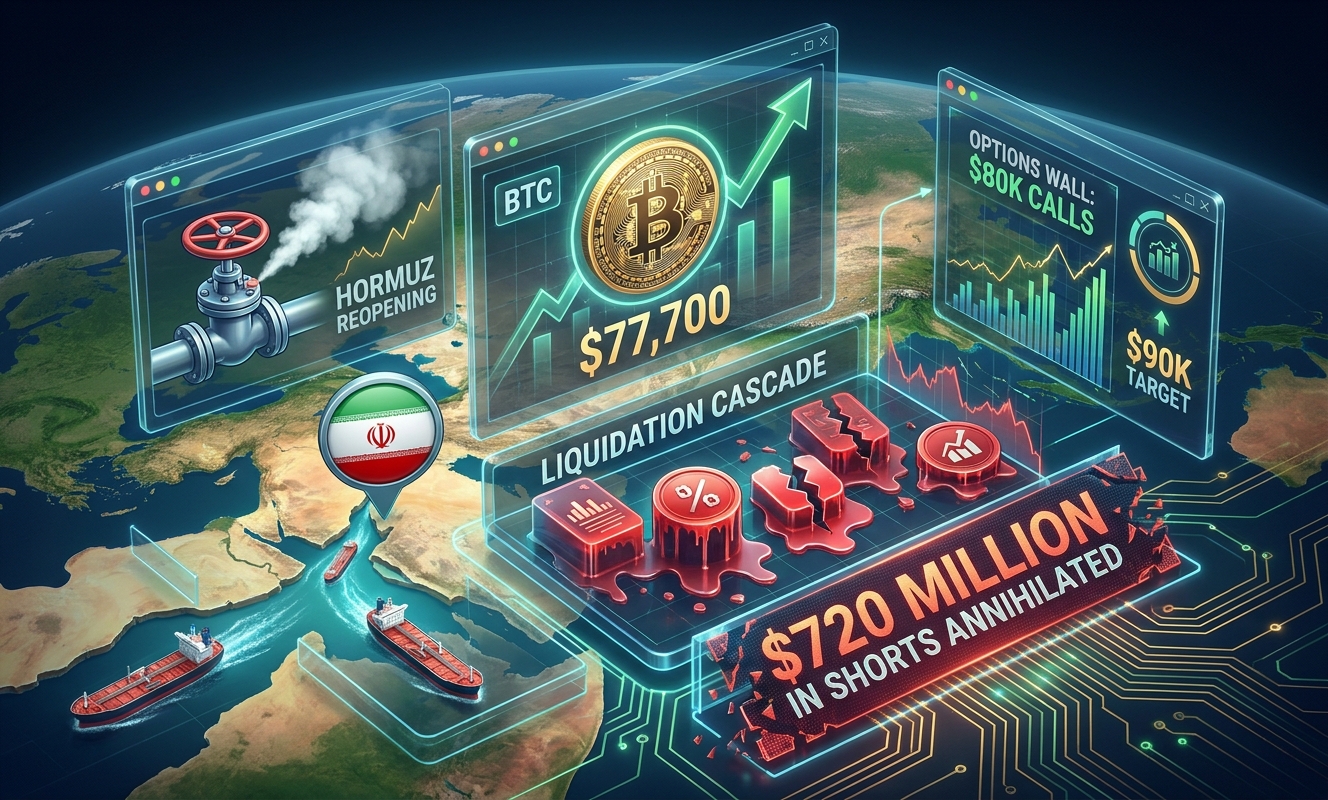
Short sellers just got carried out on a stretcher. Iran declared the Strait of Hormuz fully open to commercial traffic, oil dropped 11%, and Bitcoin ripped 5% to $77,700 in what was, frankly, one of the cleanest macro-driven squeezes this market has seen in months. Over $720 million in leveraged positions got liquidated in 24 hours. Short traders alone absorbed more than $100 million of that pain in a single hour.
Let’s be real. This wasn’t some organic crypto rally. This was a geopolitical pressure valve releasing all at once, and the crypto market was perfectly positioned to catch the blast.
Here’s the thing most people miss. The Strait of Hormuz isn’t just an oil story. It’s a global inflation story.
When that waterway was largely shut during the US-Iran standoff, markets baked in a serious risk premium across every asset class. Oil was screaming. Energy-driven inflation fears were creeping back into Fed policy forecasts. That kind of macro backdrop is brutal for Bitcoin. It tightens financial conditions, kills risk appetite, and sends institutional money running toward safety.
The strait carries roughly 20% of the world’s oil and LNG flows. When Iranian Foreign Minister Seyed Abbas Araghchi posted on X that all commercial vessels were cleared through for the remainder of the ceasefire, that single statement unwound weeks of war premium in hours. Oil fell. Inflation fears eased. And suddenly, speculative assets had room to breathe again.
Trump confirmed the news on Truth Social and thanked Iran. That double confirmation from both sides of the negotiation is what triggered the institutional buy signal. Markets needed both parties on record. They got it.
This is where it gets ugly for the wrong crowd.
A lot of traders had been building short positions during the conflict escalation, and honestly, that wasn’t a stupid trade at the time. Oil above $100, failed Iran negotiations, Bitcoin clinging to $70,500. The macro case for more downside looked solid. Then the rug got pulled.
Those short traders weren’t wrong about the fundamentals. They were wrong about the timing. That’s the oldest lesson in this market and nobody ever learns it.
Honestly, a chunk of that $243 million in one-hour liquidations also served as exit liquidity for whoever was pre-positioned long before the announcement dropped. Someone always knows something first. That’s not cynicism. That’s just how geopolitically-driven crypto moves work.
Forget the price action for a second. Look at where the smart money is parking its bets.
On Deribit, the $80,000 call option has become the most crowded trade on the board, sitting at over $1.5 billion in notional value. The next big cluster of bullish positioning is stacked at $90,000, with roughly $914 million tied to that strike.
That’s not retail doing that. Retail doesn’t move $1.5 billion notional into a single options strike. That’s institutions and large traders using derivatives to get directional exposure without touching spot.
Polymarket is also flashing optimism. The odds of Bitcoin closing above $80,000 before year-end have climbed past 88%. A week ago, during peak Hormuz panic, that number looked very different.
The market has shifted from “how bad does this get” to “how fast do we hit $80K.” That’s a meaningful psychological flip.

Look, I’d love to tell you this is the start of a clean, sustained run to six figures. But there are some very real walls still standing in front of this rally.
The worst thing you can do right now is FOMO into a 5% candle that was driven by a short squeeze and a geopolitical headline. Both of those catalysts are one-time events. They don’t sustain momentum by themselves.
Here’s a smarter framework:
Between you and me, the most dangerous trade right now is being too aggressive in either direction. The macro environment is fragile. The ceasefire is fragile. And the $80K options wall is going to create serious turbulence before this market finds its next clean leg.
Bitcoin at $77,700 is a much better story than Bitcoin at $69,000. But this rally still has a lot to prove before anyone should be calling a new bull phase with confidence.
References & Sources:
The recent surge in Bitcoin’s price is driven by a combination of easing geopolitical tensions and strong macroeconomic fundamentals. With the critical Strait of Hormuz shipping route declared open, global trade anxieties have significantly decreased, sparking a “risk-on” sentiment across financial markets. Lower perceived global risks encourage capital to flow back into high-yield, decentralized assets. Furthermore, Bitcoin’s intrinsic supply-and-demand dynamics—where lower available supply meets high institutional demand—create a bullish environment. As more investors treat Bitcoin as “digital gold,” holding it safe and out of circulation, the easing of global macro pressures acts as a primary catalyst pushing prices higher.
Yes, reaching the $80,000 milestone is highly plausible and approaching faster than many analysts initially projected. While historical sentiment showed many investors betting on $80,000 by 2026, recent macroeconomic breakthroughs have accelerated this timeline. The stabilization of major global supply chains, punctuated by the reopening of the Strait of Hormuz, injects a wave of fresh liquidity into the market. Because Bitcoin is highly volatile and highly responsive to global liquidity surges, breaking past the $70,000 to $75,000 resistance levels places an $80,000 valuation well within immediate striking distance.
While Bitcoin does not directly track crude oil, it is heavily impacted by the macroeconomic ripple effects of oil price fluctuations. Oil drives the broader economic environment; when oil prices rise—often due to shipping blockades or geopolitical conflicts—inflation typically follows. High inflation forces central banks like the Federal Reserve to maintain tight monetary policies and higher interest rates. This drains the liquidity that risk assets like Bitcoin rely on for price growth. Conversely, the recent reopening of the Strait of Hormuz helped stabilize oil prices, easing inflation fears and creating the perfect high-liquidity environment for Bitcoin’s price to jump.
The Strait of Hormuz is one of the world’s most critical maritime choke points, particularly for global energy exports. When this route is open and secure, it ensures a steady supply of oil, which stabilizes global energy costs and reduces broader economic uncertainty. For cryptocurrency markets, this geopolitical stability is incredibly bullish. Stable energy prices lower the threat of sudden inflation spikes, leading to a more favorable, predictable interest rate environment from central banks. This resulting economic stability boosts investor confidence, increasing the appetite for risk-on assets and driving major capital inflows directly into cryptocurrencies like Bitcoin.